
Henrietta Lacks and the Unseen Cost of Scientific Progress
How the woman behind the HeLa cells reshapes our understanding of consent, justice, and the moral responsibilities within reproductive care.

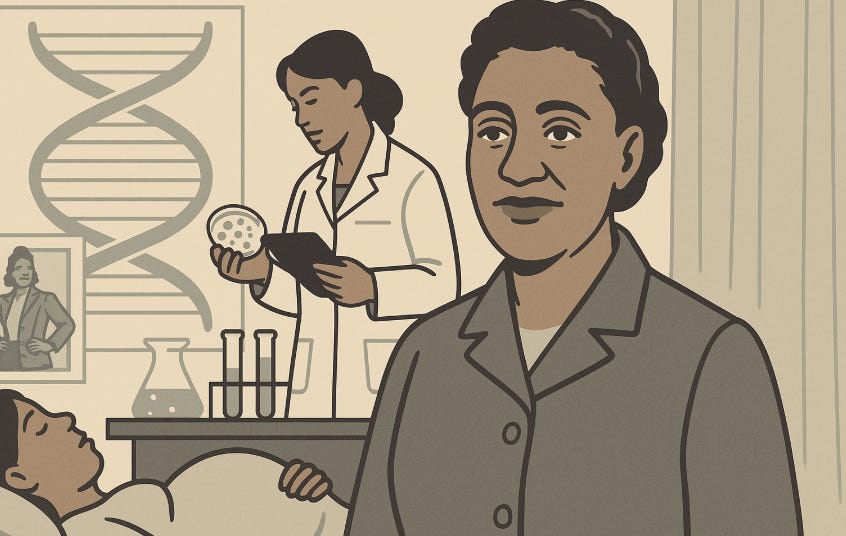
Henrietta Lacks (1920–1951) was a Black woman from Virginia whose cervical cancer cells were taken without her knowledge during treatment at Johns Hopkins Hospital. Those cells, now known as HeLa, became the first immortal human cell line and one of the most important tools in modern biomedical research. Her unwitting contribution led to breakthroughs in cancer biology, virology, IVF, gene mapping, and vaccine development. Yet for decades her identity was hidden, her family was excluded from decisions about her cells, and her story was rarely acknowledged. Henrietta Lacks challenges us to examine the intersection of race, consent, scientific ambition, and the human meaning of bodily autonomy. In obstetrics, where women routinely entrust their bodies to systems they may not fully understand, her legacy raises essential questions about power, respect, and transparency.
1. A Life Shaped by Structural Inequality
Henrietta Lacks lived in a time when Black patients often received segregated and inferior medical care. She entered Johns Hopkins not by choice, but because it was one of the few hospitals that treated Black people with cancer. Her experience cannot be separated from the realities of race, poverty, and limited access to healthcare. Obstetrics today still reflects echoes of this history. Women of color face disproportionate rates of maternal morbidity, biased clinical communication, and higher barriers to timely intervention. Lacks’s story reminds us that medical experiences are never isolated events. They are shaped by structures that determine who is listened to, who is believed, and whose suffering is taken seriously.
2. Consent as More Than a Signature
Lacks’s cells were removed without consent, a common practice in the 1950s. The ethical violation is clear with hindsight, but its implications persist. Consent must be more than paperwork. It must reflect understanding, voluntariness, and respect. In obstetrics, women frequently undergo interventions such as cervical exams, membrane sweeps, inductions, or operative births with only partial comprehension of what is being done and why. Henrietta’s legacy urges clinicians to ask whether consent processes truly honor the woman’s autonomy or whether they merely satisfy institutional requirements. Real consent requires dialogue, time, and recognition of the woman’s right to ask, challenge, or decline.
3. The Body as Data and the Person Behind It
Henrietta Lacks became famous not as a patient but as a cell line. The disconnection between the woman and the scientific material derived from her body illustrates a longstanding tension in medicine. Biological samples become data points, research tools, and commercial products, while the human story becomes obscured. Obstetrics confronts a similar risk. Ultrasound images, fetal tracings, and lab results can overshadow the person behind the numbers. Lacks’s story urges clinicians to maintain the connection between data and humanity. Every test, every sample, and every metric originates in a person who deserves acknowledgment, dignity, and respect.
4. Scientific Progress Built on Invisible Labor
The HeLa cell line has contributed to decades of medical breakthroughs. Yet for much of that history, Henrietta Lacks and her family were unnamed and uncompensated. This pattern echoes a broader truth. Much of medicine’s progress has been built on the experiences, bodies, and risks of women, especially women of color, whose contributions were not recognized. In obstetrics, countless advances were enabled by pregnant women who received little credit, little choice, and sometimes little safety. Lacks’s story makes visible the human labor behind scientific progress. It asks clinicians to ensure that future advances do not repeat past injustices.
5. Reproductive Justice as a Framework for Care
Henrietta Lacks’s experience aligns with the principles of reproductive justice, which emphasize not only autonomy but the right to bodily integrity, equitable treatment, and informed participation in medical decisions. These principles extend directly into obstetric practice. Pregnant women deserve care that recognizes their lived context, honors their agency, and ensures that their bodies are not sites of unspoken decisions or hidden agendas. Lacks’s story reveals how easily medical systems can overlook the perspectives of those most affected. A reproductive justice framework demands intentional listening and transparency.
6. The Legacy of Distrust and the Responsibility to Repair
Many Black families express hesitancy toward medical research and healthcare institutions, a hesitancy rooted in histories like Henrietta Lacks’s. In obstetrics, this distrust influences prenatal care engagement, willingness to accept interventions, and openness in communication. Trust cannot be demanded. It must be earned through consistent respect, honesty, and accountability. Lacks’s story invites clinicians to acknowledge past harm openly and strive for care that restores trust rather than expecting it unconditionally.
7. Seeing the Individual Within the System
Henrietta Lacks is often described as a symbol of ethics, but before she was a symbol, she was a woman. She had five children, a warm personality, a life full of relationships and responsibilities. The medical system saw her disease but not her humanity. Modern obstetrics must avoid this mistake. Systems, protocols, and research are essential, but they must not overshadow the individual. Lacks’s story challenges clinicians to see every woman not as a vessel of data or risk, but as a full human being whose values, emotions, and narratives matter.
Reflection
Henrietta Lacks forces obstetrics to confront the ethics of power, consent, and recognition. Her life and legacy reveal how easily systems can extract value while overlooking the person who provides it. They remind us that scientific progress does not erase ethical responsibility. The question her story asks is simple and urgent. When women give their bodies over to medical care, do we treat them as partners or as sources of information. The future of ethical obstetrics depends on answering that question with honesty and a commitment to justice.
Why do we care about the origin of these cells ? I don’t get it. The use of these cells for research that saves lives is a positive use of cells that would otherwise be destroyed. Why does it matter who they came from
It doesn’t.