
Your Baby’s Future May Start at the Gym -- And Not Just Mom’s
The old idea that Dad’s job ends at fertilization? The data says otherwise.


For decades, the fertility conversation around exercise went one direction: women were told to stay active during pregnancy, watch their weight, eat well. Fathers? Their job was done at conception. Drop off the sperm, step aside. The baby’s health was now a maternal affair.
A remarkable new study just turned that assumption inside out.
What Researchers Found
Scientists at Ohio State University, led by Kristin Stanford, published a study in Cell Metabolism (2025) showing that when male mice exercised regularly before mating, their offspring were born with better endurance -- even though the pups themselves never exercised. The father ran on the wheel. The baby got the benefit.
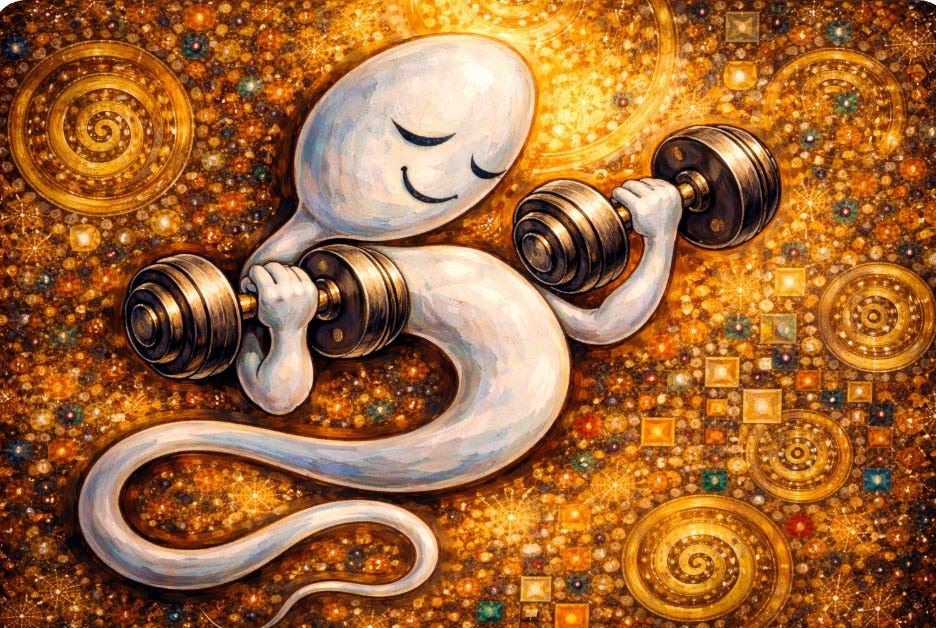
That alone is surprising. But here is the part that changes how we think about inheritance: the benefit was not passed through DNA. It was carried by tiny molecules in the sperm called microRNAs.
How Something So Small Can Matter So Much
Let me explain this simply, because it matters.
You have probably heard of DNA -- the long instruction manual inside every cell that determines things like eye color and blood type. DNA is the blueprint. But a blueprint alone does not build a house. You need someone to read the blueprint and decide which parts to build first, which to skip, and which to emphasize.
That is what microRNAs do. They are tiny molecules -- so small that about 22,000 of them could fit on the head of a pin -- and they act like volume knobs on your genes. They do not change the DNA itself. They change how the body reads it. Turn this gene up. Turn that gene down.
When a father exercises, his body produces specific microRNAs that get packaged into his sperm. When that sperm fertilizes an egg, those microRNAs come along for the ride. They then influence how the baby’s genes are read -- particularly genes involved in muscle function and metabolism.

The rest of this post is for paid subscribers.
