
Why Pregnancy Needs Real Insurance, Not Fantasy Economics
Understanding risk, protection, and why health insurance for pregnant women works exactly like fire insurance.

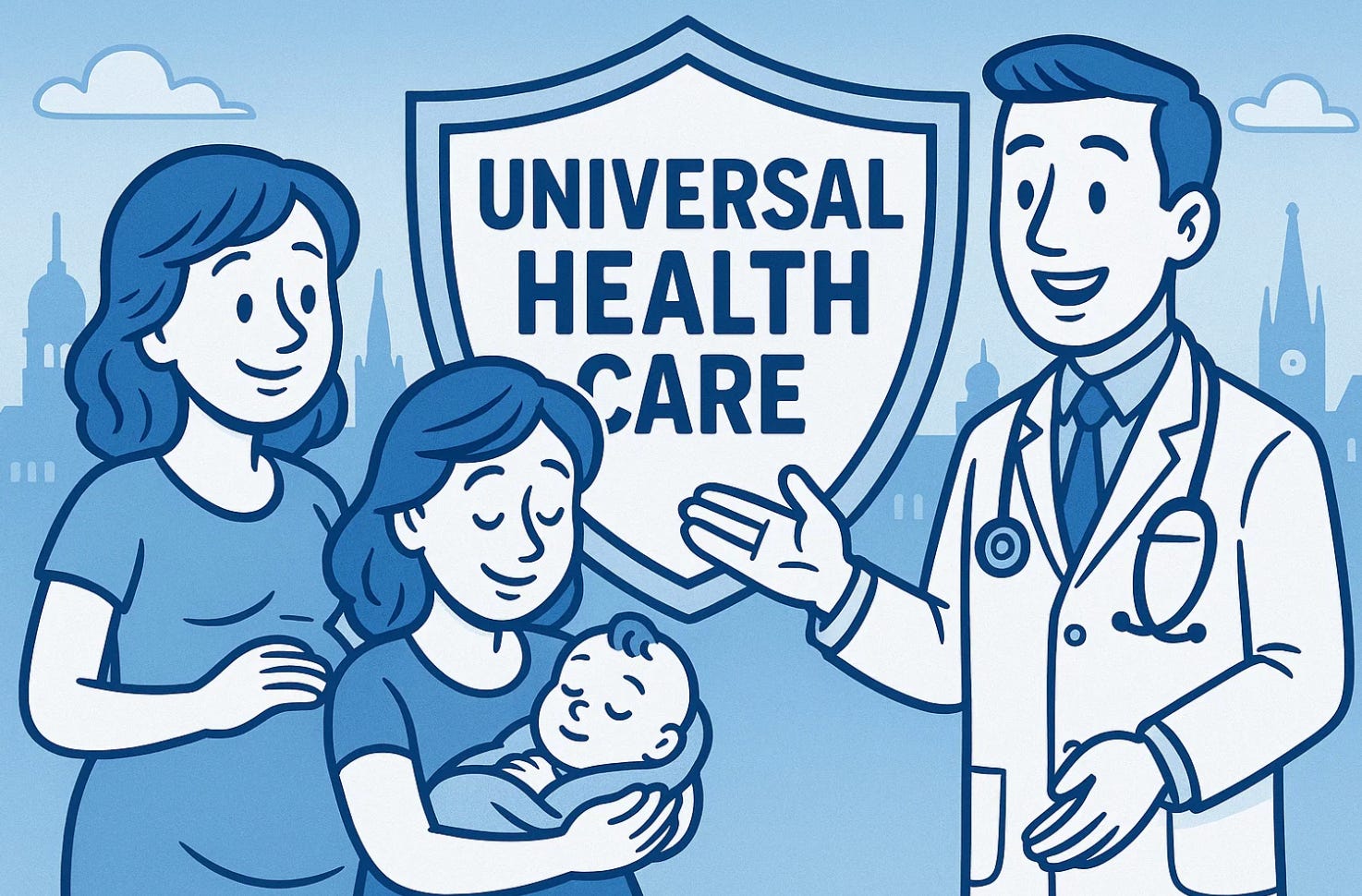
Pregnancy insurance means coverage that protects women against the medical costs, complications, and unpredictable events of pregnancy, birth, and postpartum recovery. It matters even more because pregnancy involves two patients whose wellbeing is tightly linked. And it does not stop at delivery. Insurance is needed during pregnancy and after birth to protect the mother and the newborn, who both face significant medical needs in the first year of life.
A Simple Example: Fire Insurance and Pregnancy
America has almost 150 million homes. Fewer than 400,000 experience a fire each year. Most homeowners will never file a claim, yet nearly everyone pays for fire insurance. We do this because the alternative losing your home with no protection would be financially devastating.
Pregnancy follows the same logic. Most women will have routine prenatal care and an uncomplicated birth. But obstetrics carries real risks that affect two lives at once. Severe maternal complications can arise without warning. Newborns may require urgent evaluation, resuscitation, or neonatal intensive care. Many families need both maternal and newborn coverage in the first days and months after birth.
Insurance exists for precisely these moments. It spreads the cost so that mothers and infants are protected whenever emergencies occur.
An Uneven System
The American system does not deliver that protection evenly. About 49 percent of U.S. births are covered by Medicaid, compared with roughly 50 percent covered by private insurance. These two groups receive fundamentally different care.
Women with private insurance usually obtain prenatal care from a dedicated obstetrician or an integrated group practice. They deliver in hospitals with higher staffing ratios, more subspecialty coverage, better access to maternal–fetal medicine, and more robust neonatal services.
In contrast, many women on Medicaid are funneled into large public clinics or residency clinics where they rarely see the same clinician twice. Their hospital care often occurs in safety-net facilities that operate with thinner margins, fewer resources, and higher patient-to-nurse ratios. Medicaid reimbursement rates run 40 to 60 percent lower than private insurance for the same obstetric services. This reduces hospital revenue, limits investment in staff and infrastructure, and contributes to higher rates of severe maternal morbidity in Medicaid-heavy hospitals. And because Medicaid enrollment during pregnancy often begins late or requires administrative hurdles, a significant proportion of women start prenatal care in the second trimester or later.
The result is a two-tiered maternity system in which the women most likely to face medical risk during and after pregnancy receive the least consistent care and deliver in the most strained environments.
Why Consumer-Driven Health Care Fails Pregnant Women
Some politicians argue that people should bypass insurance, pay directly out of pocket, and “shop” for cheaper care. This logic collapses the moment pregnancy enters the picture.
Obstetric and neonatal emergencies unfold within minutes. No woman with severe bleeding can compare prices for a delivery suite. No parent with a newborn in respiratory distress can delay care to find a cheaper NICU. And medical decision making for both mother and infant is complex. It cannot be treated like buying a consumer product.
Consumer-driven care ignores the realities of genetics, physiology, and high-risk obstetrics. It places the mother and the infant in jeopardy.
The Distribution of Risk
Health care spending is sharply uneven. Half of Americans spend almost nothing, while five percent account for half of all costs. Pregnancy magnifies this balance. Maternal ICU admission, emergency cesarean delivery, postpartum hemorrhage, or neonatal intensive care can produce six-figure bills.
This is insurance for two during pregnancy and insurance for two after birth. The first year of life carries the highest medical utilization of any stage in childhood. Without insurance, families face enormous financial threat.
Insurance protects families from this dual and unpredictable risk.
Universal Health Care. Why Europe Would Never Play This Game
The American debate over health insurance would make little sense in Europe. Every European country, from Portugal to Germany to the UK, guarantees universal health coverage that includes pregnancy, childbirth, postpartum care, and newborn care. These systems differ in structure, but their principles are the same. Prenatal visits are covered. Labor and delivery are covered. Postpartum care is covered. Newborn evaluations and hospitalizations are covered.
And no politician in Europe would dare propose removing maternity coverage or replacing it with out of pocket shopping. The idea would be politically suicidal. Universal maternity care is considered a basic public obligation. Protecting mothers and infants is viewed not as a market decision but as a national responsibility.
European voters expect it. European physicians expect it. European political parties from left to right defend it. Even conservative governments defend universal maternity coverage, because the health of mothers and newborns is seen as nonnegotiable.
This difference matters. Universal coverage stabilizes maternal health systems. It reduces financial stress that pushes women to delay care. It ensures newborns receive immediate evaluation rather than being turned away or billed. It prevents the bankrupting NICU bill that American families know too well. And it reinforces the ethical view that pregnancy is a protected period in which society should support, not exploit, families.
In Europe, the debate is not whether universal pregnancy care should exist. The debate is how to improve it. In the United States, we are still debating whether families deserve protection at all.
Universal systems recognize a simple truth. Pregnancy is unpredictable and costly when complications arise. No mother and no infant should be left unprotected because of political theater or market ideology.
Preexisting Conditions and Pregnancy
Before the Affordable Care Act (ACA), insurers routinely denied coverage to women with prior cesareans, gestational diabetes, or infertility treatments. Pregnancy itself was treated as a preexisting condition. These exclusions harmed mothers and newborns because delayed care leads to higher rates of preventable complications.
The ACA corrected this by banning discrimination based on medical history and by helping healthy people purchase insurance so that the pool stays balanced. Without these protections, insurers cherry pick low risk individuals, premiums rise, and pregnant women are left exposed.
Why Attacks on Health Insurance Threaten Maternal and Infant Health
Efforts to weaken or dismantle the ACA ignore the fundamentals of insurance. Removing subsidies or allowing insurers to deny coverage based on history recreates the conditions that once left millions uninsured. Women delay prenatal visits. Infants miss early evaluations. Complications escalate.
When gaps in coverage occur, the consequences fall on two lives during pregnancy and two lives afterward. Maternal morbidity rises. Neonatal care is delayed. Families face preventable harm.
A Practical Analogy for Families and Clinicians
Think of obstetric and newborn insurance the same way you think of fire insurance. You hope you never need it. But when an emergency happens, protection is essential. And in pregnancy, the risk multiplies because a maternal emergency often triggers a newborn emergency. Insurance protects both at once. Weak systems leave both vulnerable.
The Ethical Dimension
Pregnancy brings two patients into the health system at the same time. Ethical care requires protecting both across pregnancy, birth, and the newborn period. Insurance is not a luxury. It is a safeguard against catastrophic harm. Universal systems recognize this. European governments defend it. American politics ignores it.
Policies that weaken coverage do not harm just one individual. They harm a mother and her infant, and they do so during the most vulnerable period of life.
Closing Reflection
If Europe considers universal pregnancy and newborn coverage an essential part of a civilized society, why does the United States still treat it as optional? And if we accept fire insurance for the unlikely risk of a house fire, why would we question insurance that protects two linked lives from real, predictable, and costly complications? That is the question we must finally confront.
I personally like the idea of universal coverage as a base healthcare for all but the systems in other countries have lots of issues that we in the US would have to address before we could even consider it. As in other countries we would still have tiered healthcare as you could pay for additional coverage or type of coverage
This is a complex issue with lots of unintended consequences that need to be avoided