
Why ObGyn Needs an Obstetric AI Subspecialty to Protect Patients and Advance Care
A call to build a formal AI discipline inside obstetrics and gynecology before the technology overtakes the field.

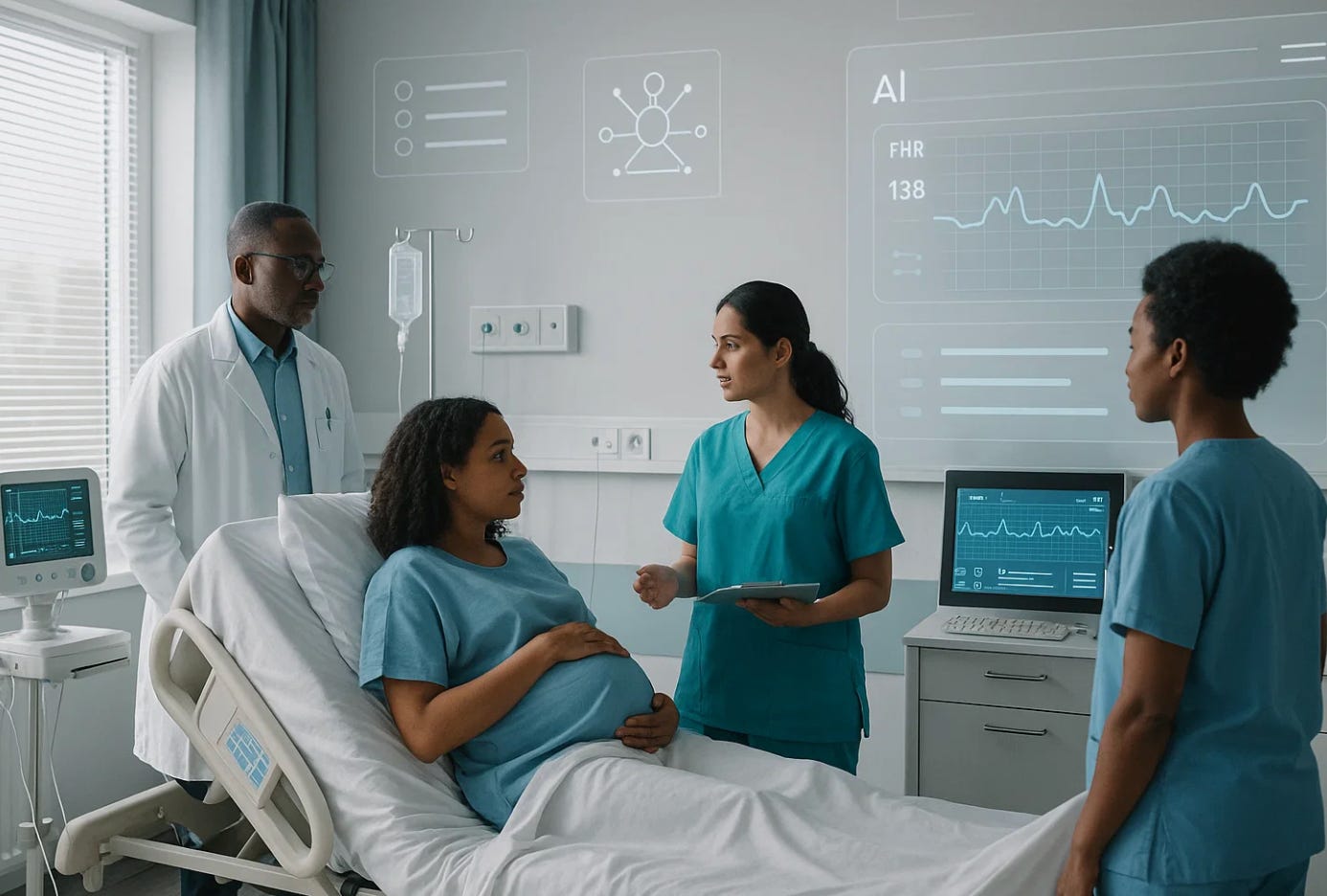
Obstetric artificial intelligence refers to tools that use machine learning and large language models to support diagnosis, communication, workflow, prediction, and patient safety during pregnancy and birth. These systems already interpret fetal monitoring, translate instructions, summarize ultrasound findings, and generate patient education. They also shape patient expectations long before a clinician joins the conversation.
Obstetrics is not prepared for this. That is why the field now needs an AI subspecialty.
A new kind of mismatch in obstetrics
Consider a common scene. It is early morning on labor and delivery. A resident shows me a fetal heart tracing that a patient recorded at home through a phone app. She wants reassurance. She wants interpretation. She wants an answer that matches the speed of the tool she used. She trusts it because it is available, confident, and immediate.
This pattern is now routine. Pregnant women use AI systems to answer questions, translate instructions, track contractions, interpret blood pressure readings, and preview ultrasound language. Sometimes the output is correct. Sometimes it is misleading or harmful. And there is no formal obstetric discipline to guide how these tools enter care.
Other specialties have moved faster. Emergency medicine uses virtualists. Internal medicine relies on clinical informaticists. Public health depends on computational epidemiologists. Despite being one of the most data-rich specialties, obstetrics still approaches AI with improvisation rather than structure.
Why obstetrics is uniquely exposed
Obstetrics sits at the center of three forces that make AI integration unavoidable.
The first is data density. Labor presents minute-by-minute information. Fetal patterns shift rapidly. Maternal vitals change quickly. Ultrasound findings must be interpreted with precision. AI systems are already being deployed to predict hemorrhage, detect tachysystole, and support triage decisions. Without obstetric experts to validate these tools, we risk building automated pathways that amplify errors instead of preventing them.
The second force is the central role of communication in pregnancy. A recent JAMA Network Open study found that AI translation of discharge instructions performed reasonably well for Spanish but was far less accurate for Chinese, Vietnamese, and Somali. In obstetrics, inaccurate instructions can delay care for preeclampsia, infections, fetal complications, or labor changes. Language equity cannot be left to chance. Clinicians must guide AI translation so that it protects, rather than harms, the patients who rely on it.
The third force is rising expectations. Pregnant women expect clear digital information, fast answers, online booking, and immediate interpretation of results. They often consult AI before contacting their clinicians. If we do not meet expectations for clarity, speed, and respect, we risk losing trust.
Prompt engineering must become an obstetric skill
Prompt engineering is now a core clinical skill. Large language models can only produce safe and accurate information when prompted with precise instructions, structured reasoning, and explicit context. A poorly crafted prompt can create incorrect reassurance about fetal movement, inaccurate risk statements about gestational diabetes, or confusing recommendations about preterm labor symptoms. A well constructed prompt can generate clear summaries, neurodivergent-friendly explanations, culturally sensitive instructions, and readable patient education.
Prompt engineering requires clinical judgment, an understanding of bias, and a commitment to patient safety. It belongs in obstetrics. A formal AI subspecialty would teach clinicians how to design prompts that amplify safety, improve equity, and minimize harm.
Developing high quality patient information
An obstetric AI subspecialist would guide the creation of patient information that is accurate, readable, and sensitive to varied learning needs. She would ensure that materials reflect the evidence, respect cultural and language differences, and support real understanding. She would help design AI-generated summaries of prenatal visits, postpartum instructions written at appropriate reading levels, and explanations of fetal anomalies that are both clear and compassionate. She would also ensure that neurodivergent women receive information that is structured, predictable, and sensory aware.
Building safe and consistent hospital guidelines
Hospitals will increasingly rely on AI tools to assist with triage, documentation, early warning systems, and patient education. An obstetric AI subspecialist would lead the development of guidelines that determine when AI should be used, how its results are validated, when human oversight is required, and how errors are identified and corrected. She would help hospitals meet ADA and civil rights obligations in language access. She would ensure that new digital workflows support safety rather than create shortcuts that undermine care.
Compassionate care in an AI-enabled world
The presence of AI does not reduce the need for compassion. It increases it. Many pregnant women feel overwhelmed by digital information, algorithmic predictions, and the pressure to track every detail of their pregnancy. Others rely heavily on AI because their past encounters with the health system left them feeling dismissed or unheard. A clinician trained in obstetric AI would recognize these dynamics. She would use AI as a tool to strengthen trust rather than weaken it. She would help patients understand when AI is helpful and when it is misleading. She would reinforce that human care, empathy, and clinical judgment remain central.
The ethical dimension
AI brings ethical responsibilities that obstetrics cannot ignore. Decisions about surveillance, risk prediction, and triage carry profound moral weight because they affect two lives at once. When an algorithm influences these decisions, clinicians must understand how it works, who trained it, what data it learned from, and where its limits lie. Equity must be monitored so that algorithms do not worsen racial or linguistic disparities. Consent must remain meaningful. Privacy must be protected against data misuse. And professional judgment must never be replaced by algorithmic outputs. An obstetric AI subspecialty would anchor these obligations and teach clinicians how to meet them.
What an obstetric AI subspecialty would actually do
A specialist in obstetric AI would monitor and validate clinical algorithms, ensure language equity in AI translation, guide the design of patient-facing tools, restructure workflows to reduce clinician burden, teach AI literacy across the department, produce high quality patient information, and help hospitals build safe guidelines. She would also safeguard ethics by demanding transparency, protecting autonomy, and maintaining human oversight in decisions that shape maternal and fetal well-being.
Why the time is now
If obstetrics does not lead, someone else will. Vendors, hospital systems, and large tech companies will define safety thresholds, data sources, and clinical language. They will shape the future without fully understanding the clinical realities of pregnancy or birth. To protect patients, and to preserve trust, obstetrics must take ownership now.
Reflection
Obstetrics has always embraced innovation, but this moment is different. We are stepping into a world in which the tools will often respond before we do. Our job is to ensure they respond wisely. The question is not whether AI will enter obstetric care. It already has. The question is whether we will guide it with professionalism, ethics, compassion, and skill.