
WHT REPORT: The Most Data-Rich Organ in Your Body Is the One Nobody Checks During Pregnancy
WOMEN’S HEALTH TECH REPORT: AI can now predict preeclampsia from a retinal photograph months before symptoms appear. Smart contact lenses may soon monitor glucose in tears. :

The retina is becoming the most powerful diagnostic window in medicine. And ObGyns still do not tell pregnant women to see an eye doctor.
The Organ We Are Ignoring
Every prenatal checklist in the country tells pregnant women to see a dentist. Good advice. Pregnancy hormones affect gum tissue, and periodontal disease has been linked to preterm birth.
But pregnancy hormones also affect the eyes. They change tear production, corneal thickness, intraocular pressure, and the blood vessels of the retina. For women with diabetes or hypertension, pregnancy can accelerate retinal disease. For women taking fertility medications like clomiphene, visual disturbances are a recognized side effect that can, in rare cases, be permanent.
Nobody tells women any of this.
Here is what makes the gap even more striking. The retina is the only place in the human body where you can directly observe blood vessels without cutting anything open. It is a live window into vascular health, neurological health, and metabolic function. And in the last three years, artificial intelligence has turned that window into one of the most powerful diagnostic tools in medicine.
AI can now look at a retinal photograph and predict cardiovascular risk, detect undiagnosed diabetes, estimate biological age, identify kidney disease, and, most relevant to obstetrics, predict preeclampsia months before a woman develops symptoms.
We tell pregnant women to visit the dentist. We do not tell them about the organ that may soon screen for the most dangerous complication in obstetrics.
This report covers the technology that is about to change that.
The Women's Health Tech Report: Safety analysis, the evidence critique, and the verdict are below -- for subscribers who want the full picture.
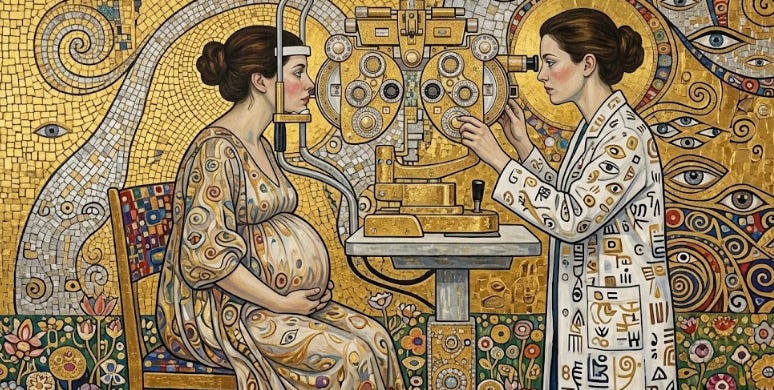
The Retina: Medicine’s Best-Kept Diagnostic Secret
The field is called oculomics: using the eye to diagnose and monitor diseases that have nothing to do with vision. The concept is simple. The retina is a thin layer of neural tissue at the back of the eye, supplied by a dense network of tiny blood vessels.
The retina is the only place in the human body that allows a view directly into your brain.
These vessels share anatomical and physiological properties with the vasculature of the heart, brain, and kidneys. When systemic disease damages small blood vessels anywhere in the body, the retina often shows it first.
Ophthalmologists have known this for decades. Hypertensive retinopathy, diabetic retinopathy, and papilledema are not eye diseases. They are systemic diseases that happen to be visible through the eye.
What is new is the scale and precision that AI brings to this observation.
In a landmark 2018 study published in Nature Biomedical Engineering, Google researchers trained deep learning models on retinal photographs from over 284,000 patients. The AI predicted cardiovascular risk factors that ophthalmologists did not know were visible in retinal images: age (within 3.26 years), sex (AUC 0.97), smoking status (AUC 0.71), and systolic blood pressure (within 11.23 mmHg). It also predicted major adverse cardiac events (1).
Baiju VP, Subash R, Venkatesan N. Integrated artificial intelligence and omics for prediction and monitoring of pre-eclampsia. Int J Gynaecol Obstet. 2026 Jan 30. doi: 10.1002/ijgo.70820. Online ahead of print. PMID: 41614371.
Pre-eclampsia is a difficult pregnancy condition that causes high blood pressure and can lead to health complications in both mother and newborn, resulting in a higher fatality rate. It presents with a wide range of symptoms and lacks specific indicators, as the contemporary diagnostic techniques, including proteinuria testing and blood pressure measurements, are not reliable.
The current evolution in artificial intelligence (AI) technology tends to show a promising transformation of pre-eclampsia management. AI algorithms are applied to process larger sets of clinical, biochemical, and image data that facilitate timely medical interventions by bringing up the early-onset and severity of pre-eclampsia. By analyzing the red cell distribution width (blood test indicators for pre-eclampsia), it is recognized as a cost-effective way of detecting inflammation.
The application of AI technology on non-invasive diagnostic (wearable) devices enables continuous monitoring with imaging techniques for the placenta and retina via cloud-based systems. These developments are not only applied for early detection of pre-eclampsia, but also assist decision making capabilities in both high- and low-resource environments.
The retina, it turns out, encodes far more information than the human eye can extract. AI can read what we cannot see.
What follows is the part most readers never find: the practical, evidence-based guidance that separates knowing a technology exists from knowing how to use it. For clinicians and patients navigating women's healthcare, that is not a convenience; it is a competitive and clinical advantage worth far more than the cost of a subscription.
Keep reading with a 7-day free trial
