
Who Really Loses in the Ob-Gyn Shortage? Patients Without Access

In August 2025, the American College of Obstetricians and Gynecologists (ACOG) sounded the alarm about a growing Ob-Gyn shortage. They estimate a 7 percent drop in practicing Ob-Gyns by 2030, leaving over 5,000 fewer physicians just as demand rises. They highlight “maternity care deserts,” where 2.2 million women and 150,000 newborns already lack reliable access to care. What they fail to add is additional “maternity care deserts” (eg Brooklyn, Queens, Detroit, LA, etc) where there are hospitals with ObGyn services but inadequate access to excellent ObGyn care. ACOG points to factors such as an aging workforce, capped residency slots, burnout, and the political fallout from Dobbs v. Jackson. They also suggest that emerging practice models—hospitalist work, telehealth, concierge medicine, or locum tenens—may help physicians adapt while keeping careers sustainable.
The Problem with Framing Shortages Around Physicians
While ACOG’s concern for physicians’ wellbeing is understandable, the way the shortage is framed misses the central ethical issue: who suffers most when access collapses? The answer is not equal across society. The Ob-Gyn shortage must be seen as a crisis of justice, not just of workforce numbers.
A Three(+)-Tiered System in Women’s Health
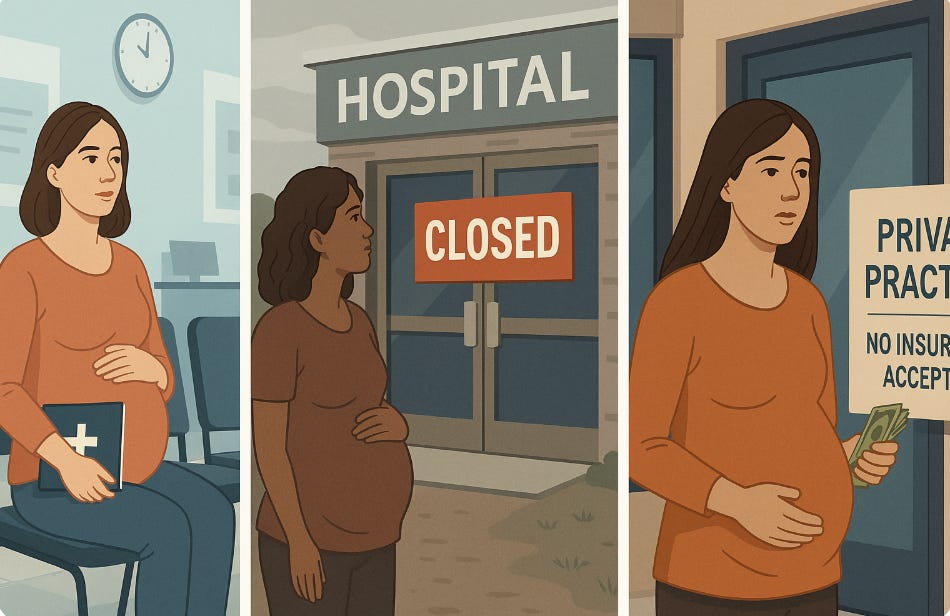
The shortage is not producing one crisis, or even the familiar two-tier divide. What we now face is a three-tiered system:
Privately insured patients: Access becomes less convenient but rarely life-threatening. These patients may wait longer for appointments, but physicians continue to accept them.
Uninsured and Medicaid patients: They face the harshest impact. Many physicians cannot afford to take Medicaid’s low reimbursement, and uninsured women are excluded entirely. Too often, they end up in emergency rooms late in pregnancy or rely on unsafe alternatives outside the medical system.
Patients shut out of private practices that no longer take insurance: Even women with insurance may find themselves locked out if physicians demand direct payment. This “cash-only” tier favors those who can pay out-of-pocket and excludes those who cannot, widening inequities even further.
This fragmented system is more than inconvenient. It reveals how access to essential reproductive care is being rationed by wealth, geography, and insurance status. The Ob-Gyn shortage is not simply a workforce issue. It is a justice problem, a distribution problem, and above all, a policy problem.
Burnout Is Real, but Abandonment Is Worse
ACOG is right to emphasize burnout, which many describe as “moral injury.” The long hours, malpractice stress, and political interference are real. Physicians deserve support.
But when the conversation focuses mainly on how doctors can redesign their careers—whether through concierge medicine, gynecology-only practices, or locum tenens work—it risks sounding tone-deaf. For vulnerable underserved women in care deserts and anywhere else too, the problem is not whether their doctor feels fulfilled. The problem is whether they have any doctor at all.
Why Market Solutions Fall Short
Market-driven fixes like concierge medicine or direct primary care may reduce burnout for some physicians and improve care for those few who can afford it. But they do nothing for the millions of uninsured or underinsured, and in fact, they accelerate the creation of a cash-only tier that systematically excludes millions.
Telehealth, while useful for some aspects of care, cannot deliver babies or manage obstetric emergencies. Locum tenens may fill staffing holes but does not create continuity of care. Without structural reform, these solutions shuffle the deck chairs while the ship continues to take on water.
What We Truly Need: Universal Healthcare
If we are serious about solving the Ob-Gyn shortage, then we must be honest about what every other high-income country already knows: universal healthcare is not optional. It is the foundation.
Every single high-income nation except the United States guarantees universal coverage. Not coincidentally, we are also the only high-income country with outrageously high maternal and infant mortality. Our fragmented, insurance-based system produces silos of care where access depends on wealth, not need. The results are deadly.
Expanding residency slots, addressing burnout, or experimenting with new practice models may help at the margins. But until the U.S. guarantees every pregnant woman access to outstanding care, not just some hospital clinic, regardless of insurance or ability to pay, our outcomes will remain an international embarrassment.
An Ethical Crossroads
The Ob-Gyn shortage is not only about careers. It is about whether we, as a profession, are willing to tolerate a system where women’s lives are valued differently depending on their insurance card or their ability to pay cash.
ACOG is right to highlight physician shortages and burnout. But unless our leading professional organization acknowledges the deeper structural issue, we are treating the symptom while ignoring the disease. Every other high-income country has universal healthcare. The United States stands alone without it—and not coincidentally, we stand alone with the highest maternal and infant mortality among wealthy nations.
That reality should be unacceptable to every Ob-Gyn. If ACOG does not make universal access to care its central demand, then its advocacy risks becoming a defense of physician lifestyle (and their pocketbooks) rather than patient lives. It is not enough to talk about concierge medicine or telehealth models when millions of women cannot find a safe place to give birth and an unacceptable number die.
The true measure of leadership is not how well we protect ourselves, but how fiercely we fight for those who cannot fight alone. Until ACOG champions universal healthcare, it will remain complicit in sustaining a three-tiered system that leaves our most vulnerable patients behind.