
WHO “Important Pregnancy Tests and Checks” Poster
This poster presents six items as a simple checklist, implying they are universally beneficial and straightforward.

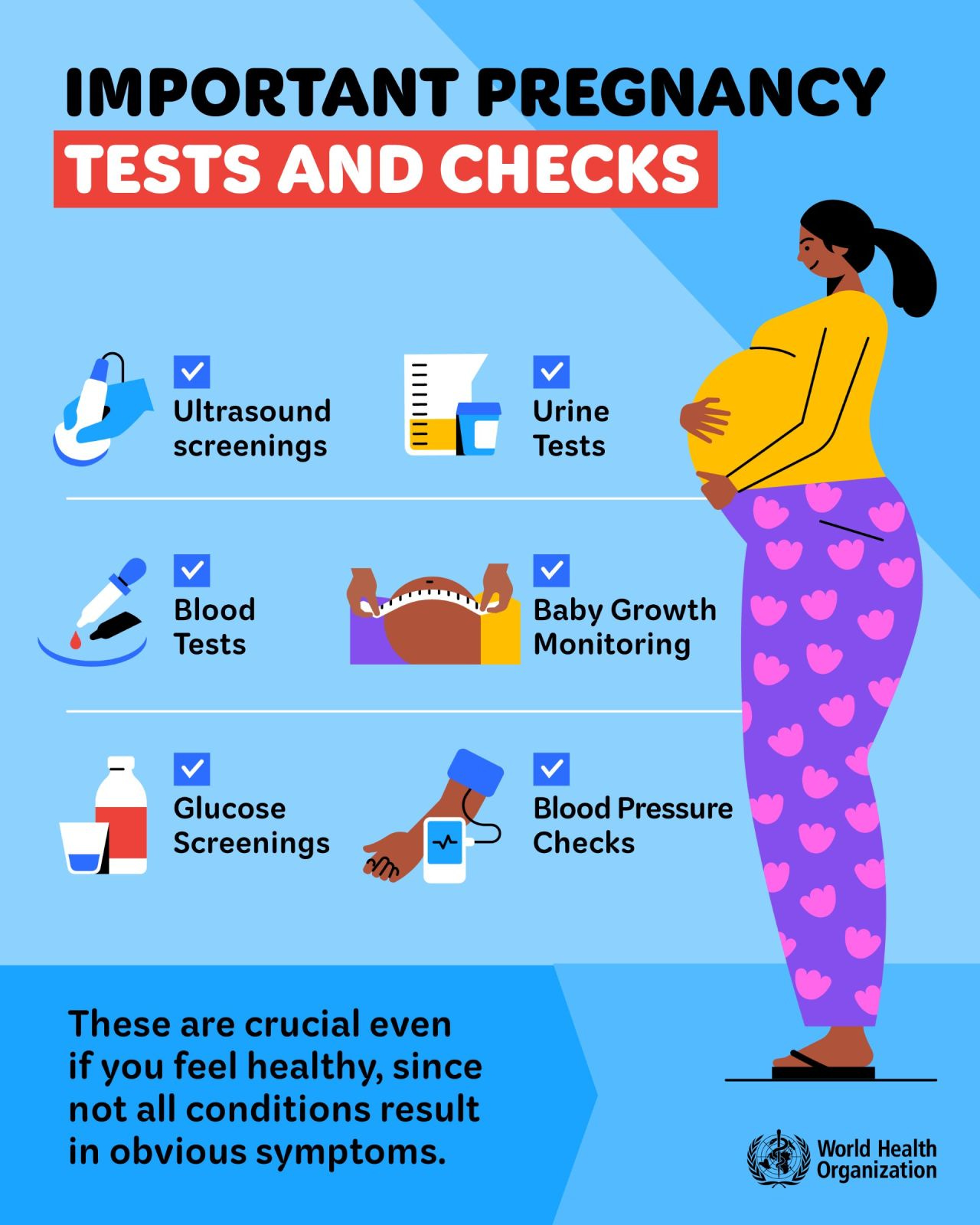
This poster presents six items as a simple checklist, implying they are universally beneficial and straightforward. It’s by the WHO World Health Organization (which, by the way, the US just left) .
The reality is more nuanced. Here is an evidence-based review of each:
And here is an evidence-based review of all pregnancy blood test.
1. Ultrasound Screenings
What ultrasound screening? For what and when?
The poster implies ultrasound is a blanket good. But the evidence shows that routine ultrasound after 24 weeks in low-risk pregnancies does not improve perinatal outcomes. The Cochrane review on this is clear: late-pregnancy ultrasound screening does not reduce perinatal mortality or morbidity in unselected populations. What it does do is increase the detection of “small for gestational age” fetuses, which leads to more interventions (inductions, cesareans) without demonstrated benefit in outcomes. The first-trimester dating scan has strong evidence for reducing post-term inductions, but the poster makes no distinction between evidence-supported and non-evidence-supported ultrasound timing. Blanket “ultrasound screenings” as a checkbox is not evidence-based guidance.
2. Urine Tests
Which urine tests. For what? and When?
Routine urine dipstick testing at every prenatal visit for proteinuria has poor sensitivity and poor positive predictive value for preeclampsia. Multiple studies have shown that dipstick proteinuria is an unreliable screening tool. The protein-to-creatinine ratio or 24-hour urine collection is far more accurate when preeclampsia is suspected, but routine dipstick screening in asymptomatic women generates false positives, unnecessary anxiety, and additional testing without improving detection of true preeclampsia when blood pressure is normal. Screening for asymptomatic bacteriuria in early pregnancy does have evidence supporting it, but that is a one-time test, not the recurring ritual the poster implies.
3. Blood Tests
This is so vague it borders on meaningless. Which blood tests? A complete blood count for anemia has reasonable evidence. Blood type and antibody screen: essential. But routine third-trimester CBC repeats in non-anemic women? Weak evidence. Routine syphilis rescreening in low-prevalence populations? Debatable cost-effectiveness. The poster treats “blood tests” as a monolithic good when in reality each test has its own sensitivity, specificity, cost, and evidence base. Presenting them as a single checkbox prevents patients from understanding what is being tested and why, which undermines informed consent.
4. Baby Growth Monitoring
What kind of baby growth monitoring? Ultrasound? Fundal Height?
Serial fundal height measurement, the most common form of “growth monitoring,” misses approximately 50% of growth-restricted fetuses. Its sensitivity is poor. The AFFIRM and Truffle studies have shown that even with more intensive monitoring protocols, detection of fetal growth restriction remains unreliable without targeted ultrasound. Meanwhile, universal third-trimester growth ultrasound (as studied in the UK POP study) detects more SGA fetuses but has not been shown to reduce stillbirth or adverse outcomes. So the poster checks a box that gives patients false reassurance. Telling a pregnant woman her baby’s growth is “being monitored” when the tool being used catches fewer than half of growth-restricted babies is not reassurance. It is a gap in honesty.
5. Glucose Screenings
There is no global consensus on how, when, or even whether to screen for gestational diabetes. The WHO uses a one-step 75g OGTT approach. ACOG uses a two-step approach with a 50g screen followed by a 100g GTT. The thresholds are different. The HAPO study showed a continuous relationship between glucose and adverse outcomes with no clear cutoff. This means the “diagnosis” of gestational diabetes depends entirely on which criteria your country or hospital uses, not on a biological threshold. A woman can be “normal” under ACOG criteria and “diabetic” under WHO criteria on the same glucose values. The poster presents this as a simple checkbox when it is one of the most contested diagnostic categories in obstetrics.
6. Blood Pressure Checks
This is the strongest item on the list, but even here the poster oversimplifies. Blood pressure measurement technique matters enormously. Studies have shown that improper cuff size, patient positioning, and the “white coat” effect can produce readings that differ by 10-15 mmHg. A single elevated office reading does not equal hypertensive disease. Furthermore, the evidence increasingly supports home blood pressure monitoring and ambulatory blood pressure monitoring as more accurate than isolated office checks for diagnosing hypertensive disorders of pregnancy.
Telling patients to get their blood pressure checked without specifying how it should be measured, how often, and what the numbers mean gives them a false sense that the box is checked when the quality of the measurement determines whether it is clinically useful.
And here is an evidence-based review of all pregnancy blood test.
The Finances of the WHO
The WHO operates on a biennial budget of roughly $6.8 billion, but only about 16% comes from assessed member state dues. The rest is voluntary contributions, most of which are earmarked for specific programs by the donors. This means the WHO has remarkably little discretionary funding and is essentially dependent on what donors want to prioritize. The U.S. was the single largest contributor at roughly 18% of total funding. When your budget is largely controlled by outside donors and you have lost your biggest one, the incentive is to produce visible, shareable, checkbox-style content like this poster rather than nuanced, evidence-graded guidance that costs more to develop and is harder to market.
The simplistic quality of this infographic is not an accident. It reflects an organization that has been stretched thin for decades, forced to prioritize broad reach over scientific rigor, and now faces a 25% workforce reduction that will only widen that gap.
Patients deserve better than a checklist. But a simplified checklist is what you get when the organization producing it cannot afford the staff or independence to do more.
The Larger Problem
The poster’s final line says: “These are crucial even if you feel healthy, since not all conditions result in obvious symptoms.” This is technically true but fundamentally paternalistic. It tells women to submit to a checklist without explaining what each test can and cannot detect, what the false positive rates are, or what happens when a test is abnormal. Informed patients do not need a checklist. They need numbers, accuracy data, and honest conversations about what screening can and cannot do.
A checklist that says “get tested” without saying “here’s what this test actually catches and misses” is not patient empowerment. It is compliance framing dressed up as care.
While I agree with the overall message your idea that it’s paternalistic to not give everyone detailed information on each test. That’s not only unrealistic but most patients do not have the ability to integrate that into decision making for each test. The mathematical and scientific educational level of most people is low so it’s wishful thinking to have such a sophisticated discussion. And most patients want to have the expert (the doctor) advise them. Not put it all back on the patient