
When the Medical Record Becomes a Battleground
Why personal grievances do not belong in the Electronic Medical Record (EMR), and what professionalism actually requires

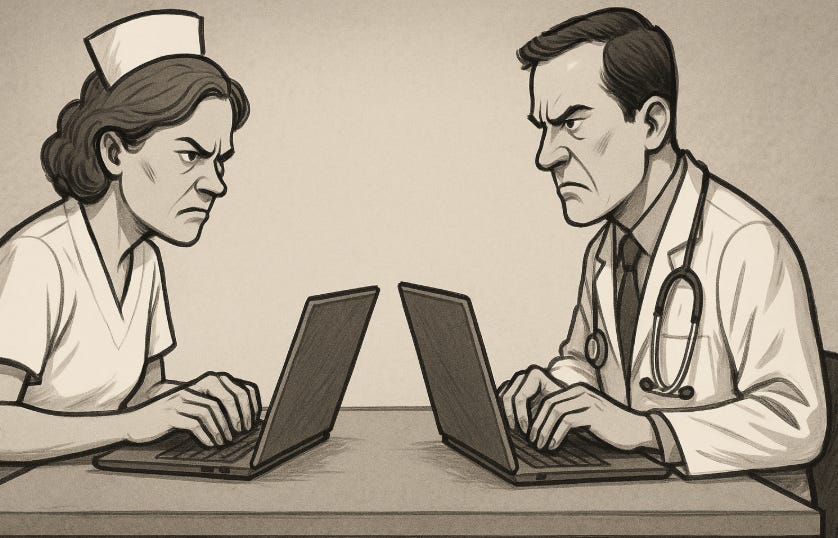
The vignette
A nurse documents, verbatim, something a physician said that made her uncomfortable. The quote is placed directly into the patient’s chart. Hours later, a physician responds in the same chart, documenting, again verbatim, what he perceived as an unprofessional response from the nurse. The exchange escalates. The patient’s medical record becomes a running transcript of workplace conflict. Neither entry advances diagnosis. Neither alters management. Neither benefits the patient.
This is not a hypothetical. It is happening. And it is a serious professional error.
I understand the frustration. Disrespectful behavior toward nurses is real, harmful, and unacceptable. It deserves to be addressed. But I want to be clear. Using the electronic medical record to document interpersonal grievances is not advocacy. It is misuse of a legal clinical document.
The EMR (Electronic Medical Record) is the digital system hospitals and healthcare facilities use to document all patient care information—notes, orders, test results, vital signs, and narrative documentation. It’s the legal record of care, which is why documenting a verbatim exchange there is significant: once entered, it becomes part of the permanent, discoverable medical-legal record that can be subpoenaed, audited, or reviewed in malpractice cases, peer review, or credentialing proceedings.
The EMR is not a forum. It is a legal medical record.
The purpose of the EMR is to document patient care. Facts. Assessments. Decisions. Interventions. Outcomes. It is not designed to adjudicate staff behavior or preserve quotes from uncomfortable conversations. Every entry becomes part of a permanent legal record that the patient, their family, regulators, and attorneys may one day read. Increasingly, patients read their notes in real time.
When we insert workplace conflict into the chart, we place irrelevant, potentially inflammatory content into a record that belongs to the patient. The patient did not consent to being the repository for unresolved staff grievances. Nor should they be.
If everyone did this, professionalism would collapse.
Consider the precedent. If nurses document every disrespectful comment in the chart, should physicians document every delayed response, dismissive tone, or disagreement from nursing staff? Should consultants document their frustration with primary teams? Should residents document how an attending spoke to them? If everyone follows this logic, the EMR becomes unreadable, adversarial, and unsafe.
Professional standards must apply in all directions. If it would be inappropriate for one group to do it, it is inappropriate for all.
This approach also fixes nothing.
An EMR entry does not trigger accountability. It does not initiate investigation. It does not lead to coaching, remediation, or cultural change. It simply sits there, permanently, in a patient’s chart, increasing legal exposure while doing nothing to resolve the underlying problem.
When clinicians resort to charting grievances, it usually reflects something deeper. A lack of confidence that concerns will be addressed through proper channels. That is a systems failure, not an individual one.
What Healthcare Organizations Must Do. And What They Have Failed to Do.
When staff resort to documenting grievances in the EMR, this is not primarily a professionalism problem. It is a systems failure. It signals that clinicians do not trust existing pathways to hear, protect, or act on legitimate concerns. No one chooses the medical record as a forum for conflict unless every other avenue feels ineffective, unsafe, or performative.
Healthcare organizations must stop treating professionalism as a slogan and start treating it as infrastructure.
First, organizations must establish clear, visible, and trusted reporting pathways for disrespectful behavior. These pathways must be easy to access, nonpunitive, and responsive. If incident reports disappear into a void, if complaints are met with silence or retaliation, staff will seek visibility elsewhere. The EMR becomes that outlet by default. That is predictable and preventable.
Second, organizations must educate staff, explicitly and repeatedly, on the purpose and boundaries of the medical record. This cannot be assumed. Training must state clearly that interpersonal grievances, verbatim quotes of conflict, and commentary on staff behavior do not belong in the patient chart, regardless of intent. This education must apply to nurses, physicians, advanced practice clinicians, trainees, and administrators alike. Professional standards lose credibility when they are unevenly enforced.
Third, leadership must respond to reports with action and feedback. Silence is corrosive. When staff report mistreatment and hear nothing back, the message received is not neutrality. It is indifference. Without feedback, there is no trust. Without trust, people document defensively. The EMR becomes a place to leave a permanent mark because no other record seems to matter.
Fourth, organizations must separate patient safety documentation from workplace conduct investigation. These are different processes with different goals. Conflating them undermines both. The medical record should remain clean, factual, and patient-centered. Behavioral concerns require structured review, due process, and confidentiality, not public airing in a patient’s chart.
Finally, organizations must hold leaders accountable for unit culture. Disrespect flourishes where leadership is absent, inconsistent, or unwilling to intervene. When staff believe that nothing will change unless something is “on the record,” they will put it on the only record they think cannot be ignored. That is not defiance. It is desperation.
If healthcare systems want staff to stop using the EMR as a battleground, they must give them something better. Clear pathways. Real accountability. Timely responses. Education that is enforced, not optional.
Until then, blaming individuals for charting grievances misses the point. The behavior is wrong. But the reason it happens is structural.
Fix the system, and the chart will return to what it was always meant to be. A record of care, not a record of conflict.
Conclusion
Documenting a verbatim hostile exchange in the EMR is problematic for several reasons.
First, the medical record exists to document patient care, not interpersonal conflicts—it’s not the appropriate venue for grievances, which belong in incident reports, HR complaints, or chain-of-command channels.
Second, it creates permanent discoverable evidence that plaintiffs’ attorneys can exploit to suggest a dysfunctional care environment, even if the exchange had no bearing on patient outcomes.
Third, it poisons the collaborative atmosphere; once staff know their words might be transcribed into the chart, trust erodes.
Finally, it’s unprofessional on both sides, the original bad behavior and the reactive documentation.
The proper response is contemporaneous incident reporting through institutional channels, not weaponizing the patient’s legal medical record
The ethical bottom line.
Respectful workplaces are essential. Psychological safety matters. Disrespect toward nurses or physicians should never be normalized. But repurposing the patient’s medical record as a battleground for interpersonal conflict violates professional responsibility and undermines trust.
The EMR belongs to the patient. Not to our grievances. Not to our frustrations. Not to our unresolved conflicts.
Advocacy for professionalism is necessary. But it must be done in ways that are effective, appropriate, and ethically sound.