
When the Law Freezes the Doctor’s Hand
A Texas teenager’s death shows how abortion bans turn treatable infections into fatal delays

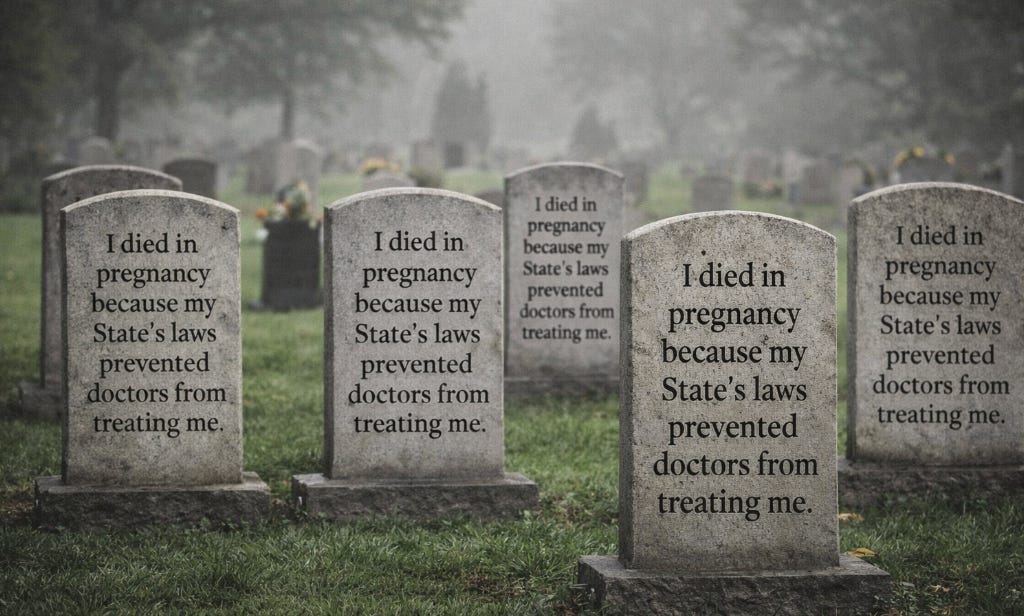
What this is about, in plain language:
This piece is about a pregnant teenager in Texas who developed sepsis, a life-threatening infection, and died after doctors declined to perform the right medical procedure because of state law. The question is not whether sepsis is dangerous. It is. The question is whether laws that restrict abortion can make standard medical care impossible, even when delay predictably leads to death.
A pregnant adolescent arrived at a Texas hospital with signs of severe infection. The pregnancy was nonviable. Her condition worsened. Sepsis progressed. According to reporting, clinicians believed that ending the pregnancy would expose them to legal risk, so they waited. She died after days of deterioration. This was not a rare disease. This was not an unpredictable outcome. This was a known medical emergency that obstetricians are trained to treat decisively.
Sepsis in pregnancy is not subtle. It announces itself with fever, tachycardia, hypotension, rising lactate, organ dysfunction. When the uterus is the source, as in septic pregnancy or previable rupture with infection, source control is not optional. Antibiotics alone are not enough. The infected tissue must be removed. In obstetrics, that means uterine evacuation. Delay increases mortality. This has been understood for decades.
What is new is not the medicine. What is new is the legal environment that reframes timely treatment as potential criminal exposure. Texas law allows abortion only to save the life of the pregnant woman, but it does not define how sick is sick enough, who decides, or when action is legally safe. That ambiguity is not academic. It creates paralysis.
Clinicians are now forced to practice threshold medicine. They wait for clearer organ failure. They wait for shock. They wait until the patient is undeniably dying. That is not good medicine. It is reactive medicine shaped by fear rather than physiology. In sepsis, waiting is harm.
Supporters of these laws often argue that doctors can act in emergencies. The problem is that emergencies evolve over hours, not seconds. Sepsis is a trajectory. Early intervention saves lives. Late intervention treats collapse. When the law only protects action at the edge of death, it converts a preventable emergency into a fatal one.
This case also exposes a quiet ethical inversion. The pregnant teenager did not refuse care. She did not ask for delay. The delay was imposed. Her autonomy was not respected. Her welfare was subordinated to legal risk management. The state effectively overrode the clinician’s duty of beneficence and nonmaleficence, then disclaimed responsibility for the outcome.
Some respond by asking why doctors did not “try harder” or “interpret the law differently.” That misunderstands how criminal statutes function. When penalties include felony charges, loss of license, and imprisonment, clinicians do not gamble on generous interpretations. They practice defensively. That defense is directed at the law, not at the patient.
Others argue that these are rare cases. That is ethically irrelevant. Safety systems are judged by how they handle predictable edge cases. Obstetrics is full of low-frequency, high-severity events. We build protocols for them precisely because delay is deadly. A system that predictably fails in these scenarios is not safe.
There is also a structural inequity embedded here. Teenagers, poor women, and those without resources are less able to travel out of state. They are more likely to present late. They are more dependent on local hospitals operating under restrictive laws. The burden of legal ambiguity does not fall evenly. It concentrates where vulnerability already exists.
From a professional responsibility standpoint, this case should unsettle every clinician. The obligation of a physician is to prevent serious harm when it is foreseeable and avoidable. When the standard treatment is known and available, but withheld because of external constraint, responsibility does not disappear. It shifts. It moves from bedside judgment to legislative design.
The lesson is not that obstetricians need clearer courage. It is that laws regulating medical emergencies must be written to allow early, preventive action, not post-collapse rescue. Medicine does not work on legal absolutes. It works on probabilities, trajectories, and timing. A statute that ignores this reality will continue to produce preventable deaths.
This teenager did not die because sepsis is mysterious. She died because the system required proof of imminent death before allowing the care that could have prevented it. That is not a tragic accident. It is a foreseeable outcome of policy.
Reflection:
If a law forces clinicians to wait until a patient is dying before acting, and the patient dies because of that wait, who is morally responsible? And how many similar cases must occur before we admit that ambiguity itself can be lethal?