
The Obstetric Intellect: Periodontal Disease in Pregnancy
What happens in the mouth does not stay in the mouth. Bleeding gums in pregnancy are not just a nuisance—they may double the risk of preterm birth and other complications.

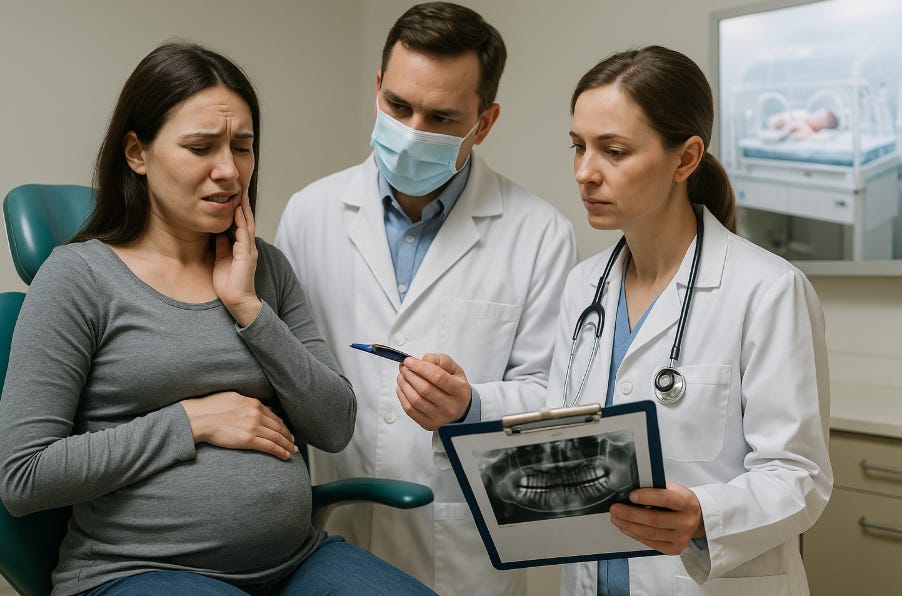
The patient who couldn’t chew
She was in her second trimester, a healthy 28-year-old, glowing with excitement about her first baby. But she came into my office not because of her pregnancy, but because her gums were so swollen and painful she could barely chew. Every time she brushed her teeth, her toothbrush came back red with blood. She was embarrassed, worried, and, most of all, afraid—was this hurting her baby?
This is not a rare story. Periodontal disease, an infection of the gums and supporting structures of the teeth, is surprisingly common in pregnancy. And its importance goes far beyond oral health.
What happens in the mouth does not stay in the mouth
Pregnancy hormones increase blood flow and make the gums more reactive to bacteria. Even women who normally have no dental issues may suddenly develop “pregnancy gingivitis”—red, puffy gums that bleed easily. In some cases, the inflammation progresses to periodontal disease, with infection, pain, and even loose teeth.
This might sound like a local problem, but it isn’t. The mouth is not a closed system. Inflammation and bacteria can spill into the bloodstream. That’s why untreated gum disease has been linked in multiple studies to pregnancy complications, including preterm birth, preeclampsia, and low birth weight.
What the studies show about risks
During pregnancy, many women develop pregnancy gingivitis, a common condition marked by red, swollen gums that bleed easily. Hormonal changes heighten the body’s response to plaque bacteria, making the gums more inflamed than usual. While gingivitis is reversible, if neglected it can progress to periodontitis, where deeper infection damages the bone and tissues that support the teeth. Pregnancy can also trigger a benign overgrowth called a “pregnancy tumor” (pyogenic granuloma) on the gums, which looks alarming but usually resolves after delivery.
Over the last two decades, researchers have looked closely at whether gum disease makes pregnancy riskier. The findings are sobering:
Preterm birth: Several studies suggest that women with untreated periodontal disease may be up to twice as likely to deliver before 37 weeks. Preterm birth is one of the leading causes of infant illness and death worldwide.
Low birth weight: Babies born to mothers with periodontal disease are more likely to weigh under 2500 grams, even when born at term. Low birth weight can affect growth and long-term health.
Preeclampsia: Some data show higher rates of this dangerous pregnancy complication among women with gum disease. Preeclampsia can threaten both mother and baby, leading to seizures, organ failure, or the need for early delivery.
Gestational diabetes: Inflammation in the mouth appears to overlap with metabolic inflammation. Some studies have found more gestational diabetes in women with periodontal disease, though the evidence is still evolving.
Stillbirth and neonatal death: A smaller number of studies even suggest possible links to stillbirth or newborn death, although the evidence here is less consistent and requires more research.
The pattern is clear: inflammation in the mouth is not just cosmetic. It may tip the scale toward complications that every pregnant woman dreads.
The chicken-and-egg problem
Here is where the controversy comes in. Observational studies consistently show that women with severe periodontal disease have higher risks of adverse pregnancy outcomes. But large randomized trials of treating gum disease during pregnancy have had mixed results.
Why the uncertainty? Because timing may be everything. By the time gum disease is advanced in the second trimester, the damage may already be done. Preventing disease before pregnancy may matter more than trying to treat it mid-pregnancy.
Daily habits matter more than most realize
We can’t talk about gum health without talking about flossing. Brushing alone only cleans about 60% of the tooth surface. The remaining 40% hides between the teeth, where bacteria thrive. Flossing daily is the single most powerful, low-tech, low-cost habit to prevent gum inflammation. For pregnant women, it can mean the difference between mild gingivitis and full-blown periodontal disease.
Think of flossing as sweeping the corners of your kitchen. You wouldn’t mop the middle of the floor and leave the crumbs under the cabinets. Yet many people do the equivalent with their teeth every day.
Food: friend and foe for your gums
Pregnancy cravings can push women toward sugary snacks and processed foods, which feed harmful bacteria in the mouth. Sticky candies, soft drinks, and refined carbs are like fertilizer for gum disease. Add smoking and alcohol, both proven to worsen periodontal damage, and the risks rise even further.
But food can also be protective:
High-fiber fruits and vegetables act like natural scrubbers, increasing saliva and helping clean the teeth.
Calcium-rich foods (milk, cheese, yogurt, fortified alternatives) strengthen both teeth and bone.
Vitamin C sources (oranges, strawberries, bell peppers) support gum tissue healing.
Lean proteins and whole grains promote stable blood sugar and reduce the inflammatory spikes that bacteria thrive on.
The simple rule: what is good for your pregnancy overall—fresh, unprocessed, nutrient-dense food—is also good for your gums.
What is often overlooked
Oral health is rarely part of prenatal care. Most women do not see a dentist during pregnancy unless they have pain. Many still believe, incorrectly, that dental treatment in pregnancy is unsafe. In fact, routine cleanings and most dental procedures are safe and recommended.
Insurance coverage is patchy. In the United States, many dental benefits are separate from medical coverage. A pregnant woman may have excellent obstetric care but no access to a dentist. That separation of mouth and body in our healthcare system makes little biological sense.
The stigma of neglect. Women often feel judged if they present with poor oral health, but the reality is that social determinants of health—poverty, access, education—play a large role. Gum disease is not just about brushing and flossing.
Lessons for patients and families
Floss daily. Think of it as non-negotiable, like taking your prenatal vitamin.
Brush twice daily with fluoride toothpaste, and replace your toothbrush every three months.
Avoid smoking and alcohol, both of which worsen gum and pregnancy health.
Choose whole, unprocessed foods. Limit added sugar.
Don’t skip the dentist: cleanings and most treatments are safe in pregnancy.
Lessons for clinicians
Ask about oral health at prenatal visits. A simple question—“When was your last dental checkup?”—can open the door.
Reassure patients that dental treatment is safe in pregnancy. Infections left untreated pose more risk than procedures.
Educate patients on flossing, not just brushing. A quick demonstration in the office can make the advice real.
Advocate for integrated care. Oral health should be part of prenatal care, not treated as an afterthought.
The ethical question
When my patient asked me if her gum disease could hurt her baby, I had to give an honest but uncomfortable answer: we know there’s an association, but we cannot promise that treatment will change outcomes. That uncertainty is hard for both doctors and patients.
It raises a deeper ethical issue: how do we counsel patients when evidence is incomplete? Do we emphasize the risks, or reassure based on the lack of proven causality? I believe the answer lies in transparency. We owe patients the full story: what we know, what we don’t, and why prevention—through daily flossing, healthy food, and regular dental care—is still the wisest path.
Closing reflection
Pregnancy magnifies everything, including gum problems. A bleeding gum may seem small compared to preeclampsia or preterm birth, but it reminds us of an old truth: the body is one connected system. If we treat the mouth as separate from the rest, we miss an opportunity for healthier mothers and babies.
The question I leave you with is this: if flossing daily, eating well, and integrating dental care could reduce pregnancy complications, why are we still leaving oral health out of prenatal care?