
When the Door Stayed Closed: Leaving Germany, 1977
What professional exclusion teaches us about belonging—and why it still matters. The Human Factor — Exploring empathy, bias, and the emotional landscape of care.

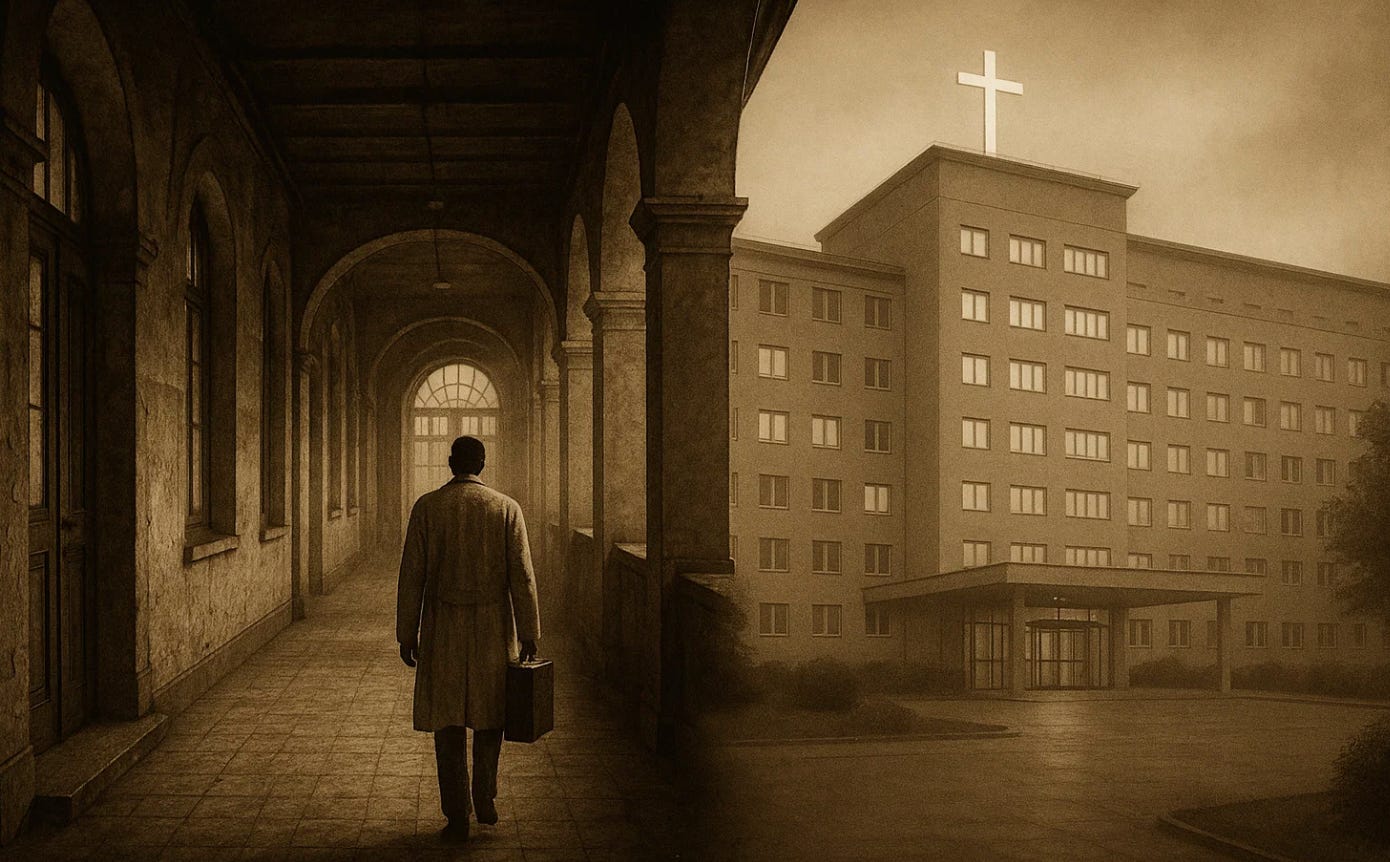
This essay is part of Dr. Amos Grünebaum’s personal reflections on professional identity, belonging, and the lived ethics of medicine.
An Advertisement in 2025 for a leading physician position in Germany: “Erwartet wird, dass sich Kandidaten mit den Werten der christlichen Konfession des Hauses identifizieren können.” (Translated: Candidates are expected to share and identify with the Christian values of the hospital.)

and this too: “Klare Werteorientierung am christlichen Glauben” (“Clear orientation of values in the Christian faith”) in an ad for a “Chefarzt der Klinik für Anästhesiologie, Intensivmedizin und Schmerztherapie”. (Do patients under anesthesia truly care what religious belief their doctor has?).
This, in short, explains why I left Germany in 1977 with a single suitcase, a medical degree, and the quiet realization that no amount of competence could outweigh a name. I had done all schooling in Germany, was the youngest finishin all requirements for medical school at 23, trained hard, published early, and earned the recommendations one needed to rise in academic medicine. Yet when it came time to apply for leadership posts, the conversations grew coded. “We admire your qualifications.” “You’d fit perfectly elsewhere.” and “Where were you born… and where do your parents come from?” Elsewhere, it seemed, meant anywhere but inside their institutions.
The problem wasn’t performance; it was perception. Hospitals described themselves as “Christian institutions committed to Christian values.” The phrase was presented as benign—simply a matter of ethos—but it carried a quiet message. For those of us who were Jewish, or otherwise “other,” it was clear that identifying with “Christian values” was not about shared ethics; it was about belonging. One could work there, perhaps, but not lead.
That unspoken ceiling became impossible to ignore. A department head once told me, “You’d be an excellent chief—but the board would never agree.” He said it kindly, as if explaining the weather. It was not personal, he said—it was “cultural.” That single word summed up everything polite society used to avoid saying outright.
So I left.
In the United States, the first thing that struck me was not the scale of the hospitals or the pace of the medicine—it was the absence of those coded barriers. In New York or Boston, no one asked whether I identified with “Christian values.” They asked whether I could teach, operate, and care for patients. Religion was irrelevant. In fact, bringing in your personal religious believes was considered taboo. The messy pluralism of American medicine was, in that sense, a liberation.
Fast forward to 2025, and the irony persists. In Germany, hospitals that call themselves “Christian institutions” still legally maintain the right to hire according to their religious ethos. The explicit demand that a chief physician be Catholic is rare, but the softer phrasing—“identification with Christian values”—is fully lawful and widely used. European Court decisions have narrowed its scope, yet the language endures. The formality has changed; the filter remains.
To be fair, Germany’s major universities and academic centers have become genuinely inclusive. They are secular spaces where Muslim, Jewish, and non-religious physicians hold professorships and direct departments without issue. Within academia, competence has largely replaced confession. That progress should be acknowledged.
But it remains ethically indefensible that in a modern democracy, the majority of hospitals can still declare themselves “Christian.” These institutions receive public funds, train physicians of every faith, and serve patients from all walks of life—yet they are allowed to maintain a confessional identity that quietly shapes who leads and who does not.
This is not a new problem.
A century ago, German obstetrics was filled with Jewish pioneers. Bernhard Zondek helped identify human chorionic gonadotropin (hCG), revolutionizing pregnancy testing. Selmar Aschheim, his collaborator, co-discovered the Aschheim–Zondek test and established one of Berlin’s first hormone laboratories. Hermann Knaus contributed to the physiology of ovulation, forming the scientific basis for understanding fertility cycles. Ernst Gräfenberg, another Berlin obstetrician, developed intrauterine contraception and the diagnostic use of silver wire sutures long before his name became linked to the “Gräfenberg spot.”
They were brilliant, ethical, and innovative—and all were Jewish. In the 1930s, their careers and lives were destroyed. Zondek fled to Sweden, then Israel. Aschheim was dismissed from his post in Berlin and died in exile in Paris. Gräfenberg was imprisoned by the Nazis, released only after international intervention, and fled to the United States. Others, like Hans Hirschfeld, a hematologist and obstetric researcher, took their own lives rather than face humiliation, professional erasure, or deportation.
The loss was not only personal but scientific. Germany’s obstetrics, once the envy of the world, hollowed itself out by purging its Jewish doctors. The intellectual exile of the 1930s set back women’s health research for decades. If not forever. And though postwar Germany built new institutions, it never fully confronted how deep that wound ran—or how quietly echoes of that exclusion persisted, long after the overt antisemitism was gone.
Paul Krugman once observed that bias endures not because individuals are overtly cruel, but because systems quietly reward the illusion that everything is fair. That illusion was Germany in the 1970s—and, in subtler form, it still is. Institutions claim neutrality even as their rules preserve a particular identity. Economists call it path dependence: yesterday’s structures steering today’s decisions.
Daniel Kahneman would call it System 1 thinking—automatic, moralized, and self-justifying. Hiring committees tell themselves they are defending “tradition,” unaware that they are defending exclusion. Kahneman taught us that good intentions do not erase bias; they make it harder to see.
The Church’s presence in healthcare is historically rooted in compassion, but charity cannot substitute for equity. In a society that calls itself pluralistic, the question is no longer whether church-run hospitals can exist, but whether they should hold a majority of hospital beds in a publicly funded system. In 2025, Germany must decide whether “Christian values” means moral universalism or institutional privilege.
Looking back, I sometimes wonder what might have happened if I had stayed. Perhaps I would have found a niche, an ally, a place to grow. But leaving opened a door that had been firmly shut. In America, I found what every physician hopes for: the freedom to be mostly defined by work, not by faith.
Professional migration is often framed as ambition, but for many of us it was mostly survival. We left not only to advance careers, but to reclaim dignity. And when I mentor young doctors today—of every background—I remind them that inclusion is not a gesture of kindness; it is a measure of justice.
Medicine, at its best, is the one place where belief should never decide belonging.
In 1977 I left Germany because “Christian values” were a hiring requirement. In 2025, they still are—legally. In the U.S., merit finally mattered.