
Secondary Safety: How “Normal Birth” Ideology Endangered Britain’s Mothers
The UK’s midwifery-led maternity model was built on trust and autonomy. But when belief in “natural birth” eclipsed clinical judgment, lives were lost. What the U.S. must learn.

The Midwifery Backbone of British Maternity Care
In the United Kingdom, pregnancy and birth care are anchored in a system where midwives are the primary clinicians. Within the National Health Service (NHS), nearly all women receive antenatal care through midwives, and midwives independently manage the majority of vaginal deliveries. Each year, about 700,000 babies are born across the UK. England alone employs roughly 25,000 full-time equivalent midwives, with smaller but proportionate numbers in Scotland, Wales, and Northern Ireland.
In the United States: In 2022, certified nurse-midwives (CNMs) and certified midwives (CMs) attended 10.9% of all births, and of vaginal births, about 15.9% were midwife-attended, while In the United Kingdom (England): It is reported that “all women giving birth … are cared for by a registered midwife during their labour and birth”. PMC+1
Thus: US midwife‐attendance is ~11% of all births (~16% of vaginal births) and UK midwife‐attendance is effectively ~100% during labour and birth
Midwives don’t just attend births—they run the system. In many NHS Trusts, labour wards and maternity units are led by a Head or Consultant Midwife who holds operational authority for staffing, triage, and escalation to obstetricians. Obstetricians are present, but they intervene primarily when complications arise. The intent is admirable: to normalize birth, reduce unnecessary interventions, and promote continuity of care.
When “Normal” Becomes Dogma
The UK’s embrace of “normal birth” evolved from a well-intentioned effort to humanize maternity care. By the early 2000s, national policy and training emphasized minimizing medical intervention. Hospitals were rewarded for low cesarean rates. Campaigns by professional bodies and childbirth educators celebrated “physiological birth” as the gold standard.
But ideology crept in where judgment should have remained. The 2022 Ockenden Report into the Shrewsbury and Telford NHS Trust exposed the human cost: hundreds of avoidable stillbirths, newborn deaths, and maternal injuries, all linked to an entrenched culture of resisting cesarean sections. One midwife reportedly boasted that only “like-minded” staff who shared the vision of “normality” were recruited.
Former Health Secretary Jeremy Hunt recently broke ranks in The Sunday Times, writing bluntly that “normal birth ideology is killing babies.” His words reflect growing recognition that this belief system—once framed as empowerment—had become coercive. Women who requested epidurals or cesareans were subtly shamed, while clinical warning signs were dismissed to preserve an illusion of natural success.
A Victorian-Age Tragedy
The dangers of this culture are not confined to hospitals. In 2025, an inquest in Manchester heard the harrowing case of Jennifer Cahill, who died along with her newborn during a home birth. A senior coroner described their deaths as “horrors that should be consigned to a Victorian-age nightmare.” Failures in antenatal planning, fetal monitoring, and emergency response were compounded by the absence of national guidance on home birth safety.
Despite repeated investigations, Morecambe Bay, East Kent, Nottingham, Shrewsbury, the underlying problem remains the same: a maternity culture built on ideology rather than evidence. In too many units, success is still measured by cesarean avoidance rather than survival.
The American Contrast: A Different System, a Similar Risk
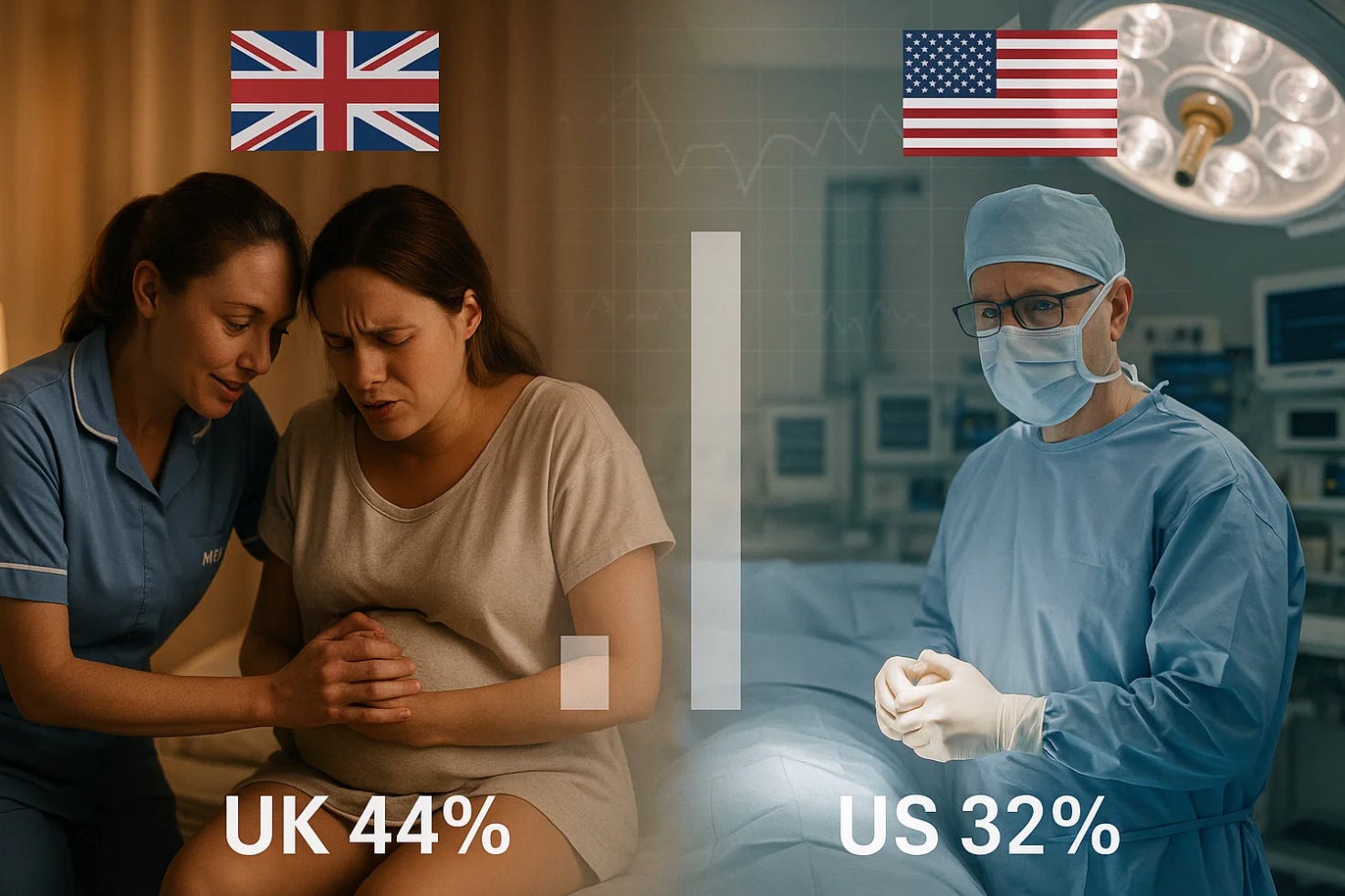
Across the Atlantic, the U.S. obstetric system is nearly the mirror opposite. Over 90% of American births are attended by obstetricians, and cesarean rates hover around 32%, as compared to over 40% in the UK.
The US system is doctor-dominated, highly medicalized, and often criticized for over-intervention. Yet the irony is stark: while the U.S. is accused of too much medicine, the U.K. is reckoning with the consequences of too little.
The American model’s strength lies in rapid escalation, surgical capacity, and clear accountability chains. Its weakness lies in fragmentation and cost. The British system’s strength lies in accessibility, relational continuity, and trust. Its weakness lies in institutional overconfidence in “normality.” Both nations, in different ways, have allowed ideology—whether technological or anti-technological—to override individualization and safety.
Comparing of Cesarean Delivery Rates: Two Systems, Opposite Pressures
The contrast between the United Kingdom and the United States tells a story of two extremes.
In England, the cesarean rate now exceeds 40%, surpassing the U.S. figure of about 32% for the first time in history.
The rise in British cesarean deliveries reflects a corrective shift following years of safety failures linked to delayed intervention under the “normal birth” ethos. Hospitals that once celebrated low cesarean rates are now being judged by their willingness to act swiftly when risk emerges. In the U.S., by contrast, high cesarean rates have long been driven by medicolegal pressure, defensive medicine, and fragmented maternity care that favours intervention. Whereas British maternity services are predominantly midwife-led and have increased cesareans to restore safety, American care is obstetrician-dominated and is trying to reduce them to improve value and patient experience. Both nations reveal how cultural and systemic pressures—whether to avoid or to perform surgery—can distort clinical judgment when safety is not the guiding principle.
Ethics and Autonomy: The Heart of the Failure
True autonomy requires truthful information and safe options. A woman cannot make an informed choice if the system withholds or minimizes risk data to preserve philosophical purity. Midwifery should mean partnership, not persuasion. When “normal” birth becomes a moral ideal, autonomy is replaced by expectation. And when professional duty to protect life yields to belief, the ethical contract between clinician and patient collapses.
As obstetricians and midwives, we must reclaim the principle that safety is the highest form of respect. A cesarean in and by itself is not failure. A well indicated cesarean birth is not a failure. An epidural is not a moral lapse. Birth is neither a performance nor a test of courage, it is a moment that should end with a living mother and child.
Rebuilding the Culture of Safety
Jeremy Hunt has called for a national taskforce led by Baroness Amos to address maternity and neonatal safety. That effort must begin by dismantling the “normal birth” ideology in training, evaluation, and policy. Midwives and obstetricians must be retrained to prioritize escalation, teamwork, and open communication. Regulatory bodies—the Nursing and Midwifery Council, General Medical Council, and Care Quality Commission—must speak with one voice: no metric or belief justifies delayed intervention.
The UK should also look outward. The U.S. system, despite its excesses, can teach the value of redundancy and accountability. Conversely, America could learn from Britain’s relational model of midwifery care. The ethical path forward lies in hybridization, not polarization—a culture that values human connection but never confuses it with infallibility.
The Moral Lesson
The tragedies of Morecambe Bay and Manchester are not failures of individuals but of collective moral drift. When birth ideology becomes an identity, it silences dissent, distorts ethics, and costs lives. The only normal birth is a safe one.
As I see it, in the US CS rate is influenced by money: fear of malpractice and the higher reimbursement.