
When Professional Organizations Fail to Protect: Why ACOG, AMA, and ACP Still Will Not Say “Require” for Chaperones
A critical look at soft guidance, real risks, and the ethics of inconsistent standards

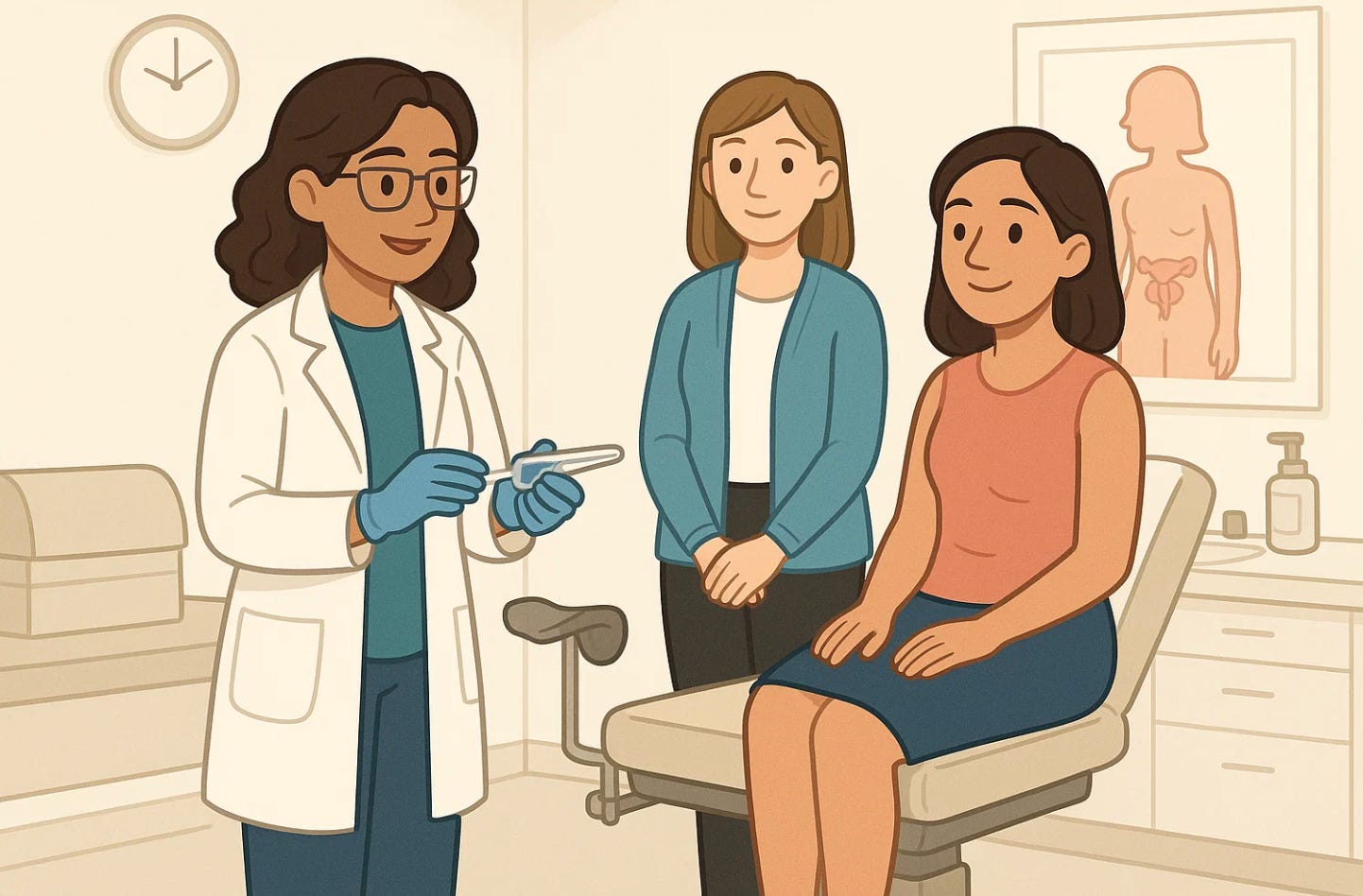
A chaperone is a trained staff member who stays in the room during breast, genital, or rectal examinations. Chaperones protect the patient, protect the clinician, and create transparency and trust during the most vulnerable parts of medical care.
The concept of requiring a chaperone should be simple. The benefits are clear. Yet major professional organizations still avoid the one word that would make this protection universal. None of them say “require”.
Instead they say “recommend”, “offer”, “encourage”, or “should”. These are soft verbs for a high-stakes scenario.
Too Soft verbs used by professional organizations
• Recommend: Suggests an action is advisable but optional. It communicates preference, not obligation, and allows wide variability in practice.
• Offer: Places responsibility on the clinician to present an option but does not obligate either party to follow it. This maintains flexibility but does not establish a standard.
• Encourage: Signals approval or support for a behavior but with no expectation of consistent adoption. It communicates moral support rather than professional duty.
• Should: Indicates strong guidance but stops short of being binding. It implies that clinicians may reasonably deviate based on preference or circumstance.
Mandatory verbs that establish standards
• Must: Expresses a non-negotiable requirement necessary for safe, ethical, or lawful practice. It creates a clear expectation and removes discretionary variability.
• Require: Establishes an enforceable standard of care that institutions and clinicians are expected to follow. It creates accountability and defines what is professionally acceptable.
Where the Guidelines Actually Use “Recommend”
The vagueness is not hidden. It is written directly into the guidance.
ACOG’s FAQ on pelvic exams states: “ACOG recommends that a chaperone be present for all breast, genital, and rectal exams.”
The ACP Ethics Manual says physicians “should offer” a chaperone.
The AMA Code of Medical Ethics says chaperones “may be advisable” and that clinicians “should honor patient requests”.
Nowhere in these documents is there a requirement. Nowhere is there a standard. But there should be.
The Contrast: Where These Same Organizations Do Use Mandatory Language
Professional organizations clearly know how to set firm rules. They do so when they choose to. In other areas of practice, these same groups use the word “require” without hesitation.
Examples include:
• ACOG requires screening for intimate partner violence as part of routine obstetric care in some practice bulletins.
• ACOG requires immediate evaluation for suspected ectopic pregnancy and outlines mandatory steps to rule it out.
• ACOG requires Rho(D) immune globulin administration for unsensitized Rh-negative pregnant women in specific clinical situations.
• AMA requires explicit informed consent before any medical or surgical intervention except in true emergencies.
• AMA requires accurate and truthful certification of death, birth, and other legal documents without alteration or omission.
• ACP requires disclosure when physicians have a financial conflict of interest that might influence care.
• ACP requires adherence to strict boundaries and prohibits physician patient sexual contact with no exceptions.
These are strong, clear, mandatory standards. They reflect seriousness, accountability, and professional expectation.
The question is obvious. If these organizations can require safety actions in other areas, why do they only “recommend” chaperones?
Chaperones Strengthen Autonomy, Not Weaken It
Some believe a mandatory chaperone policy conflicts with patient autonomy. This is a misunderstanding. Autonomy does not mean navigating vulnerability alone. It means being able to make decisions in an environment where power is balanced and safety is assured.
A consistent chaperone policy:
• reduces vulnerability
• improves communication
• supports informed consent
• lowers the risk of coercion or misinterpretation
• allows patients to pause or decline more freely
A safe environment strengthens autonomy. It does not limit it.
The Real Consequences of Soft Language
When guidance stops at “recommend”, patients receive different experiences depending on the clinician, the practice, or the day. Variability creates risk.
Research shows that Black and Hispanic women are significantly more likely to prefer a chaperone, and that patients seeing male clinicians request chaperones more often. This links chaperones directly to trust and equity.
Soft language also leaves clinicians exposed to allegations of misconduct even when they acted appropriately. A neutral witness protects both sides. No clinician should be placed in a position where one misunderstanding can destroy a career.
The Cost of Misconduct: More Than TWO Billion Dollars in Settlements
The consequences of weak boundaries are not theoretical. They have already cost academic institutions well over one billion dollars.
The University of Southern California paid more than 1.1 billion dollars in settlements related to decades of misconduct by campus gynecologist George Tyndall, the largest sexual-abuse payout in higher education.
At UCLA, gynecologist James Heaps led to settlements totaling approximately 700 million dollars, exposing long-standing failures in oversight.
NewYork-Presbyterian and Columbia University agreed to over 700 million dollars in settlements related to former ObGyn Robert Hadden, whose abuse revealed deep institutional breakdowns in reporting and accountability.
These are just a few cases and there are many more that show what happens when institutions rely on soft expectations instead of firm requirements. Mandatory chaperones are not a formality. They are a fundamental safeguard that protects patients, clinicians, and the institution itself.
Institutions Prove That Clear Rules Work
Individual systems have adopted mandatory policies because national groups have not.
The Weill Cornell guideline requires chaperones for all sensitive exams. If a patient declines, the clinician documents the conversation and retains the right to postpone or decline the exam if boundaries cannot be safely maintained.
The American College Health Association uses stronger language, stating institutions must “ensure” the presence and training of chaperones.
These are standards, not suggestions.
Why Do National Organizations Avoid “Require”?
The reluctance is not scientific. It is political and cultural.
1. Concern about administrative burden.
Requiring chaperones obligates institutions to staff, train, schedule, and fund them. Some leaders fear backlash from small practices.
2. Fear of raising the legal standard of care.
If a guideline uses the word “require”, failure becomes a deviation. Organizations worry about liability and litigation.
3. Discomfort confronting sexual misconduct.
Mandatory chaperones acknowledge a painful truth. Rare but serious misconduct exists. Many organizations prefer softer language to avoid highlighting the issue.
4. Misplaced belief that autonomy requires optional safeguards.
This is incorrect. Safety enhances autonomy.
None of these reasons justify avoiding a clear standard.
Why Chaperones Must Be Mandatory
The risk of harm is low, but the consequences are permanent. A single misunderstanding. A single allegation. A single predator. Sensitive exams deserve consistent protection.
A mandatory policy:
• protects patients
• protects clinicians
• reduces inequities
• creates uniform boundaries
• improves communication
• strengthens trust
This should be the national standard. Not a recommendation.
Reflection
Professional organizations know how to require safety when they choose to. They do it in many other areas of practice. The question is simple. If a mandatory chaperone policy protects patients, protects clinicians, and strengthens autonomy, why do ACOG, AMA, and ACP still stop at “recommend”?
The linguistic analysis between recommend and require is crucial here. These organizations clearly understnad how to set mandatory standards when they want to, as you've documented with other safety protocols. The $2+ billion in settlements isn't just a financal argument, it's evidence that soft language has real consequences. Your point about autonomy is especially strong. A safe enviroment doesn't limit choice, it enables it.
I am a retired OBGYN. During my training in Baltimore, having a female chaperone was a requirement. When I started my practice in Chicago 40+years ago, some patients were not used to and didn't like a chaperone. I politely discussed the issue and lost few patients. In my office it was a requirement which I never regretted. I read in a friend's Gyn office: "Notify my office if you prefer a sheparon during the examination." I disagree with it. I think it should be a requirement w/o regard for the doctor's sex.
Jose M Galvez MD