
When Ethics Refused to Wait: The AZT Trial and the Price of Doing Nothing
In 1988, a new drug promised to protect babies from HIV. But medicine’s pursuit of scientific proof came at a moral cost.

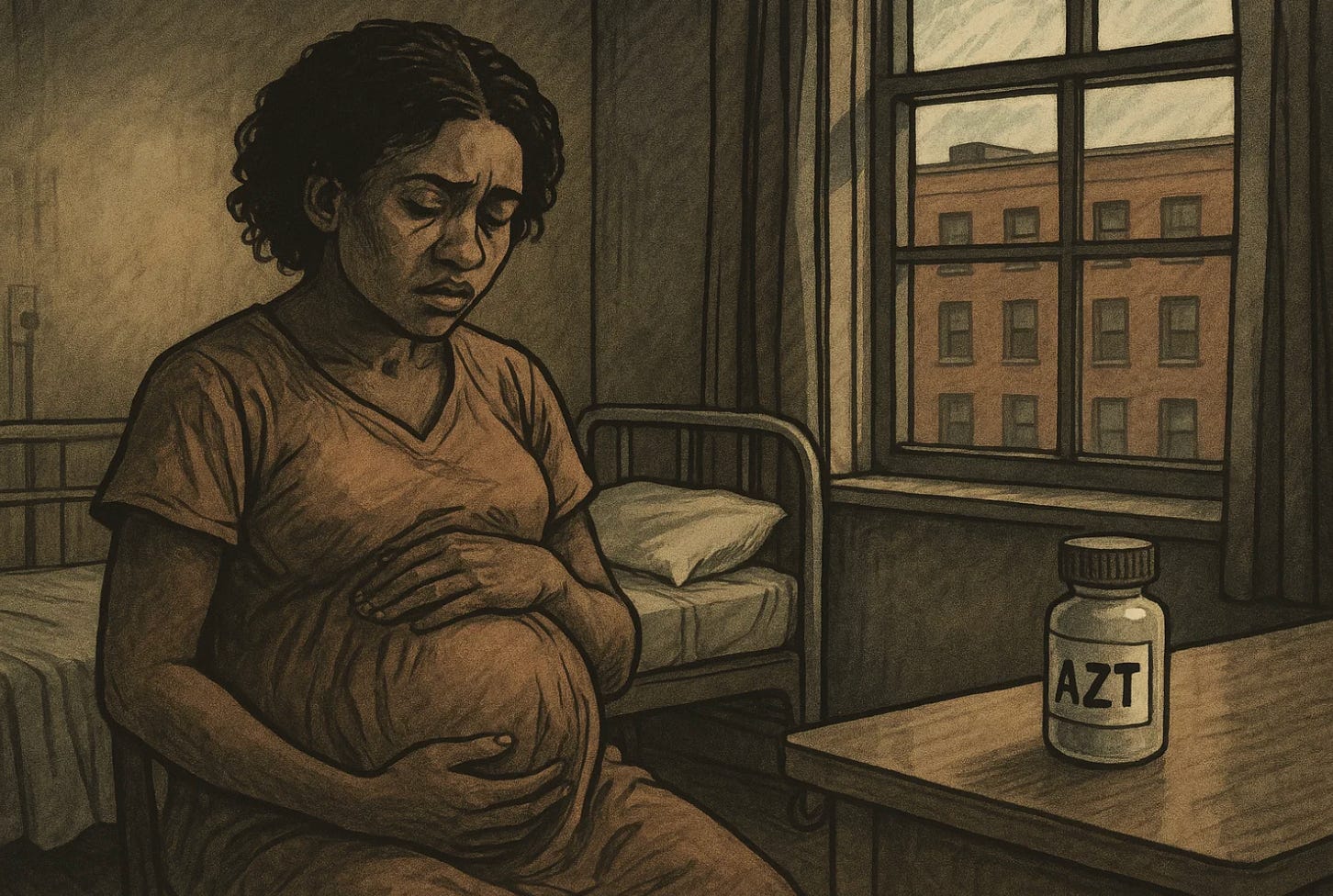
In 1988, I was directing an obstetric unit in Harlem that cared for one of the largest groups of HIV-positive pregnant women in the United States. It was a time of fear, loss, and daily ethical confrontation. We had no effective treatment to protect mothers or babies from the virus. Then came zidovudine—AZT—a drug that showed early evidence of reducing viral load in adults. For those of us on the front lines, the logic seemed clear: if the maternal viral load fell, the baby’s risk of infection should fall too.
Soon after, the AIDS Clinical Trials Group (ACTG) launched a large multicenter study—ACTG 076—to determine whether giving AZT during pregnancy, labor, and to the newborn could reduce vertical transmission. It was a double-blind, randomized study with a placebo control.
Women were asked to participate in a design that meant some would receive no treatment at all. At several centers, an additional stipulation was added: the father also had to sign the consent form.
I declined to participate. To me, the trial was academically elegant but ethically impossible. I gave my patients AZT because it already had biological plausibility, clinical effect, and a favorable safety profile. To randomize them to a placebo meant accepting a foreseeable risk of neonatal infection. I could not justify it.
When ACTG 076 was completed and published in 1994, it confirmed what many clinicians had already believed. AZT reduced mother-to-child HIV transmission by roughly 70%. The study was hailed as a landmark, a triumph of scientific rigor. Yet beneath the celebration lay a troubling question: how many infants in the placebo group became infected so that we could “prove” what clinical observation had already suggested?
This is the paradox of the randomized controlled trial, often celebrated as the gold standard of medical evidence. The design maximizes internal validity, but it does not automatically confer ethical legitimacy.
When uncertainty (equipoise) becomes artificially prolonged in the name of methodological purity, the “gold standard” can turn ethically corrosive. What shines scientifically may darken morally.
The requirement for paternal consent was another layer of injustice. It reflected a time when women’s reproductive autonomy was still filtered through male authority. For many of my patients—often single, stigmatized, and struggling with disclosure—the rule effectively excluded them from access to potentially life-saving treatment. It was not ethics; it was control disguised as protection.
The AZT story is not about one trial or one drug. It exposes the tension between scientific rigor and moral duty. There are moments in medicine when the pursuit of perfect evidence collides with the obligation to prevent harm. Randomization is powerful when uncertainty is real, but when benefit becomes probable and risk foreseeable, continuing to withhold treatment becomes an ethical failure.
Even today, the phrase gold standard is invoked as if it were synonymous with truth. Yet gold, while pure, is also inflexible. The same trial design that can clarify uncertainty can also perpetuate inequity if applied without moral judgment. In global health, we still see placebo-controlled studies in low-resource settings long after benefit has been established elsewhere—an echo of ACTG 076.
The lesson is lasting. Ethics must not trail behind discovery. The “gold standard” (which is not always ethical) should never be worshipped as an end in itself. It is a tool, not a virtue. The highest standard in medicine remains not methodological perfection but moral responsibility—to act when action is justified, to protect when risk is clear, and to remember that no study design should ever cost a child their chance at life.
Reflection:
We call randomized trials the gold standard. But in medicine, gold can blind as much as it shines. The ethical test is not whether a design is pure but whether it is humane. Science must always ask not only Is this rigorous? but Is this right?
Great article and an invitation for science for conceptualize more ethical ways to pursue/define gold standard evidence when biological plausibility and significant evidence is already accepted. I struggle with this as a scientist - studies without a contemporaneous comparison/placebo aren’t seen as impactful, and are certainly difficult to get funded