
When Discomfort Drives Dangerous Choices and Home Births
The Human Factor - The right question is not why do women choose home birth? but why do they feel unsafe where it is safest?

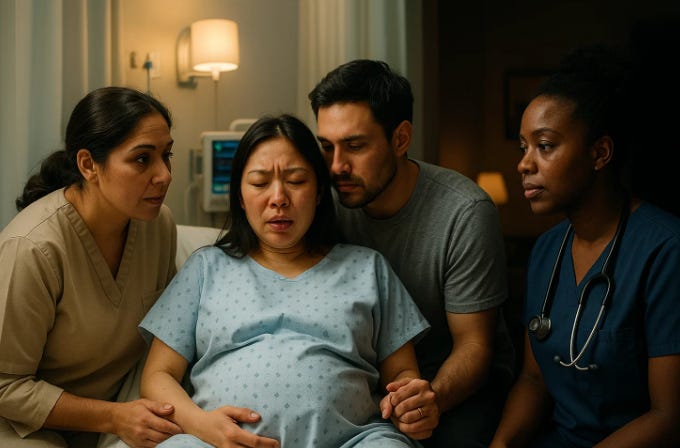
Many women turn to home birth because hospitals make them feel unseen. The answer isn’t escape—it’s conversation.
When Safety Feels Like Control
For many women, labor and delivery in a hospital feel more medical than maternal. Machines beep, staff rotate, and policies—while meant to ensure safety—can feel intrusive. Being told when to push, when to lie down, or when to accept an intervention can make the experience seem impersonal. What was meant to be a shared celebration becomes a controlled environment where women often feel watched, not supported.
This discomfort is not trivial. It speaks to a gap between clinical safety and emotional safety. When that gap widens, women start seeking spaces that feel more humane, and home birth begins to look like an appealing alternative.
Home births have worse Oucomes
Extensive research, including our own analyses of U.S. national birth data, has shown that planned home births are associated with a dramatically higher risk of neonatal death compared with hospital births. Using CDC data covering millions of deliveries, we found that babies born at home have approximately four to ten times higher mortality rates than those delivered in hospitals, even when adjusting for maternal age, parity, and medical risk factors. These excess deaths are not random—they often result from complications that could have been managed or prevented with timely hospital interventions such as cesarean delivery, resuscitation, or treatment of hemorrhage. The data make clear that while most home births end well, the price of even one preventable loss is unacceptable when the same mother and baby would likely have survived in a hospital setting. In obstetrics, proximity to emergency care is not a luxury; it is the difference between life and death.
The Wrong Solution to the Right Problem
Home birth is often not chosen out of ignorance, but out of frustration. Many women who plan home deliveries are educated, thoughtful, and deeply engaged in their care. They want an experience that feels natural and respectful. Yet the problem is not birth itself—it is the failure of the hospital environment to make women feel heard and in control.
But choosing home birth to escape discomfort replaces emotional safety with medical risk. No matter how healthy a pregnancy appears, complications can develop within minutes: postpartum hemorrhage, shoulder dystocia, cord prolapse, or unanticipated fetal distress. These are not predictable, and when they occur outside the hospital, time is lost and lives are endangered.
The right question is not why do women choose home birth? but why do they feel unsafe where it is safest?
Rebuilding Trust Through Conversation
The path forward begins with communication, not confrontation. Hospitals must create a culture where women feel they can express what they want and why. A birth plan should not be a checklist to be tolerated but a tool for understanding. When a woman says she wants minimal monitoring, dim lighting, or delayed cord clamping, she is not rejecting medicine—she is asking to be seen as a person, not a patient.
When caregivers respond with curiosity rather than defensiveness, trust grows. A nurse who explains why a monitor is needed, or a physician who asks, “What matters most to you?” can change the entire emotional trajectory of a birth. Respectful communication transforms the hospital from a place of compliance into a place of collaboration.
The Role of Hospitals in Emotional Safety
Hospitals can and should offer environments that protect both the body and the spirit. The idea that safety requires surrender is outdated. Many labor units now integrate midwives, doulas, and family-centered practices that preserve dignity without sacrificing readiness for emergencies. Allowing mobility in labor, providing music or aromatherapy, using natural light, and keeping interventions evidence-based but optional whenever possible—these small adjustments matter deeply.
Leadership must see emotional safety as part of quality improvement. A woman who feels respected is more likely to consent to care, more likely to trust, and more likely to return. Respect is not a soft skill; it is a safety strategy.
What Women Can Do
Women, too, have a responsibility—to speak up, not step away. The solution to a cold or rigid hospital experience is not avoidance but engagement. Before labor, discuss preferences openly: Who should be present, what kind of environment feels calming, which interventions are acceptable, and what fears need to be addressed.
Providers are far more adaptable when patients are clear about their values. A well-communicated birth plan gives staff the chance to honor personal choices within the boundaries of medical safety. Silence, by contrast, leaves assumptions unchallenged and needs unmet.
The Real Meaning of Empowerment
Empowerment in childbirth does not mean rejecting medical care. It means ensuring that medical care respects women’s humanity. A hospital birth should be a partnership—one where expertise and empathy coexist. When women and providers work as allies, the hospital becomes not an adversary but an ally against danger.
True empowerment lies in being informed, confident, and heard. The best birth is one where both mother and baby are healthy, and both feel safe in every sense of the word.
Reflection
When a woman says she wants to give birth at home, the response should not be judgment but curiosity. Instead of asking, “Why take that risk?” ask, “What made you feel you didn’t belong where it’s safest?” The answer often reveals more about us than about her.
LinkedIn tagline: When women choose home birth out of discomfort, it’s a symptom of poor communication, not defiance. Listening, not leaving, is how we make birth safer.
Hashtags: #Obstetrics #MaternalHealth #BirthExperience #PatientSafety #Communication #EthicsInMedicine #RespectfulMaternityCare
Image prompt (16:9): A softly lit hospital birth room with a midwife and nurse listening attentively to a laboring woman, contrasted with a small home setting in shadow—symbolizing that empathy, not location, determines safety.