
When Autonomy Collides With Risk: What the Free Birth Movement Gets Wrong About Safety
Pregnant women deserve respect and agency, but they also deserve accurate information and competent care.

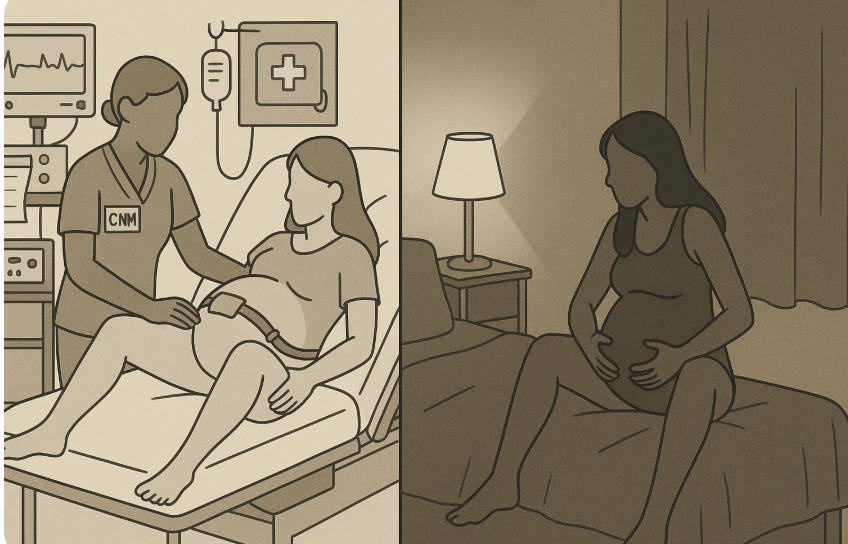
Pregnant women deserve respect and support, but they also deserve accurate information and competent care. The rising appeal of free birth and unqualified “midwives” in the U.S. shows what happens when autonomy is allowed to float unmoored from safety.
A good place to begin is with a plain definition: Free birth refers to intentionally giving birth without any trained medical professional present. In its most extreme form, women avoid prenatal care, decline ultrasound evaluation, and refuse hospital transfer even when complications arise. The adjacent problem in the United States is the growing number of self-styled “midwives” who lack accredited education, standardized training, or regulatory oversight. These individuals present themselves as safe alternatives to obstetric care but operate outside recognized professional frameworks, with no required competencies and no accountability structure.
Recent reporting has brought this into sharp relief. Investigative journalism has documented the Free Birth Society’s online influence, its promotion of “radical responsibility,” and the tragic outcomes that have occurred when preventable complications were met with ideology instead of clinical skill. The Guardian’s investigation, highlighted in the New York Times, described stillbirths, neonatal deaths, and catastrophic harm linked to free birth advice and to leaders who openly state they would not resuscitate newborns because birth should “unfold naturally.” This is not empowerment. It is the abandonment of the basic protections that every pregnant woman and every fetus deserve.
Why is this happening, and why in the United States?
Part of the answer lies in real grievances. Many women have experienced disrespect, dismissal, or coercion in medical settings. The legacy of obstetric racism, unnecessary interventions, and poor communication has created fertile ground for movements that promise sovereignty and control. The problem is that the solution offered is not safer, more humane maternity care but a fantasy of risk-free nature, detached from physiology and from the statistical realities of childbirth.
Another driver is linguistic and regulatory confusion. In the U.S., nearly anyone can call herself a “midwife”. Certified Nurse-Midwives (CNMs) complete accredited graduate education, national board examinations, and hospital-based clinical training. By contrast, many “traditional birth attendants,” “birth keepers,” and “certified professional midwives” complete short courses, online modules, or apprenticeship models with no validated assessment of competence. Their training does not resemble midwifery in countries like the U.K. or the Netherlands. Yet families often do not understand these distinctions. Titles sound equivalent. The risks are not.
What is the ethical question at the heart of all this?
It is the tension between autonomy and beneficence.
Pregnant women have the right to make decisions about their births. But autonomy is not self-justifying. It requires informed choice.
Informed choice requires accurate information, realistic risk communication, and the ability to understand how unpredictable labor can be. The U.S. cannot ethically endorse a system in which women unknowingly entrust their lives and their babies’ lives to attendants who could not pass even the most basic emergency skills assessments.
Home births in the US are associated with up to 10-times increased newborn mortality rates. I know it because we have published over 3 dozen articles on this.
The consequences are not abstract. Free birth and poorly supervised home birth carry increased risks of intrapartum fetal death, neonatal encephalopathy, shoulder dystocia injury, postpartum hemorrhage, and maternal morbidity compared with hospital birth. These risks rise further when attendants cannot perform neonatal resuscitation, manage hemorrhage, or identify fetal compromise. The NYT report underscores how ideology can override recognition of danger, leading to irreversible outcomes.
Maternal autonomy is essential. But autonomy is not enhanced when information is distorted or withheld.
It is not autonomy when women are told that complications are rare “stories from fear-based obstetrics,” or that fetal monitoring is unnecessary because babies “choose” whether to live. It is not autonomy when a pregnant woman is reassured that breech, twins, preeclampsia, or prior cesarean pose “no meaningful risk at home,” despite clear evidence to the contrary. It is not autonomy when a professional title masks the absence of professional standards.
What should we do?
We should confront the problem directly.
First, the U.S. needs national protection of the title “midwife.” Every high-income country with safe home birth requires credentialed midwifery education tied to hospital integration. The U.S. is the outlier. Public misunderstanding will persist until states draw a clear line between licensed, clinically competent midwives and unqualified attendants.
Second, we must invest in respectful, evidence-based maternity care that rebuilds trust. Women seek free birth not because they reject safety but because they reject disrespect. When clinicians listen, communicate clearly, and collaborate, the appeal of extremist alternatives diminishes.
Third, we need transparent reporting of home birth outcomes. Most U.S. home birth data are incomplete or selectively reported. Women deserve the truth about risks so they can make decisions anchored in reality, not ideology.
Fourth, hospitals must reduce the behaviors that inadvertently push women away: unnecessary inductions, inflexible labor protocols, compulsive monitoring without explanation, and interactions that undermine dignity. Safety and humanity are not opposites. We must stop treating them as if they are.
Finally, clinicians must speak plainly. Free birth is dangerous. Untrained attendants are dangerous. Preventable deaths are occurring, and calling this “sovereignty” does not make it ethical.
Reflection / Closing
The ethics of childbirth are not solved by choosing autonomy over safety or safety over autonomy. The task is to create a system where women do not have to choose between them. The question we must ask is simple and uncomfortable. Are we willing to allow preventable maternal and neonatal harm in the name of unexamined autonomy, or are we prepared to build a system where freedom and safety coexist? The answer will determine what kind of maternity care culture we create for the next generation.