What’s Wrong with ACOG’s Public List of Indications for Labor Induction
ACOG’s list of “reasons” for inducing labor is widely circulated and superficially reassuring. Yet, a closer look reveals that it mixes true medical indications with vague conditions and general risk
The American College of Obstetricians and Gynecologists (ACOG) serves as the most influential voice shaping patient education in U.S. obstetrics. Its online “Frequently Asked Questions” pages, such as Labor Induction (updated 2023), are written for the public but carry the authority of professional consensus. Patients, journalists, and even clinicians often treat these summaries as definitive statements of clinical policy. Yet, in simplifying complex risk–benefit decisions into accessible language, these documents sometimes blur critical distinctions between possible, conditional, and clear medical indications.
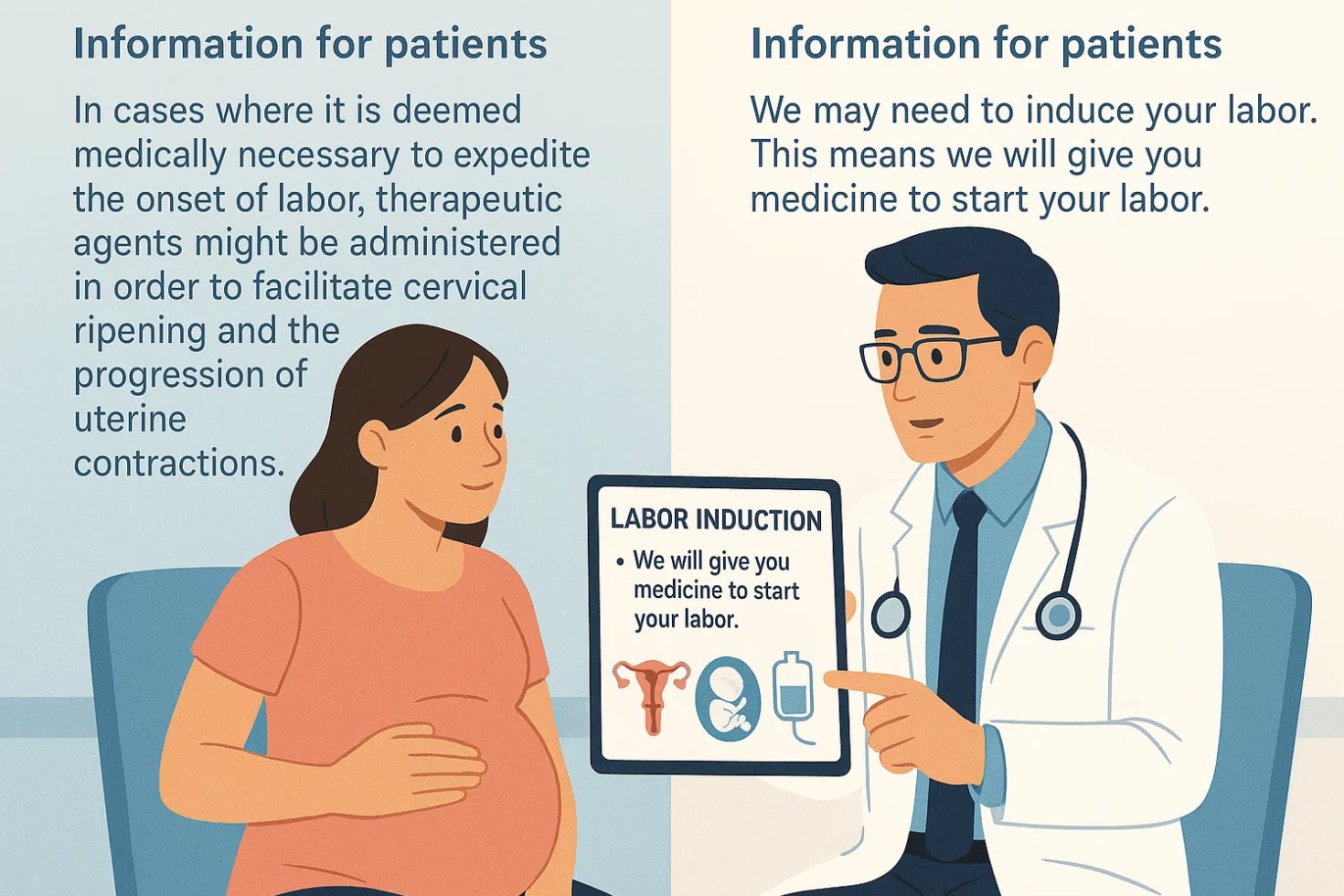
ACOG’s FAQ on labor induction reads at about a 9th-grade level, accessible for many lay readers but still higher than ideal for universal health literacy standards. For true accessibility, patient materials on such a high-stakes intervention should aim for a 6th- to 8th-grade level, as recommended by the AMA and NIH. We have previously published research showing that ACOG’s readability levels are too high: Patient education materials: improving readability to advance health equity. J Perinat Med 2025 Jul 25. doi: 10.1515/jpm-2025-0368. Online ahead of print.
At that level, explanations would use shorter sentences, everyday language, and clear cause-and-effect phrasing—such as “labor is started to protect the health of the mother or baby when waiting is no longer safe.” Simplifying structure without losing accuracy allows patients of all literacy backgrounds to understand risks, options, and alternatives well enough to make informed decisions.
The ACOG description of labor induction exemplifies this tension. It begins with the statement that labor is induced “to stimulate contractions of the uterus in an effort to have a vaginal birth,” followed by a long list of “reasons” for induction that range from prolonged pregnancy to chronic disease. The list reads as both permissive and defensive. It uses broad categories—“problems with the placenta,” “health problems such as heart or kidney disease”—that are neither diagnostic nor specific. While every item might, under certain circumstances, justify delivery, very few are genuine indications for induction as opposed to delivery by other means.
This blending of lay education, risk management, and guideline language creates conceptual confusion. It makes induction sound like the universal answer whenever pregnancy deviates from normal, when in reality, the decision is a nuanced ethical and clinical judgment. The following critique analyzes what is wrong with this list, why it reflects institutional hedging rather than clinical precision, and how it could be reframed to convey evidence-based indications more honestly.
ACOG’s list of “reasons” for inducing labor is widely circulated and superficially reassuring. Yet, a closer look reveals that it mixes true medical indications with vague conditions and general risk factors. The result is a document that sounds comprehensive but lacks diagnostic and ethical precision.
1. Conceptual Vagueness
The first sentence—“Labor is induced to stimulate contractions of the uterus in an effort to have a vaginal birth”—misrepresents the purpose of induction. Induction is not about achieving a vaginal delivery. It is a medical intervention used when the risks of continuing pregnancy outweigh those of delivery. In many situations, the goal is not “vaginal birth” but “safe birth.” By framing induction as a means to achieve a vaginal delivery, the text implies that cesarean delivery is a failure rather than a clinical alternative. This reflects a subtle but important conceptual drift: a focus on process instead of purpose.
Here is an example of vagueness:
The ACOG sentence “Some prostaglandins are not used if you have had a previous cesarean birth or other uterine surgery…” is too weak and potentially misleading.
A medically accurate revision would be:
“Prostaglandins should not be used to induce labor in women who have had a previous cesarean delivery or other uterine surgery because they increase the risk of uterine rupture.”
That statement aligns with ACOG Practice Bulletin No. 222 (2020) and SMFM guidance, which list all prostaglandins as contraindicated in scarred uteri.
This phrasing problem is not minor; it reflects a deeper institutional tendency within ACOG to avoid definitive safety language even when the evidence is unequivocal. By saying “some prostaglandins are not used,” ACOG substitutes cautionary vagueness for a clear safety prohibition. The data on uterine rupture after prior cesarean are among the most consistent in obstetrics. Every prostaglandin preparation increases risk, and all are contraindicated for induction in women with a scarred uterus.
Yet ACOG’s choice of wording leaves room for misinterpretation, as if certain formulations might still be acceptable. This is not patient-centered communication; it is risk management phrased to protect the organization rather than the patient.
Professional responsibility requires unambiguous guidance where preventable harm is well documented. A single sentence, “Prostaglandins should not be used for induction after a previous cesarean or other uterine surgery because they increase the risk of uterine rupture”, would be safer, clearer, and ethically stronger than the current language.
2. Clinical Over-Breadth and Hedging
Many of the listed “indications” are overly broad or misapplied. For example, saying “Your pregnancy has lasted more than 41 to 42 weeks” blurs the difference between a post-term pregnancy that truly requires intervention and a 41-week gestation where enhanced monitoring may suffice. Induction at 41 weeks is a management option, not a medical necessity.
The next group, “You have health problems, such as problems with your heart, lungs, or kidneys”, is medically nonspecific. Some cardiac or renal disorders may indeed require delivery, but others do not. Induction could even worsen maternal compromise if hemodynamic stability is not achieved first.
The statement “There are problems with the placenta” is also clinically incoherent. Some placental conditions, such as abruption or insufficiency with reassuring fetal status, may justify induction. But others, such as placenta previa or accreta, are absolute contraindications to vaginal delivery. This single phrase collapses incompatible clinical realities.
Similarly, “There are problems with the fetus, such as poor growth” is a gross oversimplification. Fetal growth restriction is a spectrum. Some fetuses should be delivered by cesarean because of Doppler abnormalities or compromised reserve. Others can safely undergo induction after 37 weeks. The indication is not “poor growth” but risk of continued intrauterine compromise.
Listing “gestational diabetes or diabetes before pregnancy” is also problematic. Most women with well-controlled diabetes are not induced simply because of the diagnosis. Timing of delivery depends on glycemic control, fetal growth, and antenatal testing results. Here, the diagnosis is a risk factor, not a standalone indication.
The inclusion of “chronic hypertension, preeclampsia, or eclampsia” similarly conflates very different conditions. Severe preeclampsia is indeed an indication for delivery, but “chronic hypertension” is not unless maternal or fetal status deteriorates. The mention of “eclampsia” is particularly misleading; these patients require immediate stabilization, magnesium therapy, and often urgent delivery by the most expedient route—usually cesarean—not elective induction.
Finally, “prelabor rupture of membranes” (PROM) is an incomplete statement. Term PROM usually warrants induction to reduce infection risk, but preterm PROM requires individualized management depending on gestational age, fetal status, and infection markers. A single bullet point cannot capture that complexity.
Taken together, these examples reveal that the list functions more as a medico-legal hedge than a clinical guide. It allows ACOG to appear comprehensive while avoiding specificity that could be misinterpreted as exclusionary. The cost is clarity.
3. Ethical and Communicative Flaws
The ethical weakness of the list lies in how it presents all these conditions as automatic “reasons” for induction. It does not explain that each requires nuanced assessment of risk, gestational age, cervical readiness, and patient preference. There is no mention of shared decision-making, Bishop score evaluation, or alternative management options.
The closing reassurance, “Sometimes labor induction may be needed even if it means that the fetus will be born early”, is scientifically true but rhetorically hollow. It reduces complex maternal–fetal balancing into a vague risk-versus-risk statement without explaining how that determination is made.
By grouping dissimilar conditions together under one heading, ACOG normalizes induction as the default outcome of any obstetric complication. This framing can unintentionally encourage overuse of induction in borderline or elective situations, contributing to rising intervention rates without evidence of better outcomes.
4. A More Accurate Framing
A more honest and clinically precise approach would divide situations into three categories.
First, clear indications, such as post-term pregnancy beyond 42 weeks, severe preeclampsia, chorioamnionitis, or intrauterine fetal demise.
Second, conditional indications, including growth restriction with abnormal Doppler studies, oligohydramnios, or well-controlled diabetes at 39 weeks.
Third, individualized situations, such as chronic disease or term PROM, where careful evaluation and shared decision-making are essential.
In Summary
Most of ACOG’s listed “reasons” are not true indications but broad clinical contexts in which induction might be considered.
The phrasing is deliberately cautious, serving legal defensibility and public readability at the expense of medical precision. It simplifies a complex clinical process into a checklist of loosely defined conditions. It also serves more to “cover” doctors than improving patient safety.
The real risk is not that patients will misunderstand why induction is performed, it is that clinicians will stop articulating the distinction between possibility and necessity. In obstetrics, that difference defines the boundary between ethical practice and over-intervention.


