
What Daniel Kahneman Can Teach Us About Labor, Risk, and the Stories We Tell Ourselves
How a Nobel laureate’s insights on bias and judgment reshape the way we counsel pregnant women and practice obstetrics.

1. Introducing Daniel Kahneman
Daniel Kahneman (1934–2024) was an Israeli-American psychologist whose work reshaped modern understanding of judgment and decision-making. He spent much of his academic life at the Hebrew University of Jerusalem and later at Princeton University, where he deepened his research into human cognition. In 2002, he received the Nobel Prize in Economic Sciences for demonstrating that people systematically deviate from rational decision models, especially when facing uncertainty. His findings revealed that intuition often overrides analysis, even in high-stakes environments. Obstetrics offers a clear example of this. Pregnant women and clinicians alike navigate complex risks, shifting emotions, and uncertain futures. Kahneman provides a rigorous framework for explaining why decisions on labor floors frequently diverge from what statistical reasoning alone would predict.
2. Risk, Emotion, and the Stories That Override Statistics
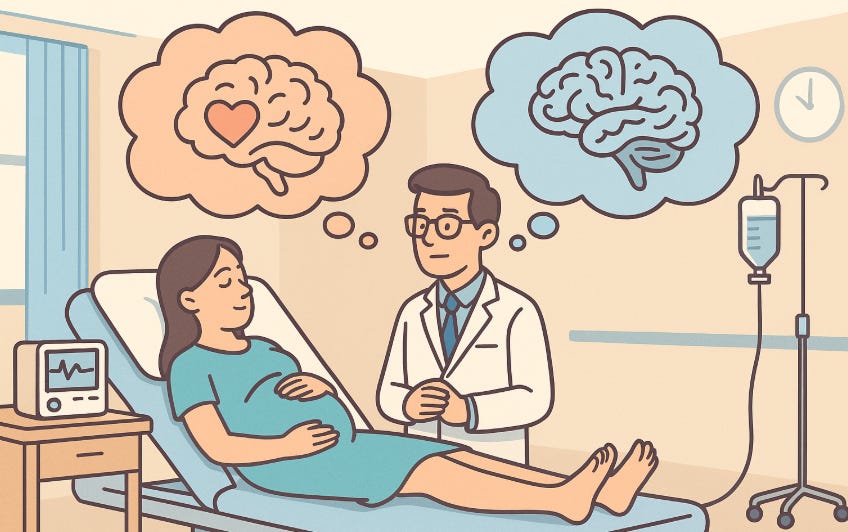
Kahneman’s availability bias explains something obstetricians witness constantly. Pregnant women often judge their own risk by recalling powerful stories, not by reviewing probabilities. A friend’s urgent cesarean, described with emotion and detail, may outweigh entire guideline documents. A striking home birth video may feel more persuasive than population-level morbidity data. Kahneman showed that people unconsciously replace the question “What is likely” with “What can I easily imagine.” Pregnancy heightens this substitution because the stakes feel deeply personal. Women try to protect themselves from the story they fear most, even if that story reflects a very low-probability event. This human pattern shapes decisions about induction, epidurals, birth setting, and timing of cesarean delivery. The emotional vividness of one anecdote often eclipses the statistical relevance of thousands of outcomes.
3. Bias Within Clinicians and the Emotional Memory of Labor Units
Kahneman insisted that experts are as vulnerable to cognitive bias as anyone else. Obstetricians, midwives, and nurses carry emotional memories from prior clinical experiences, especially difficult ones. After a single severe hemorrhage or unanticipated neonatal complication, perceptions of risk shift—sometimes dramatically. Tracings that looked “reassuring” last week now feel borderline. Thresholds for intervention tighten. Trainees quickly sense these shifts and absorb them as part of unit culture. Kahneman would call this a blend of anchoring and loss aversion, the tendency to overweight low-probability catastrophic events because their emotional impact is so great. Obstetrics amplifies this effect. The possibility of fetal harm exerts disproportionate psychological force, shaping judgment even among highly skilled clinicians. Recognizing this pattern is not an indictment. It is an acknowledgment that clinical judgment is inseparable from the clinician’s emotional history.
4. Counseling Through the Lens of Human Cognition
If cognition predicts misunderstanding, counseling must adapt. Kahneman made it clear that humans do not naturally interpret risk numerically. They interpret it narratively. That means the way obstetricians present information matters as much as the numbers themselves. When we describe the risk of VBAC, induction at 39 weeks, or preeclampsia recurrence, women are not simply calculating. They are imagining outcomes, projecting fears, and anticipating regret. Effective counseling must therefore combine data with an explanation of how the mind distorts risk. Saying “This is the actual probability, and here is why it may feel higher” creates more clarity than an avalanche of statistics. Kahneman showed that people benefit when they understand their own cognitive tendencies. In obstetrics, this fosters shared decision-making rooted in honesty rather than in unspoken emotional currents. It respects autonomy by acknowledging the psychological landscape in which decisions are made.
5. Reducing Noise and Strengthening Professional Responsibility
Later in life, Kahneman turned his attention to noise, the unpredictable variability in judgments made by professionals who should, in principle, reach similar conclusions. Obstetrics displays noise everywhere. Two experienced clinicians may interpret the same fetal tracing differently. Cesarean rates vary widely between hospitals with nearly identical patient populations. Counseling about the same risk can diverge by provider or by shift. Kahneman argued that reducing noise is essential for fairness and safety. In obstetrics, this translates into standardized counseling frameworks, clearer communication protocols, and shared mental models during intrapartum care. These strategies do not eliminate clinical nuance. They reduce preventable inconsistency. Kahneman’s message for obstetric practice is ultimately a call for humility. Understanding how bias and noise shape judgment allows clinicians to practice with greater precision and greater honesty. It reminds us that supporting pregnant women requires not only scientific knowledge but an awareness of the mind’s tendencies, including our own.