
What 19th-Century Obstetricians Got Wrong That Still Affects Us Today
Is “The less we intervene, the safer the mother.” still valid today?

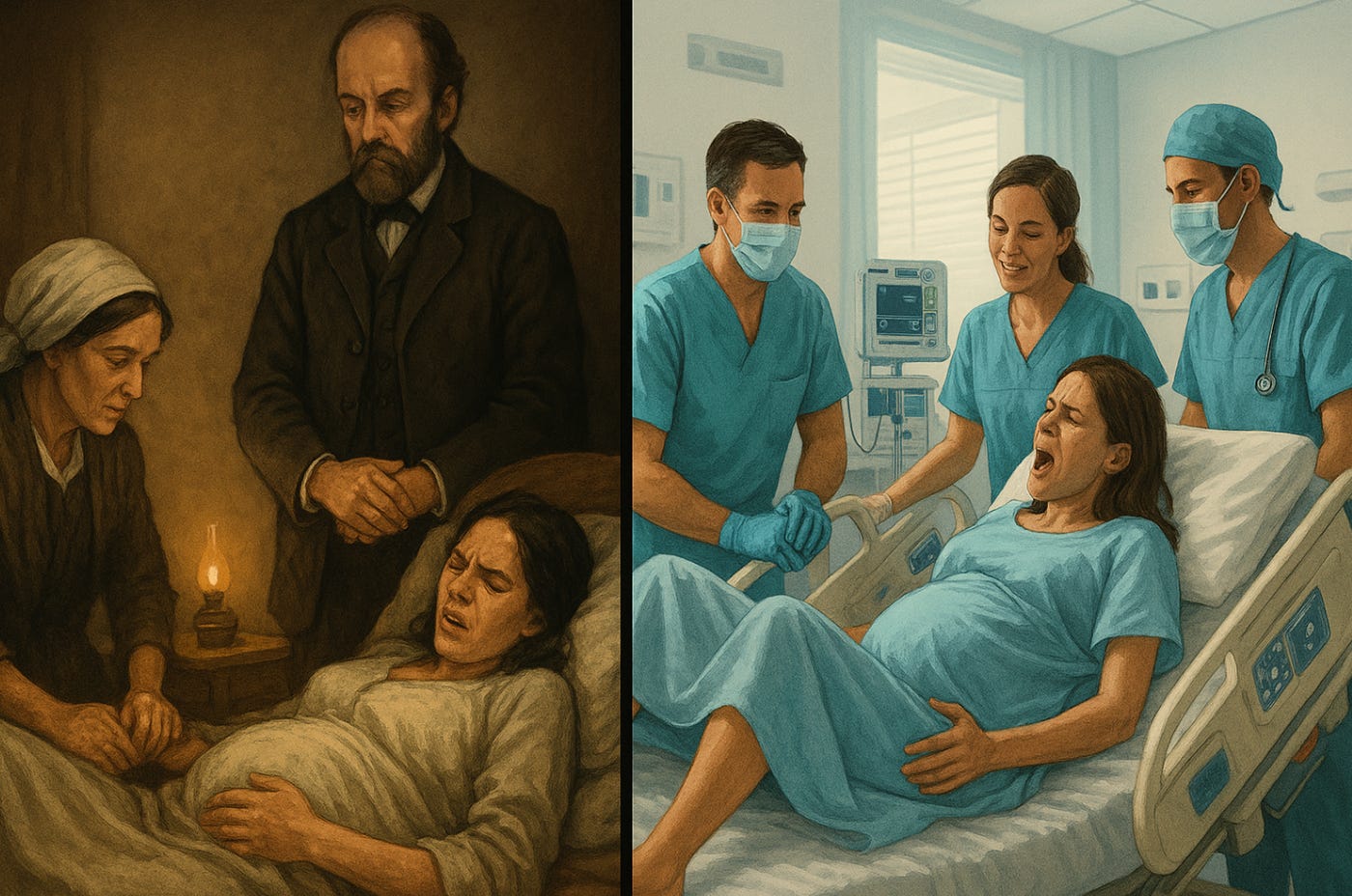
In the late 1800s, many obstetricians proudly declared: “The less we intervene, the safer the mother.” Ironically, at the same time, maternal mortality rates were shockingly high—often 1 in 100 births. Their insistence on “natural” birth, free from surgical help, wasn’t a triumph of wisdom. It was a tragic misunderstanding that cost countless women their lives.
Lessons From the Past
History has a way of shaping how we practice medicine today. In obstetrics, the ghosts of the 19th century still influence how we think about labor, birth, and intervention. Back then, many doctors believed that intervening—using forceps, cesarean sections, or even performing hand-washing—was dangerous or unnecessary. They trusted “nature” more than science.
But “nature” was not kind. Women died from hemorrhage, infection, and obstructed labor. Babies died from lack of oxygen or birth injuries. The truth is simple: childbirth without safe medical support was one of the most dangerous experiences in a woman’s life.
The Analogy: Seatbelts in Cars
Think of it like driving a car without a seatbelt. Yes, most people will reach their destination safely without crashing. But when something goes wrong, the seatbelt saves lives. In obstetrics, interventions like cesarean delivery or antibiotics are the seatbelts of modern medicine. They’re not needed every time, but when they are, they make the difference between life and death.
The Controversy That Still Lives On
Here’s the controversial part: some modern voices still echo the 19th-century belief that less medicine means better birth. Movements promoting “natural birth at all costs,” or home birth without emergency backup, sometimes disguise themselves as empowering. But in reality, they can repackage the same old mistake—ignoring that childbirth is unpredictable and occasionally dangerous.
It is not about dismissing natural birth. For many women, labor progresses smoothly without major intervention. The problem arises when ideology overshadows safety, and when professionals hesitate to act decisively because of misplaced loyalty to “naturalness.”
What’s New and Often Overlooked
The real innovation in obstetrics has never been about choosing between “natural” and “medicalized” birth. It has been about balance—using science to know when to wait and when to act. And to always act ethically. Today we can monitor the fetus in real time, predict preeclampsia before it strikes, and reduce infection risk with simple hygiene measures. These are not intrusions into birth. They are protections.
What’s overlooked is that many interventions—epidurals, cesareans, inductions—are often miscast as failures. In reality, they are success stories of modern medicine. They represent progress, not defeat.
A Practical Lesson for Patients and Families
When you choose where and how to give birth, think like you would when planning a trip. You may hope for smooth weather, but you still pack an umbrella, just in case. Hospitals, obstetricians, anesthesiologists, and operating rooms are not evidence of distrust in nature. They are the umbrella we hope we never need but are grateful to have.
Families should ask their care team:
What is your plan if complications arise?
How quickly can help be mobilized?
What safety nets are in place?
These questions don’t undermine natural birth. They protect it.
A Practical Lesson for Clinicians
For clinicians, the past should remind us not to fall into either extreme: intervening too quickly without reason, or waiting too long out of misplaced trust. Evidence-based medicine and the professional responsibility model demand both humility and courage. Humility to know when nature is working well. Courage to step in when it isn’t.
Why This Matters Ethically
The ethical dimension is clear: our duty is not to nature but to patients. When women and babies face preventable risks, neutrality is not an option. Saying “let’s just wait and see” in the face of danger is not ethical—it is abandonment.
Medicine’s progress over the last century reduced maternal and newborn deaths by more than 90%. That is not an argument to turn back. It is a call to protect what was gained.
Reflection / Closing
History teaches us that “doing nothing” is not neutral—it can be deadly. The question for us today is: How do we honor the beauty of natural birth while refusing to repeat the mistakes of the past?
Exactly. At the end of the day, all we can do is publish, teach, and keep educating—patients, colleagues, and the public. That’s how we counter misinformation and remind people that safety isn’t the enemy of autonomy, it’s what preserves it.
This is so true. However this age of social media has become so toxic. Patients view us as the enemy instead of the healer. The doulas who begin all their advice with “don’t let them” make it almost impossible to practice. The midwives doing trial if labor on 2 prior cesarean at home with no back up but I have to get their permission to act when they dump the sick mother and baby on my doorstep.