
The Whisper Network: When Medicine Stops Listening
The Obstetric Intellect - Why so many women can’t get help for midlife symptoms—and what it says about how American ObGyn has lost its voice.

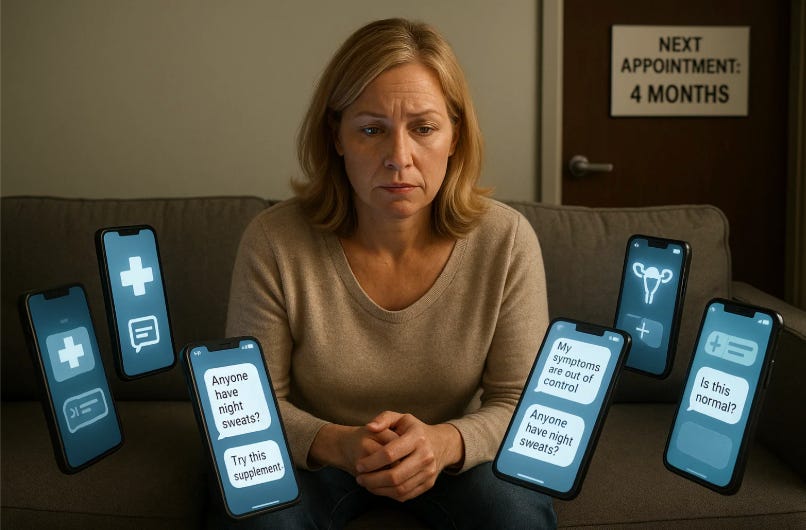
When American OB-GYNs are too busy “doing” to listen, women turn to WhatsApp for care. Perimenopause is exposing the moral cost of a healthcare system that doesn’t pay for time. It pays for procedures.
Perimenopause marks the hormonal transition between the reproductive years and menopause, often beginning in a woman’s 40s but sometimes earlier. It can last many years, even decades. Estrogen and progesterone levels fluctuate unpredictably, causing symptoms like insomnia, hot flashes, mood changes, and irregular bleeding. Though universal and entirely normal, this phase has been poorly understood and rarely prioritized in medical training, leaving many women to navigate it alone or seek answers outside traditional medical care.
Perimenopause is not a mystery of nature. It’s a predictable, physiologic transition that happens to half the human race. Yet in the United States, finding a doctor who will talk about it can feel like trying to get into a secret club - one that only accepts patients who “know someone.”
Let’s start with what perimenopause actually is. It’s the years leading up to menopause, when estrogen and progesterone begin to fluctuate and the menstrual cycle becomes irregular. It can bring hot flashes, brain fog, hair loss, night sweats, insomnia, weight changes, mood shifts, and vaginal dryness. Most women will experience some of these. None of it should be mysterious. Yet across the country, it’s becoming a scavenger hunt for care.
Many American women discover that their OB-GYNs - the very specialists expected to guide them through the reproductive lifespan - are largely unprepared to address perimenopause. Annual visits are often reduced to five-minute checkups focused on Pap smears and contraception. Patients report being dismissed with phrases like “you’re too young” or “it’s just stress.” The result: millions of women turn to book clubs, WhatsApp groups, or Instagram threads for medical advice their doctors never offered.
This silence isn’t accidental. It’s structural.
The Economics of Listening
In modern American Ob/Gyn, time doesn’t pay. Procedures do. Deliveries, surgeries, and IVF cycles generate income; counseling does not.
It’s no wonder that reproductive endocrinologists, the IVF doctors, often pivot to selling “hormone optimization” or “menopause management” packages that promise vitality, youth, and balance.
A single IVF cycle can cost $20,000 to $40,000, most of it cash, and many clinics have learned that the same women seeking fertility treatments may later be drawn to other profitable “wellness” procedures.
The business model naturally expands: hormone pellets, compounded estrogen creams, thyroid “tuning,” Botox, fillers, cosmetic labiaplasties, and “vaginal rejuvenation” surgeries—all cash-based services that can cost thousands of dollars each and require no insurance oversight. In this hybrid space between reproductive medicine and beauty marketing, the financial incentives are clear. Time spent counseling earns nothing, while every injection, cycle, or incision pays.
Meanwhile, the average Ob/Gyn visit lasts seven minutes face-to-face. That’s barely enough to address one problem, much less unravel the complex hormonal, emotional, and relational changes of perimenopause. Clinicians aren’t heartless; they’re trapped in a system that punishes time and rewards volume.
The Whisper Network
Out of that void, a “whisper” network has emerged. Women text one another the names of “good” doctors, ones who listen, who take insurance, who actually discuss hormone replacement therapy (HRT). This underground exchange of medical leads has become as essential as a prescription.
Telehealth startups have jumped in to fill the gap. Platforms like Midi and Alloy Health now market themselves as the empathetic alternative to rushed OB-GYN practices. They offer virtual hormone consultations and overnight prescriptions. All fdor good $$. For some, this is a lifeline. For others, it’s just another paywall.
$Billions are invested in these companies, and most of these companies rely on direct-to-consumer advertising and out-of-pocket fees. Once again, access depends on income.
A Professional Failure
The failure here isn’t technological—it’s professional.
When women report fatigue, brain fog, or sexual pain, they are describing real physiologic shifts. Dismissing them as “stress” or “aging” is not evidence-based medicine. It’s neglect.
Part of the blame lies in how obstetrics has defined its boundaries. For decades, OB-GYN training emphasized what one doctor called “bikini medicine”: breasts, uterus, ovaries. Everything between puberty and pregnancy was fair game; everything after was an afterthought. That mindset persisted even as life expectancy increased and menopause became one-third of a woman’s life.
The 2002 Women’s Health Initiative study—widely misreported—only deepened the retreat. When early headlines suggested that hormone therapy caused heart attacks and cancer, doctors stopped prescribing it. What many missed was that the study’s risks applied mainly to women over 60 starting therapy late. For women in their 40s and 50s, evidence now shows that HRT is both safe and beneficial for most. But the damage to public and professional confidence remains.
The Bigger Picture
This isn’t just about menopause. It’s about a profession that has allowed financial incentives and bureaucratic constraints to silence its own human core. American obstetrics has become a field of “doers,” not “discussers.” The averag ObGyn makes over 3-4 times their European counterparts, and much more for procedures. The same problem shows up elsewhere: contraception counseling rushed into two minutes, miscarriage care outsourced to urgent care, postpartum depression treated as an afterthought.
We’ve built a healthcare economy that reimburses doing, cutting, scanning, and injecting—but not explaining. When a woman wants to talk about why her periods are erratic or why sex has become painful, she’s not asking for a luxury service. She’s asking for medicine.
What Needs to Change
Reform must start in residency. Future OB-GYNs need structured, evidence-based education on perimenopause, menopause, and sexual function—not as electives, but as core clinical competencies.
Health systems must change reimbursement models to pay for time and communication. A 30-minute visit discussing hormonal therapy, sexual health, or lifestyle medicine is worth as much as any ultrasound or biopsy. But gets reimbursed at 1/10th that.
Finally, professional societies like ACOG must reclaim the narrative. It should not take celebrity podcasts or influencer clinics to tell women that perimenopause is real and treatable.
The ethical principle of beneficence demands more than doing procedures—it requires doing good. That means listening.
Reflection / Closing:
Medicine shouldn’t depend on a whisper network. When the only way to find care is through a friend’s text thread, the system has already failed. The next revolution in women’s health will not come from a new hormone patch or an app; it will come when doctors are paid, trained, and expected to listen.
Will we keep building clinics that “do more,” or finally rebuild one that hears better?
Here are seven trustworthy, non-commercial resources that genuinely support women through perimenopause and menopause:
1. Let’s Talk Menopause – A U.S. nonprofit dedicated to education and awareness. It offers free webinars, podcasts, and resources to help women understand perimenopause without pushing products.
https://www.letstalkmenopause.org
2. National Menopause Foundation – Focused on building community and advocacy around midlife health, this foundation provides fact-based education and public health resources.
https://nationalmenopausefoundation.org
3. The Menopause Society (formerly NAMS) – A respected nonprofit professional society that also runs public education campaigns and a free directory of certified menopause practitioners. https://menopause.org
4. The Menopause Foundation of Canada – A national charity working to improve awareness, research, and workplace support for women in perimenopause and menopause.
https://menopausefoundationcanada.ca
5. Society for Women’s Health Research (SWHR) – A Washington-based nonprofit advocating for research and policy that address women’s unique health needs, including hormonal transitions.
6. The Menopause Charity (UK) – Founded by medical professionals and patient advocates, this UK charity offers clear, evidence-based information and free support for women experiencing menopause.
https://themenopausecharity.org
7. Daisy Network – A UK-based charity providing education, emotional support, and peer connections for women with primary ovarian insufficiency and early menopause.