
The Sleep Decoder and it's Impact on Women's Health
A massive new study in Nature suggests that while we sleep, our bodies are actually broadcasting a complex news report about our future health

Here is an observation on the groundbreaking new sleep study, focusing on its potential impacts on women’s health.
Article: “A multimodal sleep foundation model for disease prediction”
Journal: Nature Medicine 2026
We spend about one-third of our lives asleep. For a long time, we thought of this time as just “powering down” to recharge. But a massive new study suggests that while we sleep, our bodies are actually broadcasting a complex news report about our future health. The problem was, we didn’t speak the language—until now.
Researchers have developed a new artificial intelligence tool called “SleepFM”. Published in the journal Nature Medicine, this study shows how AI can “listen” to the data our bodies produce at night to predict diseases years before they happen.
Here is the synthesis: The researchers gathered a massive library of sleep data—over 585,000 hours of recordings from more than 65,000 people. This wasn’t just tracking movement like a Fitbit. They used “polysomnography,” the gold standard of sleep tracking, which records brain waves, heartbeats, eye movements, muscle activity, and breathing all at once.
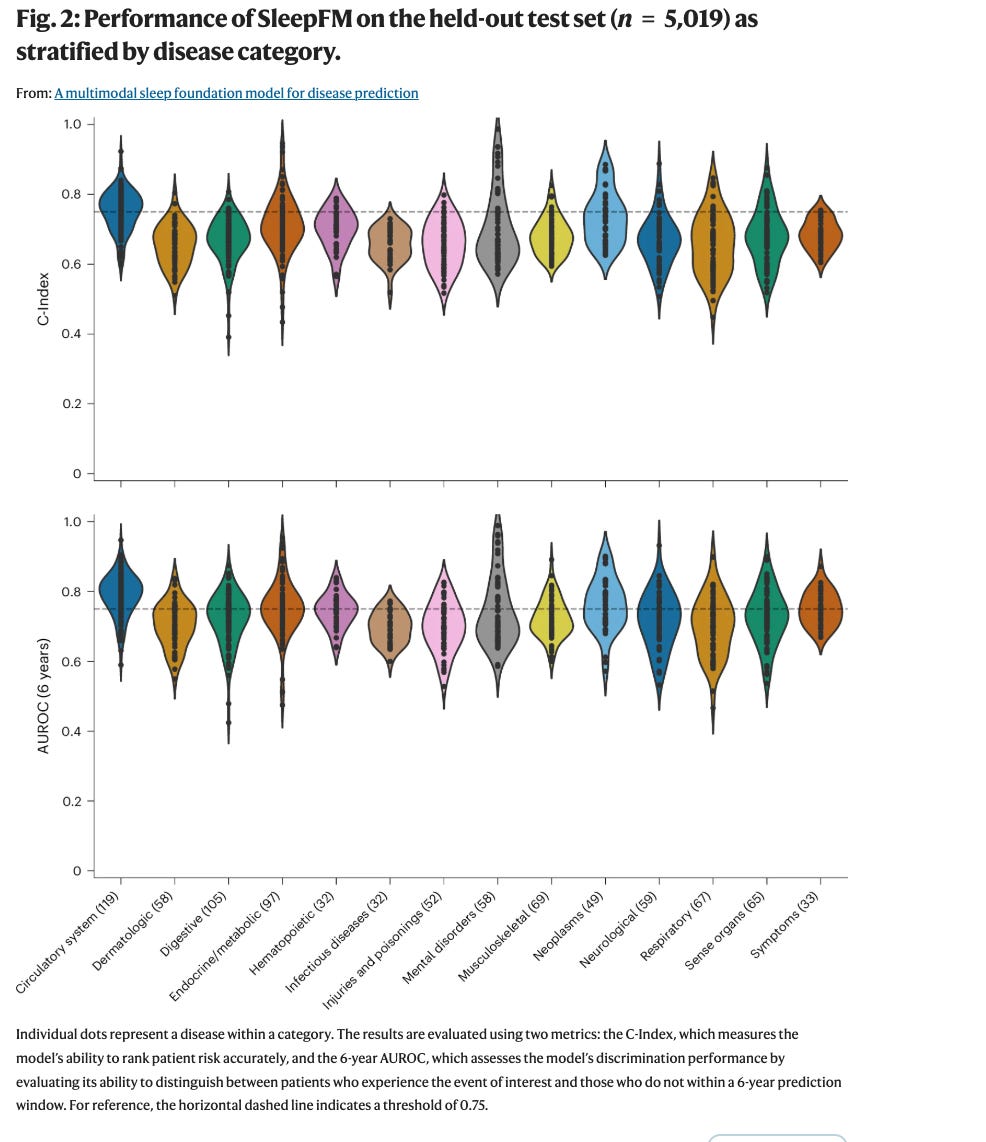
By feeding this massive amount of data into their AI model, the computer learned to spot hidden patterns that human doctors might miss. The result? From just one night of sleep data, this tool could accurately predict the risk of 130 different conditions. These weren’t just sleep problems; they included heart failure, dementia, kidney disease, and even certain types of cancer.
This is a major leap forward because it turns a standard sleep test into a crystal ball for your overall health. It moves us from simply asking “Did you sleep well?” to asking “What is your sleep telling us about your heart, your brain, and your future?”.
Impact on Women’s Health
Historically, medical research has often focused heavily on male subjects, leading to a “data gap” in women’s health. This new study is significant because it included a very large and diverse group of people. For example, in the main group of data used (the Stanford Sleep Clinic cohort), over 13,000 participants were female. This ensures that the AI isn’t just learning from men; it is learning from women, too.
The model showed it was incredibly accurate at identifying biological sex from sleep signals alone, achieving a very high accuracy score (AUROC of 0.86). This proves that male and female bodies behave differently during sleep in ways that machines can recognize and analyze.
More importantly, the model showed strong predictive power for diseases that specifically or disproportionately affect women. For instance, the study explicitly mentions the model’s ability to predict risk for breast cancer with high accuracy (AUROC 0.90). This is a game-changer. Usually, assessing cancer risk involves blood tests, genetic screening, or imaging. The idea that a non-invasive sleep test could flag someone as “high risk” for breast cancer allows for earlier screening and better prevention.
Furthermore, because the model looks at the whole body—combining heart, brain, and breathing signals—it creates a complete picture of a woman’s health. It moves away from looking at symptoms in isolation and starts connecting the dots between how a woman sleeps and her overall physical safety.
Impact on Menopause
While the study does not explicitly break down a “menopause” category, the capabilities of SleepFM directly address the major health risks that rise significantly for women during and after menopause. Menopause is a time of drastic hormonal change that often disrupts sleep architecture, but it also marks a period where cardiovascular risk skyrockets.
The study found that SleepFM is exceptionally good at predicting heart issues. It predicted heart failure with 80% accuracy and stroke with 78% accuracy. This is vital for menopausal women because the loss of estrogen can leave the heart more vulnerable. By analyzing the electrocardiogram (ECG) data collected during sleep, the model can spot the subtle signs of heart disease that often go unnoticed in women until a major event occurs.
Additionally, sleep disturbances like insomnia and sleep apnea become much more common during menopause. SleepFM proved it is competitive with expert human doctors in “staging” sleep—identifying exactly how much time a person spends in deep sleep versus light sleep or REM sleep. It can also diagnose sleep apnea with high accuracy.
For a woman going through menopause, this technology could validate her struggles. Instead of just being told “it’s just hormones,” this model can quantify exactly how her sleep quality is degrading and link those specific sleep patterns to long-term risks like “hypertensive heart disease” (high blood pressure affecting the heart). It provides the hard data needed to justify better heart monitoring and lifestyle interventions during this critical transition period.
Impact on Pregnancy
Pregnancy places a massive physiological load on the body, affecting the heart, lungs, and sleep cycles. One of the most promising findings in this report is the model’s ability to predict “pregnancy complications”. The text explicitly lists this category as one where SleepFM demonstrates strong results.
During pregnancy, conditions like preeclampsia (dangerously high blood pressure) or gestational diabetes can develop silently. SleepFM’s ability to analyze “circulatory conditions” and “metabolic disorders” suggests it could act as an early warning system. For example, the model was successful at predicting Type 2 diabetes outcomes. Since gestational diabetes shares similar metabolic markers, identifying these risks through sleep patterns could help doctors intervene sooner to protect both the mother and the baby.
The safety of this approach is also a major benefit. Many medical scans (like X-rays or CT scans) are avoided during pregnancy due to radiation risks. A sleep study, however, is completely non-invasive. It simply involves wearing sensors while resting. The study shows that the model uses respiratory signals (breathing) to predict metabolic disorders effectively. Since pregnancy physically crowds the lungs and changes breathing patterns, having an AI that can distinguish between normal pregnancy changes and dangerous disease markers is incredibly valuable.
This tool essentially turns sleep into a safe, nightly check-up for pregnant women, potentially catching complications that standard prenatal visits might miss between appointments.
Impact on Postpartum
The postpartum period is often defined by sleep deprivation, but it is also a time of significant mental and physical vulnerability. One of the standout features of SleepFM is its ability to predict “mental disorders”. The study found that brain activity signals (EEG) collected during sleep were the strongest predictors for mental and neurological conditions.
Postpartum depression and anxiety are serious conditions that affect millions of new mothers. Often, the symptoms are dismissed as just “new mom exhaustion.” However, SleepFM’s ability to analyze sleep architecture—specifically the breakdown of REM and non-REM sleep—could offer objective markers for mental health struggles. The study notes that sleep disturbances often happen before the clinical onset of psychiatric disorders. This means the AI could potentially flag a new mother as being at high risk for depression based on her brain waves at night, long before she feels the full weight of the symptoms.
Furthermore, the model’s data-driven approach to “sleep staging” is crucial here. New mothers experience fragmented sleep. SleepFM can quantify exactly how much deep, restorative sleep is being lost. This isn’t just about feeling tired; chronic loss of specific sleep stages is linked to long-term cognitive decline and cardiovascular issues. By accurately measuring this fragmentation, healthcare providers could prescribe better support systems or interventions for postpartum women, treating sleep not as a luxury they are missing, but as a vital health metric that needs to be stabilized for their long-term well-being.
Final Comment
The “SleepFM” model represents a massive shift in how we view health. For years, we have treated sleep as a passive activity. This study proves that sleep is actually an active, data-rich state that holds the keys to our longevity.
By training AI on hundreds of thousands of hours of human hibernation, we have unlocked a new diagnostic tool. It is label-efficient, meaning it learns from raw data without needing a human to tag every single second of it. This makes it scalable.
As wearable technology advances, we may soon see versions of this tech in our own homes. Imagine a smart watch or a sleep ring that doesn’t just tell you that you slept poorly, but warns you to check your heart health or screen for a metabolic issue based on the “language” of your sleep. For women’s health especially—an area often reliant on self-reporting and subject to dismissal—this objective, data-hardened approach offers a new frontier of validation and early protection.