
The Real Danger Isn’t AI. It’s Us.
Doctors who fear algorithms forget that medicine’s most lethal errors have always been human. The Responsibility Clause — Ethical reasoning at the crossroads of autonomy, duty, and professionalism.

Every few weeks, another headline warns that artificial intelligence will harm patients. “AI could make fatal mistakes,” the critics say. “Doctors must be careful.” But here’s an uncomfortable fact: medical errors already kill over 250,000 Americans every year—about 9.5% of all deaths—making them the third leading cause of death in the United States. Those deaths are not theoretical. They are happening right now, without AI’s help.
Physicians fear AI’s mistakes while ignoring their own. The third leading cause of death in America is human error—not artificial intelligence.
If we’re going to talk about danger in medicine, let’s start with the one we already tolerate.
What Is AI and What Is GAI?
Artificial Intelligence (AI) refers to the use of computer systems that can perform tasks typically requiring human intelligence—such as recognizing patterns, learning from data, solving problems, or making predictions. AI already touches everyday life: when your phone unlocks with facial recognition, when an app predicts traffic, or when a hospital computer flags abnormal lab results.
Generative Artificial Intelligence (GAI) is a newer branch of AI that doesn’t just analyze information—it creates it. Using large language models trained on vast amounts of data, GAI can write text, summarize research, generate images, compose music, or even simulate a medical conversation. In healthcare, GAI can help clinicians draft documentation, explain diagnoses to patients, or generate decision-support tools. The key difference is that traditional AI detects and predicts, while GAI can generate new and useful content from what it has learned.
The Mirror, Not the Monster
Many physicians frame AI as a threat to their judgment, professionalism, or moral authority. But the truth is that AI is not a monster; it’s a mirror. It reflects the weaknesses already embedded in our systems: poor communication, fragmented care, decision fatigue, and inconsistent application of evidence.
The same clinicians who say, “AI will make mistakes,” often ignore that human clinicians already do—constantly. Diagnostic errors, medication mix-ups, wrong-site surgeries, missed sepsis, and delayed responses to alarms are not futuristic risks. They’re everyday events.
When we look at AI and see danger, we’re really seeing a reflection of our own discomfort with accountability.
The Stethoscope Analogy
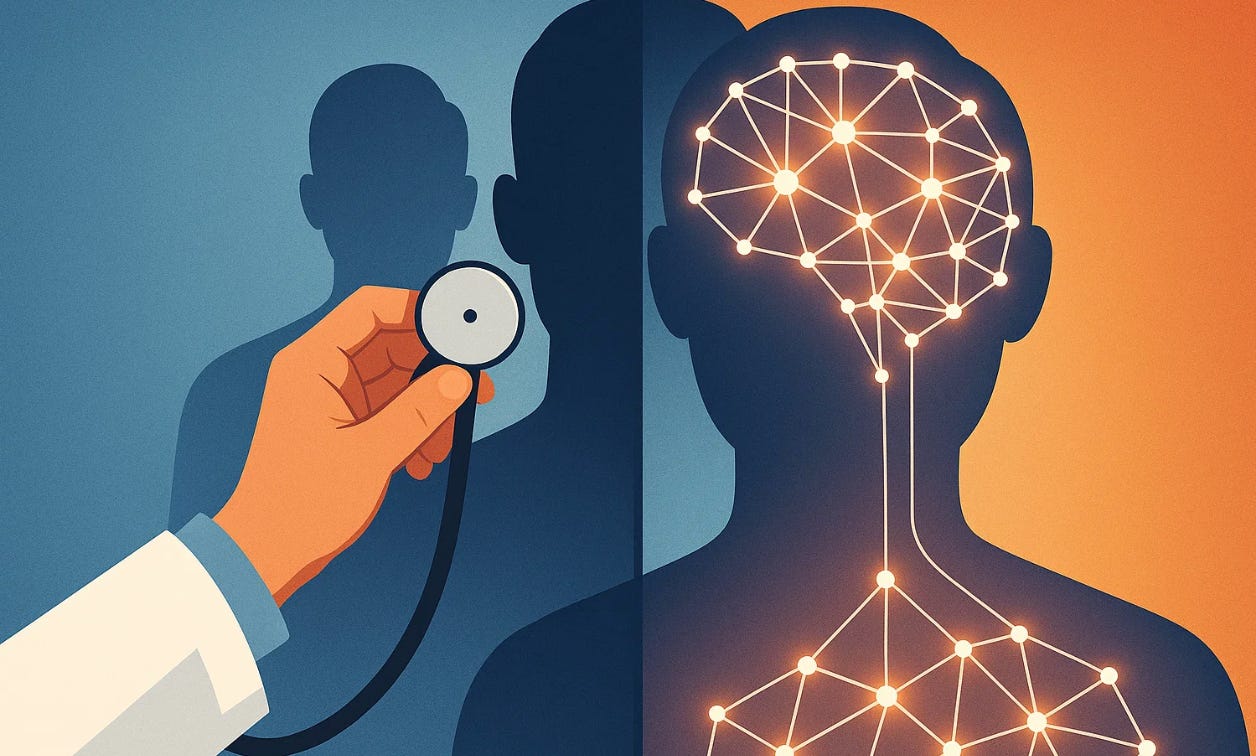
Think of it this way: a stethoscope can amplify heart sounds, but it cannot interpret them. The physician does that. If the diagnosis is wrong, the tool doesn’t take the blame. The same will be true of AI. Large language models and diagnostic algorithms can support reasoning, suggest possibilities, or detect patterns invisible to the human eye. But they do not “decide.” The physician still holds the pen, signs the order, and bears responsibility for the outcome.
Blaming the tool for a human decision is not ethics. It’s evasion.
The Accountability Crisis
Long before AI, medicine has had an accountability problem. We have built a culture where error is normalized, where “bad outcomes” are discussed behind closed doors, and where peer review is too often defensive rather than corrective.
Instead of seeing AI as a scapegoat, we should see it as an opportunity to fix that culture. Algorithms don’t need to protect their reputations. They don’t lie about what they missed. They record every decision, timestamp every variable, and provide a transparency that medicine has long avoided.
This is what truly frightens many physicians—not that AI will make mistakes, but that it will expose theirs.
What AI Can Actually Do
AI cannot replace the human relationship that defines good care. But it can help prevent the catastrophic errors that define bad care. It can:
Flag sepsis before it’s visible to the eye.
Cross-check drug interactions at 3 a.m. when the team is exhausted.
Remind a clinician that the creatinine is rising, that the fetal tracing is deteriorating, or that a test result was never followed up.
Catch what human attention, dulled by overwork, might miss.
These aren’t science fiction examples. They are already happening in hospitals that use AI responsibly—with improved safety outcomes and fewer preventable deaths.
Ethics of Blame vs. Ethics of Use
The ethical question isn’t whether AI will make mistakes. Every tool in medicine—from scalpels to statins—has risks. The ethical question is whether we are willing to use it responsibly, transparently, and accountably.
True ethics requires humility. It means saying: yes, we make errors. Yes, AI will sometimes make errors too. But together, human and machine can make fewer errors than either alone.
The moral failure isn’t in adopting AI. It’s in refusing to improve because we’d rather defend our pride than protect our patients.
From Fear to Stewardship
AI in healthcare must be guided by clear principles: safety, oversight, data transparency, and patient consent. But stewardship does not mean paralysis. It means engagement. It means training clinicians to use AI critically and ethically, just as they were trained to use stethoscopes, ultrasound machines, and EHRs.
Every generation of physicians has faced a new tool that challenged their identity. The printing press, the microscope, the X-ray, and the computer were all accused of “dehumanizing medicine.” Yet each, when used wisely, saved lives.
We can do the same with AI—if we stop treating it as an intruder and start treating it as an instrument.
Reflection / Closing:
Medicine’s greatest danger is not that AI will take over. It’s that fear will keep us from using it to prevent the deaths we already cause. The ethical challenge before us is not “Can AI be safe?” but “Can we be honest enough to use it well?”