
The Prognosis: The Nobel That Explains How Pregnancy Works
Mary Brunkow’s discovery of the FOXP3 gene reveals why a mother’s immune system can accept her baby without rejection—and why understanding immune tolerance could reshape obstetrics.

In October 2025, the Nobel Prize in Physiology or Medicine was awarded to Mary E. Brunkow, Fred Ramsdell, and Shimon Sakaguchi for discovering how the immune system learns tolerance—the ability to live in peace with what it might otherwise attack. At first glance, this seems far from obstetrics. But their work helps explain one of pregnancy’s oldest mysteries: Mary Brunkow’s discovery of the FOXP3 gene, together with Fred Ramsdell and Shimon Sakaguchi’s work on immune regulation, reveals why a mother’s body can accept her baby without rejection—and how understanding this tolerance may reshape obstetrics.
Why doesn’t a mother’s immune system reject a baby who is half foreign DNA?
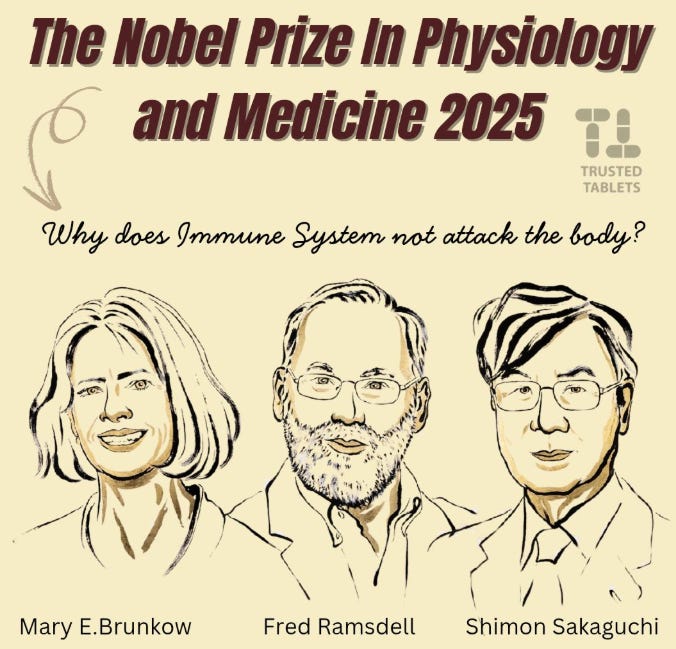
Three scientists, one discovery
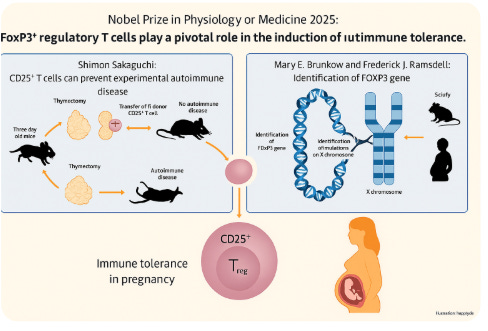
Shimon Sakaguchi first identified a special group of white blood cells—regulatory T cells, or Tregs—that act as peacekeepers, preventing the immune system from attacking the body itself.
Mary Brunkow and Fred Ramsdell later discovered the key gene, FOXP3, that allows these cells to function. Without FOXP3, the body’s immune tolerance collapses. The result is severe autoimmune disease in humans (called IPEX syndrome) and in mice, a fatal condition known as scurfy. Together, their work revealed something profound: the same tolerance that protects us from autoimmunity also makes pregnancy possible.
Why this matters in obstetrics
Every healthy pregnancy depends on immune balance. The mother’s immune system must stay strong enough to fight infection yet calm enough to tolerate the fetus.
When that balance breaks down, complications follow:
Recurrent miscarriage when tolerance fails early
Preeclampsia when inflammation damages the placenta
Preterm birth when immune activation triggers early labor
What we often call “placental disorders” may, at their root, be tolerance disorders. Brunkow, Ramsdell, and Sakaguchi gave us the biological language to describe them.
The future: immune tolerance as the next frontier
Understanding FOXP3 and Tregs won’t change immediately what happens on tomorrow’s labor floor—but it changes how we think.
Future prenatal tests might measure a woman’s tolerance profile. Future treatments could aim to restore immune peace before symptoms appear.
Their discovery is a reminder that pregnancy itself is an act of controlled tolerance, a daily negotiation between two immune systems that must coexist for nine months.
Mary Brunkow, Fred Ramsdell, and Shimon Sakaguchi did not set out to explain pregnancy. Yet their work may prove to be one of the most important discoveries for it.
Suggested Reading: How Their Discovery Touches Obstetrics
For readers who want to see how this Nobel-winning science connects directly to pregnancy and maternal–fetal medicine, here are five clear and accessible papers:
Regulatory T Cells and Immune Tolerance in Pregnancy: A New Target?
Am J Reprod Immunol (2009). How FOXP3-positive Tregs enable immune tolerance in normal pregnancy.
Read on PubMed Central →Regulatory T Cells and Preeclampsia: An Overview of the Literature
J Reprod Immunol (2016). Lower CD4⁺FOXP3⁺ Treg levels in preeclampsia suggest early immune imbalance.
Read on PubMed →Therapeutic Potential of Regulatory T Cells in Preeclampsia
Front Immunol (2019). Animal and human studies show that reduced FOXP3 Tregs cause placental inflammation and poor uterine artery remodeling.
Read on PubMed Central →Memory Regulatory T Cells in Pregnancy
Front Immunol (2023). “Memory Tregs” may persist between pregnancies and improve outcomes in later ones.
Read on Frontiers →Regulatory T Cells in Pregnancy Adverse Outcomes: A Systematic Review and Meta-Analysis
Front Immunol (2021). Lower Treg counts are linked to miscarriage, preeclampsia, and preterm birth—showing how the Nobel trio’s discovery lives within obstetrics.
Read on Frontiers →
Nobel Prizes That Changed Pregnancy
The most important discoveries of the last 30 years that reshaped how we understand or care for pregnancy.
2025
Laureates: Mary E. Brunkow; Fred Ramsdell; Shimon Sakaguchi
Discovery: Peripheral immune tolerance via FOXP3 and regulatory T cells
Pregnancy impact: Explains maternal–fetal tolerance. Reframes miscarriage, preeclampsia, and preterm birth as tolerance problems.
2023
Laureates: Katalin Karikó; Drew Weissman
Discovery: mRNA vaccine platform
Pregnancy impact: Enabled COVID-19 vaccination in pregnancy, reducing severe maternal illness and providing neonatal antibody protection.
2019
Laureates: William G. Kaelin Jr.; Sir Peter J. Ratcliffe; Gregg L. Semenza
Discovery: Oxygen-sensing HIF pathway
Pregnancy impact: Central to placental adaptation to hypoxia, informs growth restriction and preeclampsia biology.
2015
Laureates: Tu Youyou; with shared year honors for Campbell; Ōmura
Discovery: Artemisinin antimalarials
Pregnancy impact: First-line therapy after the first trimester in malaria regions, reduces maternal and fetal deaths.
2010
Laureate: Robert G. Edwards
Discovery: In vitro fertilization
Pregnancy impact: Transformed infertility care and prenatal genetics; millions of births.
2003
Laureates: Paul C. Lauterbur; Sir Peter Mansfield
Discovery: Magnetic resonance imaging
Pregnancy impact: Safe, non-ionizing imaging for maternal and fetal indications when ultrasound is not enough.
2020, Chemistry
Laureates: Emmanuelle Charpentier; Jennifer A. Doudna
Discovery: CRISPR-Cas9 gene editing
Pregnancy impact: Drives reproductive genetics, embryo models, and potential fetal or neonatal gene therapies.