

The Prognosis: Quantum Physics Meets the Womb
From quantum tunneling in superconducting circuits to listening to a baby’s heartbeat before birth.

The 2025 Nobel Prize in Physics went to John Clarke, Michel Devoret, and John Martinis for something that sounds abstract but touches the real world in surprising ways. Their experiments, begun in the 1980s, proved that the weird rules of quantum physics—normally reserved for atoms and subatomic particles—can also appear in systems big enough to hold in your hand.
Imagine an electrical circuit so cold that it’s only a fraction of a degree above absolute zero—the point where almost all motion stops. In that deep freeze, something extraordinary happens: the electrons stop acting like individual particles and start moving together, perfectly synchronized, like a single wave. The scientists who built this circuit added a paper-thin barrier, called a Josephson junction, to see what the wave would do. Instead of climbing over the barrier, it suddenly appeared on the other side—as if it had slipped through a wall. That strange leap, called quantum tunneling, breaks the rules of ordinary physics but fits beautifully with quantum theory. Even more remarkable, the circuit could absorb and release energy only in exact, tiny chunks—no more, no less. This was the first clear proof that quantum behavior could happen not just with atoms, but in objects big enough to see under a microscope. That insight became the foundation for today’s quantum computers, which use similar ultra-cold circuits to do calculations that once seemed impossible.
But here’s the unexpected twist: one of the laureates, John Clarke, also used these same superconducting principles to develop SQUIDs—superconducting quantum interference devices. These tiny sensors can detect magnetic fields a trillion times weaker than a refrigerator magnet. They became vital tools in medicine, including in obstetrics.
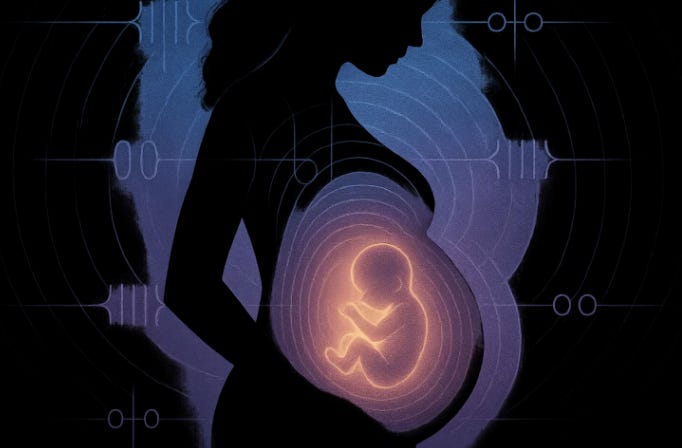
In the 1990s and 2000s, researchers adapted SQUIDs to record the faint magnetic fields produced by a baby’s heart inside the uterus, a technique called fetal magnetocardiography (fMCG). Unlike ultrasound, which measures movement and sound, fMCG directly captures the electrical activity of the fetal heart. It can reveal hidden rhythm problems such as fetal arrhythmias or long QT syndrome long before birth. Similar devices have even been used to study the fetal brain’s magnetic signals (fMEG), offering glimpses into early neurological development.
Although these SQUID-based methods remain mostly research tools due to their complexity and cost, they show how discoveries born in the world of superconductors and quantum tunneling can echo in the delivery room. The same physics that helps build quantum computers also helps doctors “listen” to a baby’s heartbeat in ways once thought impossible.
So while the 2025 Nobel Prize celebrated physics on the quantum frontier, part of its legacy already lives quietly in perinatal medicine—where quantum science helps illuminate life before birth.