
The Prenatal Visit Is Broken
Women wait too long, see their clinicians too briefly, and receive too little of what actually matters. It is time to redesign prenatal care with intelligence, not inertia.

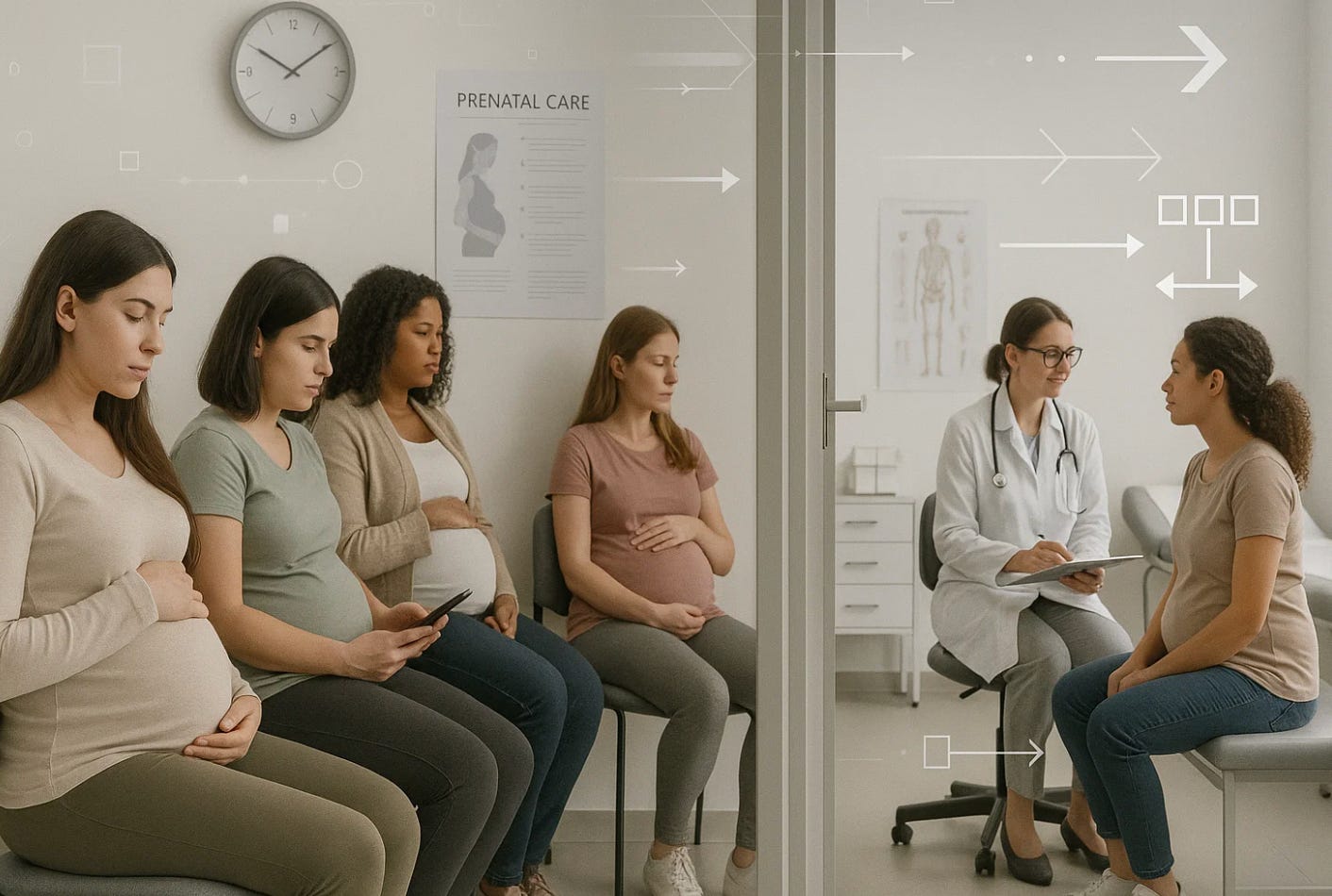
During my years seeing pregnant women in the clinic, I learned how ineffective verbal counseling can be when the clock is running and the waiting room is full.
I began asking patients to email me their questions or concerns at least forty eight hours before their visit. This allowed me to review their chart, search the evidence, and prepare answers that were accurate rather than improvised. It also saved precious time in the encounter.
Talking alone leads to poor retention. Most patients remember less than twenty five percent of what is said during a medical conversation. Written communication retains far more because it can be read, reread, saved, and shared with partners or family. The result was better understanding and a stronger sense of partnership, even though the face to face minutes did not increase.
American prenatal care is built on a schedule designed in the 1930s and barely updated since. Twelve to fourteen visits for low risk pregnant women was never evidence based. It simply became the norm and stayed there. Today it functions more as a ritual than a strategy. Women sit in waiting rooms for thirty to sixty minutes, sometimes longer, to see a clinician for an average face to face time of less than 5-10minutes. In many busy practices, the true encounter length is measured in seconds. A quick blood pressure reading. A fundal height measurement. A fetal heart rate check. A few perfunctory questions. Then the clinician moves to the next room.
We rarely ask whether this structure produces the outcomes we claim it does. We rarely acknowledge how much of a prenatal visit is administrative rather than clinical. Much of it is a box checking exercise. The patient waits for the medical assistant to room her. She repeats the same answers to the same questions. She may get a weight check, a urine dip, or pulse oximetry. Most of this has limited value for low risk pregnancies, and much of it adds little to safety. Urine dipsticks for protein are notoriously unreliable screening tools. Many women are never counseled on what changed risk actually means. And very few leave with the sense that they had a thoughtful conversation about their pregnancy.
The core of a prenatal visit is simple. Evaluate maternal well being. Evaluate fetal well being. Identify complications early. Counsel about expected changes. Plan follow up. Yet most visits barely accomplish this. Women describe feeling rushed, unheard, and hurried out the door. Clinicians describe being overscheduled, understaffed, and forced to rely on shortcuts because the system leaves them no time to think. Prenatal care should be anticipatory. Instead it is often reactive.
The irony is that half the content of a typical prenatal encounter does not require a clinician at all. Blood pressure can be recorded at home with validated monitors. Weight can be tracked at home. Screening questions can be answered electronically. Education does not require an exam room. The structure is outdated, yet we cling to it because it is familiar, not because it is effective.
Midwifery and obstetrics often defend the current visit schedule as sacred. But more is not always better. Without adequate time for communication, a greater number of visits simply means more waiting and more superficial interactions. If the average clinician spends eight minutes or less with a pregnant womaIn, the number of visits is irrelevant. Frequency cannot compensate for thin, hurried care. Women need meaningful time, good data, and actionable counseling. They do not need more waiting room chairs.
We also ignore what prenatal care does not do. It does not reliably identify early preeclampsia. It does not predict fetal growth restriction without ultrasound. It does not detect silent infections. It does not assess sleep, nutrition, stress, or cardiometabolic risk in any systematic way.
In the United States, prenatal care has become a narrow lens when pregnancy requires a wide one.
The result is a paradox. We offer many visits, but we deliver little value. We collect data that have minimal predictive power. We provide reassurance without clarity. We call it comprehensive, but it is not.
What Better Prenatal Care Could Look Like With AI
Artificial intelligence if used responsibly, can help rebuild prenatal care around function rather than tradition. The goal is not to replace clinicians. The goal is to redistribute tasks so that clinicians spend their time on what humans do best: interpretation, empathy, clinical reasoning, and complex judgment.
First, AI can support risk stratification. Instead of assuming every woman needs the same visit schedule, predictive models can identify who requires closer monitoring based on clinical, demographic, and physiologic data. This allows high risk pregnancies to receive more attention and low risk pregnancies to avoid unnecessary appointments.
Second, AI can manage information flow. Pregnant women receive disjointed advice from multiple sources. AI systems can consolidate guidelines, provide daily education, prompt key questions for the next visit, and identify early warning signs. Women deserve coherent information that is tailored to their pregnancy rather than generic pamphlets that have not been updated in years.
Third, AI can free clinicians from low value tasks. Intake questions, symptom screens, and lifestyle assessments can be completed through conversational agents before the visit. This allows the face to face time to focus on the patient rather than documentation. A ten minute visit can become a ten minute conversation instead of a four minute sprint.
Fourth, AI can support continuous monitoring. Home blood pressure data can be analyzed for trends rather than single readings. Weight gain patterns can be assessed throughout pregnancy. Sleep disruptions, mood changes, and activity levels can be tracked longitudinally. Instead of snapshots every four weeks, clinicians would see trajectories. Patterns predict complications far better than isolated values.
Fifth, AI can help detect what the prenatal visit misses. Algorithms trained on vital signs, symptoms, and home sensor data may identify women at risk for preeclampsia, gestational diabetes, or preterm birth earlier than our current clinical assessments. These tools should be carefully evaluated, validated, and ethically integrated, but the opportunity is significant.
Sixth, AI can transform the visit schedule itself. We can design hybrid models that combine telemedicine, home monitoring, asynchronous communication, and targeted in person evaluations. The number of visits becomes a function of need rather than habit. The structure becomes rational instead of historical.
AI will not replace clinical judgment. It will not eliminate the need for physical examination. But it can make prenatal care more intelligent, more individualized, and more humane. It can return the visit to what it was supposed to be: a meaningful interaction between a clinician and a pregnant woman focused on health, safety, and shared understanding.
The real threat to prenatal care is not technology. It is inertia. We cannot redesign a system by defending the number of visits or the length of the template. We can only redesign it by asking what outcomes matter and building upward from there.
Closing Reflection
The prenatal visit should be the backbone of obstetric care. Today it is too often a rushed ritual. AI gives us a chance to rebuild it with intention. The question is whether we will use that chance wisely.
Dr. Grunebaum is absolutely correct. Unfortunately ACOG OR SMFM Continue to base quality of care on the number of visits rather than the quality of visits. All the suggestions provided are doable and will SAVE overworked and over booked clinicians time. One area not mentioned is collaborative care with the MFMs who are obstetricians to provide a obstetrical care when they are doing a first trimester scan, a second trimester scan and a growth scan so the patient doesn’t have to go to the MFM one day and then the Ob the next. Questions can be answered by nurses and education can be accomplished with NPS. ALL of this is a win for the patients and a win for the doctors. I don’t understand why this cannot be supported by both ACOG AND SMFM.
I remember in 1977 when I worked for Kaiser for 10 months after my army discharge my schedule often had 5 prenatal appointments in a single 15 minute time slot. I always ran late.
This was one of the reasons I left.