
The Safety Ledger: Why Surgeons Should Never Scrub Out for a Phone Call
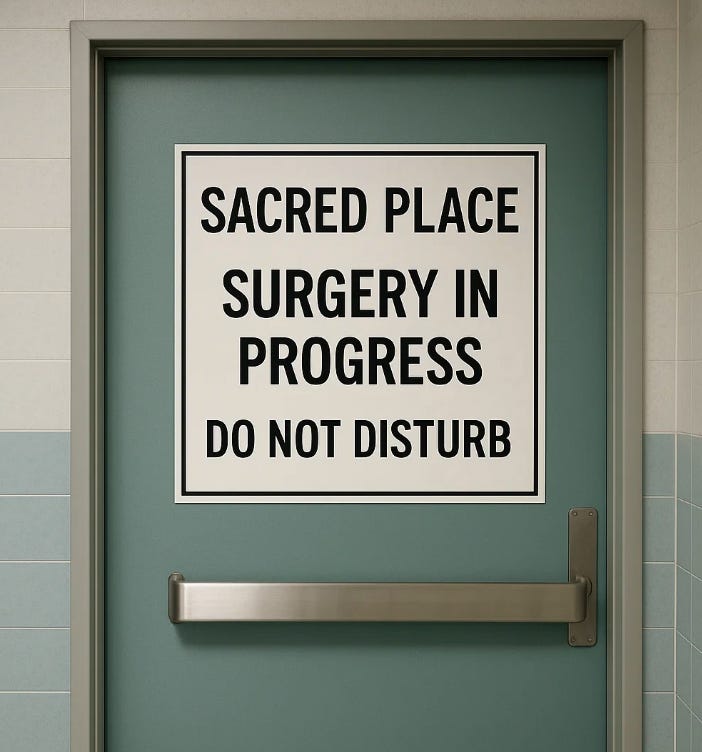
The operating room is unlike any other space in medicine. It is not an office, a clinic, or a telehealth booth. It is a sacred, protected zone.

The viral story that makes us pause
Recently, a surgeon went viral after posting a complaint on social media. She described how, in the middle of an operation, she had to scrub out because an insurance company was on the line demanding she certify another patient’s case. Her frustration was directed at the insurer for interrupting her. And understandably so, insurance bureaucracy intruding on patient care is maddening.
But the part of the story that caught my attention was not the insurance company. It was the act of scrubbing out mid-surgery to take a phone call. That detail raises deeper ethical questions about the sanctity of the operating room, the trust between patient and surgeon, and the very definition of professional responsibility.
This is not an article about insurance. It is an article about focus, ethics, and what patients should expect when they are asleep on the operating table.
The operating room is not just another workplace
The operating room is unlike any other space in medicine. It is not an office, a clinic, or a telehealth booth. It is a sacred, protected zone. When a patient consents to surgery, they are placing ultimate trust in their surgeon’s undivided attention. At that moment, the patient is completely vulnerable. Their life and well-being depend on a team working seamlessly, without distraction, interruption, or divided priorities.
Imagine boarding an airplane and learning that halfway through the flight, the pilot might leave the cockpit to handle a call from the airline’s billing department. The outrage would be instant. Yet in medicine, stories like this one get reframed as complaints against insurance companies instead of as ethical lapses inside the OR.
Scrubbing out is not a minor pause
To the public, “scrubbing out” might sound like simply stepping away. But it is not that simple. The act itself is a disruption. The surgeon removes sterile gloves and gown, leaves the field, and later must scrub back in, regown, reglove, and regain mental focus. While the surgical team can carry on certain tasks, the lead surgeon’s presence is not optional. That pause is not trivial. It is a break in continuity, concentration, and responsibility.
Patients rarely know about such interruptions. They assume their surgeon is there for the entirety of their operation. And they have every right to expect exactly that.
The ethics: undivided duty to the patient on the table
At the core of medical ethics is the principle of beneficence, do good. Walking away from a patient mid-surgery for any reason short of an absolute emergency risks harm, even if no error occurs. It undermines the sacred trust the patient has placed in the surgeon.
Another principle, fiduciary duty, reminds us that the patient on the table is not just one among many. At that moment, they are the only patient. The surgeon’s duty is not to balance competing obligations but to give full and continuous attention to the life entrusted to them.
Insurance interruptions may be outrageous, but they are not emergencies. They do not justify breaking that covenant.
Phones in the OR: a slippery slope
Technology has brought smartphones into every corner of our lives. In hospitals, they are used for communication, quick consultations, even intraoperative imaging. But there is a sharp ethical line: personal or administrative calls should never intrude into surgery.
Allowing a “just this once” exception risks normalizing distraction. If an insurance call can pull a surgeon away, what about a text message? What about a scheduling issue? The OR is no place for these intrusions. Just as pilots power down personal devices in the cockpit, surgeons must protect the OR as a no-distraction zone.
The appearance of professionalism matters
Even if the surgeon insists that the patient’s safety was never compromised, perception matters. When the public hears that a surgeon left the OR to talk to an insurance company, the story erodes trust—not only in that individual but in the profession as a whole.
Medicine already struggles with public skepticism. Adding images of surgeons distracted by phone calls feeds the dangerous narrative that patients are just numbers in a system, not human beings deserving of absolute focus. Maintaining the sanctity of the OR is not just about the patient on the table—it is about protecting public trust in the entire surgical enterprise.
What about true emergencies?
Of course, exceptions exist. If a surgeon’s child has been in an accident or a family member is critically ill, a brief interruption may be justified. Likewise, if another surgical team down the hall is managing a simultaneous life-threatening complication and urgently needs the attending surgeon’s input, stepping out could be ethically permissible.
But these are extreme cases. They are not insurance calls, not scheduling issues, and not administrative paperwork. Hospitals can and must create structures so that only the rarest, dire emergencies ever reach a surgeon’s ear while they are operating.
The responsibility of hospitals and colleagues
This is not just about individual surgeons. Hospitals and surgical teams have an ethical responsibility to shield the OR from such interruptions. Staff should be trained: no calls, no referrals, no administrative messages during active surgery unless a genuine emergency arises. Calls from insurers can wait. There are always other physicians or administrators who can respond.
Colleagues, too, should reinforce the culture of focus. Residents, anesthesiologists, and nurses can all help preserve the sanctity of the OR by refusing to normalize interruptions. Protecting the patient means protecting the surgeon’s undivided attention.
A personal analogy
When I teach residents about the ethics of the OR, I often compare it to being entrusted with holding a newborn infant. If someone asked you to step away, hand the baby to someone else, and take a phone call about insurance billing, most people would refuse without hesitation. “This baby needs me right now.” The patient under anesthesia deserves the same absolute commitment.
Practical lessons for surgeons and patients
For surgeons: Treat the OR as sacred. Do not scrub out for non-emergencies. Set clear boundaries with staff and administrators. Leave you cell phone ouside the OR. You won’t be able to answer it anyway while scrubbed in.
For hospitals: Establish firm policies. No calls to the OR except in true emergencies. Shield surgeons from administrative distractions. Consider even blocking calls into the OR or establishing guidelines to leave cell phones outside the OR
For patients: Know that you have the right to your surgeon’s undivided attention. If you ever hear of practices that compromise that trust, speak up.
Full Disclosure
In my more than 40 years as a surgeon and as director of Labor and Delivery, I can count on one hand the times I had to scrub out mid-procedure. I remember each one. Each involved a true emergency, patients in the OR next to mine or a labor & delivery room where another doctor was struggling to deliver a baby and seconds mattered and my experience and additional hands were required. In those rare instances, I stepped away only because my own patient was stable,there was nobody else to help with the other patent, and another experienced surgeon was present at the field. Those are the exceptional circumstances, and they underscore why anything short of a true emergency should never justify leaving the OR and abandoning a patient.
Closing reflection
The viral surgeon’s frustration with insurers may be justified. But the deeper ethical issue should not be lost: no patient deserves to be left mid-surgery because of a phone call. The operating room is sacred, and surgeons owe their patients absolute focus.
So here is the question we should all reflect on: In an age where distractions are everywhere, how do we protect the few spaces that must remain sacred? And are we, as doctors and patients, willing to insist that the operating room remain one of them?