
The Safety Ledger: The Night the Uterus Ruptured
What happened that night still shapes how I teach, how I practice, and how I think about ethics at the edge of life.

Why This Story Still Matters
Words like “stat cesarean” carry drama. But unless you’ve been in the room, it is hard to appreciate the seconds stretching into eternity, the silence before the decision, and the team moving in sync as if pulled by invisible strings.
One night, years ago, I encountered one of the most terrifying emergencies in obstetrics: a ruptured uterus in a woman with a prior cesarean delivery. What happened that night still shapes how I teach, how I practice, and how I think about ethics at the edge of life.
The Arrival
It was close to midnight when the call came from triage. A young woman had just walked in, visibly pale and in severe abdominal pain. She was bleeding from her vagina, she was 39 weeks, in labor, had a lot of pain, more than usual, and had a history of a prior cesarean.
Her vital signs told the story before she spoke: low blood pressure, rapid pulse, shallow breathing. The fetal heart tracing showed profound bradycardia at about 80 bbeats per minute. Her cervix was closed,.Nurses looked at me, eyes searching for direction, but we all knew what was happening. We grabbed an ultrasound machine and saw that the fetus was protruding from the uterus into her abdomen.
“Probable ruptured uterus,” I said. The words fell heavy.
Why Prior Cesareans Matter
For those not in the field, here is the context. A cesarean leaves a scar in the uterus. Most of the time, that scar holds strong. But in rare cases, under the stress of contractions, the scar gives way. This is called uterine rupture.
It is catastrophic: mother and baby can bleed internally, the baby may be ejected into the abdomen, and every minute counts. It is a race against hypoxia for the baby, and against exsanguination for the mother.
The risk is higher when labor follows a prior cesarean—especially if induction drugs are used or if the prior scar was classical (vertical). But rupture can occur even in what appears to be a “low-risk” case.
The Decision
There was no time for written consent forms, no time for debate. Ethically, this was one of those situations where the principle of beneficence overrides autonomy. She was already slipping into shock.
I looked at the patient and said, “We think you have a rupptured uterus, the baby is in trouble, and so are you. We need to do an emergency cesarean right now. It’s the only chance for you and the baby.” She nodded faintly, too weak to speak. That was good enough for me as a consent.
In less than a minute we were in the OR. Scrub techs ripped open instrument trays. Anesthesia rushed to start an IV and then proceeded intubate. The room buzzed with controlled chaos.
The Cesarean
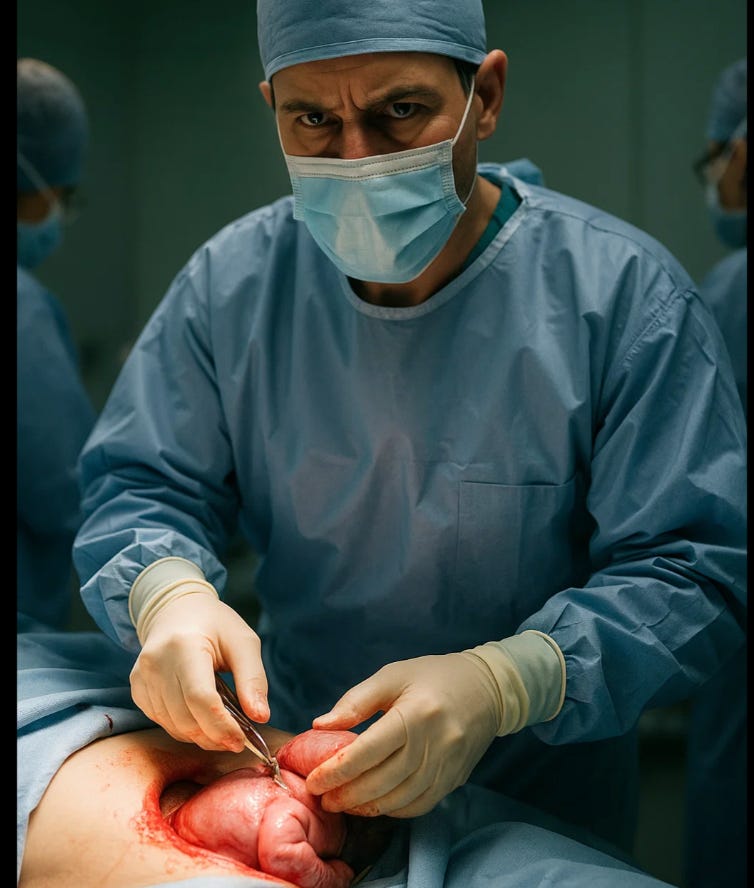
Skin incision. Blood everywhere. The uterus was torn wide open, the baby partly in the abdominal cavity. The placenta was disrupted, bleeding torrentially.
We moved with practiced speed. The baby was delivered within two minutes—limp, pale, but with a faint heartbeat. Neonatology took over, resuscitating.
The uterus was shredded, almost impossible to repair. We made the decision for hysterectomy, removal of the uterus. It was the only way to save her life. The OR filled with suction sounds, clamping, suture after suture.
Finally, bleeding controlled. Abdomen closed. She survived.
The Aftermath
The baby spent weeks in the NICU, with seizures and uncertain prognosis. The mother woke up without her uterus, grieving the loss of fertility but grateful to be alive.
I visited her the next day. She held my hand and asked the question every patient asks: “Why did this happen?”
There is no easy answer. Risk factors can be explained, probabilities quoted, guidelines reviewed. But for her, this wasn’t statistics—it was her life, her baby’s life, turned upside down in one night.
The Bigger Picture
1. The False Security of “Low Risk”
Many women with prior cesareans are counseled about the option of a vaginal birth after cesarean (VBAC). For most, VBAC is safe, and rupture is rare. But rare is not never. Patients often hear “less than 1%” and understandably feel reassured. Yet when that 1% is your case, statistics lose meaning.
This is where ethical counseling matters. Too often, VBAC is framed in overly simplistic terms: natural and empowering versus “another unnecessary surgery.” What gets lost is the sober truth: VBAC is safe only in a facility equipped for rapid emergency response. The risk is small, but the consequences are enormous.
2. Why Home Birth Should Never Be Attempted
Some women with prior cesareans are lured into home births, reassured by midwives or online communities that uterine rupture is “too rare to worry about.” This is dangerous misinformation. A uterine rupture at home is almost always fatal for the baby and sometimes for the mother. There is no time for transport. By the time an ambulance arrives, the window for survival has closed. Once the uterus ruptures, there are only minutes to save the baby.
3. The Challenge of Consent
Informed consent is not a signature on a piece of paper—it is a process of honest conversation. Patients deserve to know both the numbers and the narratives. They deserve to hear not just “your risk is less than 1%,” but also “if rupture occurs, it is catastrophic and requires immediate surgical care.” True consent equips patients with the whole picture, not a reassuring fragment. In such a dire emergency, it’s difficult to get a complete informed consent, because time matters. But still, we need to get the patient to consent, or even her partner/husband.
4. The Role of Team Training
This woman survived because our team had trained for this exact scenario. We had practiced simulated ruptures, simulated emergencies, rehearsed roles, drilled the sequence. We had timed how long it takes to transport a patent to the OR, get the team together, get anetshesia and neonatology. When the real crisis hit, we didn’t debate, we acted. Training is what turns panic into precision. Hospitals that support VBAC must invest in this type of simulation. It is not optional; it is the ethical cost of offering choice.
5. Systems Save Lives
No single physician can save a mother in this scenario alone. It requires nurses, anesthesiologists, neonatologists, blood bank staff, and OR techs working seamlessly. Every hospital that permits VBAC should ask itself: do we have this system ready at 3 a.m. on a Sunday? If the answer is no, then VBAC is not ethically defensible there.
Lessons for Patients and Families
Know your history. If you have a prior cesarean, always mention it when you arrive in labor. It changes everything.
Ask the right questions. If considering VBAC, ask: How fast can you do an emergency cesarean here? Is the OR staffed 24/7? Does the hospital run rupture drills?
Avoid home birth after cesarean. It is simply not safe. It’s contraindicated. No matter what anyone tells you, there is no way to rescue a ruptured uterus at home.
Lessons for Clinicians
Recognition is everything. Severe pain, shock, and abnormal fetal tracing—do not hesitate.
Simulation saves. Regular team training should be mandatory for all labor units.
Consent is conversation. A signed form without real dialogue is ethically empty. Patients need truth, context, and space to ask questions. But in an emergecy consent can be obtained verbally but must be documented clearly.
The Debrief
Following the emergency of this ruptured uterus, our team conducted a debrief. A debrief is a structured discussion held promptly after a critical event in order to reflect on what happened, review the sequence of actions, and clarify any points of confusion. The purpose is twofold: first, to ensure that all team members understand the clinical course, the decisions that were made, and the rationale behind them; and second, to identify opportunities to improve systems, communication, and preparedness for future emergencies. Just as importantly, the debrief serves as a space to acknowledge the emotional impact such high-intensity situations can have on staff, offering mutual support and reinforcing resilience. By reviewing both what went well and what could be improved, the debrief transforms a crisis into a learning opportunity, helping the team strengthen collaboration and ultimately improving the safety and quality of care provided to mothers and babies.
Reflection
That night still sits heavy with me. It reminds me that modern obstetrics walks a razor’s edge: balancing respect for choice with readiness for catastrophe, celebrating normal births while preparing for the rare but deadly.
A uterine scar is not just a line of tissue. It is a story written into the uterus, one that can reopen at the worst possible moment.
The ethical lesson is clear. We owe patients honesty about risk, humility about uncertainty, and systems robust enough to act when minutes matter. Informed consent is not a checkbox; it is a promise to tell the whole story.
When I think back to that patient, I remember not just the blood, the rush, the crisis—but her eyes the next day, asking “why.” That single word is why I keep writing, teaching, and questioning. Because in obstetrics, every “why” is a chance to do better.