
The Myth of the Low-Risk Pregnancy
If we can’t define it, maybe it doesn’t exist

Maria was 28, healthy, with no medical problems. Her first pregnancy had been textbook perfect. At her 36-week visit, her blood pressure was normal, her baby was growing well, and she had passed every screening test. By every definition, she was “low risk.”
Twelve hours into labor, she needed an emergency cesarean for a cord prolapse.
Her outcome was excellent. But it raised a question that obstetrics has never adequately answered: What exactly do we mean when we call a pregnancy “low risk”?
A Definition That Doesn’t Exist
When researchers tried to pin down a standard definition of “low-risk pregnancy” for a national workshop, one expert channeled Supreme Court Justice Potter Stewart’s famous line about obscenity:
“I shall not today attempt further to define the kinds of material I understand to be embraced within that short hand description; concluding perhaps, I could never succeed in intelligibly doing so. But, I know it when I see it.”
This isn’t a joke. This is the actual state of obstetric science.
Different research groups use wildly different criteria. One Australian trial defined low risk using 17 separate inclusion criteria. A UK study limited “standard” midwifery candidates to Caucasian women, aged 20-34, taller than 155 centimeters, with singleton vertex pregnancies. American birth center criteria add their own variations.
The result? Depending on which definition you use, anywhere from 38% to 88% of pregnancies might qualify as “low risk.” That’s not a small discrepancy. That’s a 50-percentage-point gap in who gets labeled as safe for minimal intervention.
The 29% Problem
Here’s where it gets uncomfortable.
A study of over 10 million U.S. births applied strict criteria using 19 different risk characteristics. Only 38% of pregnancies qualified as truly low risk by all measures.
Among those carefully screened, low-risk pregnancies: 29% had at least one unexpected complication.
Read that again. Nearly one in three pregnancies with no identified risk factors still experienced something that required more than routine care.
And here’s the kicker: for certain complications, the “low-risk” group actually had higher rates than women with identified risk factors. Vacuum deliveries, forceps deliveries, meconium staining, and chorioamnionitis were all more common in supposedly low-risk pregnancies.
How can that be? Probably because providers expect problems in high-risk patients and intervene earlier. In low-risk patients, complications come as surprises.
“Low Risk for What?”
The deeper problem is that “low risk” answers a question nobody asked.
Most risk assessment tools in obstetrics predict one specific outcome: preterm birth, cesarean delivery, or perinatal mortality. We have no validated tools that predict maternal morbidity and mortality.
So when we say “low risk,” we’re really saying: “low risk for some things we can measure, based on factors present right now, with no guarantee about what happens next.”
A woman can have pregnancy risk factors like obesity or hypertension but sail through labor without incident. Another woman with no risk factors can have a catastrophic hemorrhage. Both of these happen regularly.
Risk in pregnancy and risk in labor are related but separate concepts. A perfect pregnancy doesn’t guarantee a perfect delivery. As one research team noted: “Most emergent cesarean deliveries develop during labor in low-risk women and cannot be anticipated by prelabor factors.”
The Dynamic Problem
Risk in pregnancy is not a fixed state. It changes.
A woman classified as low risk at 12 weeks might develop gestational diabetes at 26 weeks. Someone low risk at 38 weeks might have a placental abruption at 39. A patient who starts labor as low risk might need emergency intervention an hour later.
One large Australian study divided over a million pregnancies into low, intermediate, and high-risk categories. The findings confirmed what clinicians know intuitively: risk stratification helps predict outcomes at the population level. But at the individual level, surprises happen constantly.
Even among women with heart disease who are classified as “low risk” by cardiac standards, about 5% still experience cardiovascular complications during pregnancy. “Low risk” doesn’t mean “no risk.”
What We Actually Mean
When providers say “low risk,” they usually mean one of three things:
1. Administrative low risk: This pregnancy qualifies for a birth center, midwifery-only care, or a lower level of facility under our protocols.
2. Statistical low risk: Based on known factors, this patient falls into a group with better average outcomes than patients with risk factors.
3. Current-moment low risk: Right now, today, we don’t see any problems.
These are all legitimate uses of the term. But they’re not the same thing. And none of them means “nothing bad will happen.”
The Birth Setting Question
This matters enormously when we discuss where women should give birth.
Some argue that low-risk women can safely deliver in freestanding birth centers or at home. Others counter that complications are unpredictable enough to warrant hospital access for everyone. Both sides cite evidence. Both are partly right.
The data show that about 12-20% of women who begin labor in out-of-hospital settings end up transferring to hospitals. Some transfers are non-urgent. Others are emergencies.
Transfer rates vary wildly based on how “low risk” is defined and how rigorously that definition is enforced. A birth center that screens strictly and transfers early will have different outcomes than one with looser criteria.
This isn’t an argument for or against any particular birth setting. It’s an argument for honesty about what “low risk” actually means and what it cannot predict.
The Professional Responsibility
Here’s what troubles me most.
We use “low risk” as though it’s a diagnosis. It’s not. It’s a description of our current knowledge about a patient at a single point in time.
When something goes wrong in a “low-risk” pregnancy, the response is often: “This was unforeseeable.” And sometimes that’s true. But sometimes “unforeseeable” really means “we categorized this patient as low risk, so we weren’t watching for problems.”
The culture of a birth setting affects perception of risk. Research shows that midwives working in high-intervention hospital environments perceive intrapartum risk as greater and are more likely to transfer patients. Midwives in low-intervention settings underestimate risk and overestimate the likelihood of normal progress.
Same patients. Same objective risk. Different perceptions based on environment.
What Patients Deserve to Know
If you’re pregnant and your provider tells you you’re “low risk,” you deserve honest answers to these questions:
What specific criteria are you using? There is no universal standard. Ask what factors were considered.
Low risk for what outcomes? Preterm birth? Cesarean? Maternal complications? The answers might be different.
What could change this assessment? Risk is dynamic. What are the warning signs that would change my category?
What is your plan if something unexpected happens? Every birth setting, no matter how low risk the patient, should have protocols for emergencies.
What’s the actual rate of unexpected complications in patients like me? If the answer is “about 29%,” that’s worth knowing.
A Better Vocabulary
Maybe we need different language entirely.
Instead of “low risk” vs. “high risk,” what if we described pregnancies by what we actually know?
“No current complications, and no history suggesting elevated risk for [specific outcomes].”
It’s clunkier. But it’s honest. It acknowledges that we’re describing a moment in time, not issuing a guarantee. It specifies what we’re assessing risk for. And it leaves room for the reality that pregnancy can change in an instant.
“Low risk” sounds reassuring. That’s precisely the problem.
The Bottom Line
The concept of “low-risk pregnancy” is useful for system planning, resource allocation, and general communication. At the population level, it helps match patients to appropriate care settings.
At the individual level, it can create false confidence.
Nearly one in three “low-risk” pregnancies will have complications requiring more than routine care. Most emergency cesareans happen in women who started labor as low risk. Risk changes throughout pregnancy and labor, sometimes in minutes.
When you hear “low risk,” understand what it means: “Based on what we know now, we don’t see red flags.” That’s valuable information. But it’s not a promise.
Every pregnancy carries risk. The question isn’t whether you’re “low risk” or “high risk.” The question is whether you, your provider, and your birth setting are prepared for the full range of possibilities.
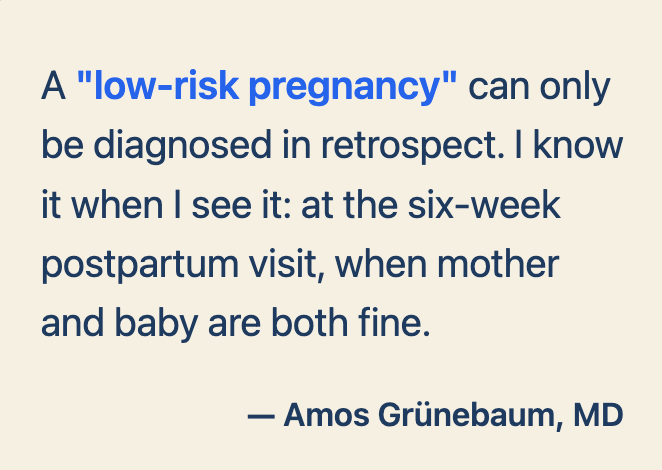
Because in obstetrics, the only truly low-risk pregnancy is the one that’s already over.
What’s been your experience with risk categorization in pregnancy? I’d love to hear from clinicians and patients alike. Share your thoughts in the comments.
References
Gregory KD. Assessment of Risk in Pregnancy. In: An Update on Research Issues in the Assessment of Birth Settings: Workshop Summary. National Academies Press; 2013.
Rosenstein MG, et al. Unexpected complications of low-risk pregnancies in the United States. Am J Obstet Gynecol. 2015;212(6):809.e1-6.
Elgendy IY, et al. Midwife-Led Versus Obstetrician-Led Perinatal Care for Low-Risk Pregnancy: A Systematic Review and Meta-Analysis of 1.4 Million Pregnancies. J Clin Med. 2024;13(22):6629.
Umazume T, et al. Development of quality indicators for low-risk labor care provided by midwives using a RAND-modified Delphi method. BMC Pregnancy Childbirth. 2017;17:315.
Thornton C, et al. Maternal risk stratification and planned birth improve pregnancy outcomes at term: A population-based cohort study. Am J Obstet Gynecol. 2025.
ACOG/SMFM. Levels of Maternal Care. Obstetric Care Consensus No. 9. Am J Obstet Gynecol. 2019;221(2):B19-30.
How about - all pregnancies are at risk Being pregnant is the risk