
The Safety Ledger: The Myth of "Natural Safety" in Pregnancy
What history teaches us about childbirth, mortality, and modern medicine

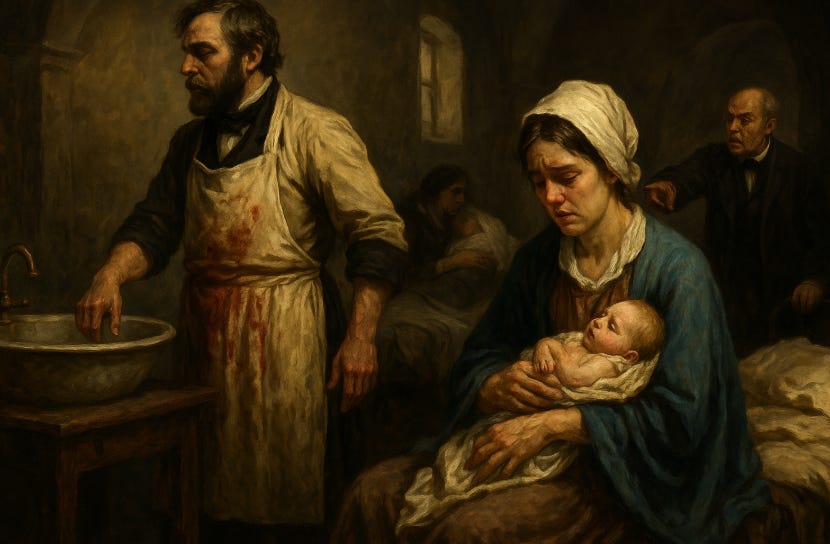
I still remember the first time I walked into a delivery room as a young medical student and noticed how casually everyone touched patients. Gloves were not yet universal. Hand sanitizer dispensers did not hang on every wall. Nurses moved from one patient to another, and doctors—including myself—were often guilty of rushing through without pausing to wash our hands. It was not malice or negligence—it was simply the way things had always been done.
That day, an older attending whispered to me: “Don’t forget Semmelweis.”
I nodded, but at the time, I barely understood what he meant. Years later, after seeing the devastating consequences of postpartum infection, his words became a permanent reminder: what feels “natural” or routine in childbirth can be deadly if we forget the lessons of history.
The Natural Illusion
Many people, including some clinicians, still speak about childbirth as if it were a process that nature designed to be safe. In truth, nature cares very little about safety. Evolution favors reproduction, not maternal survival. For most of human history, childbirth was one of the leading causes of death for women.
Before modern medicine, estimates suggest maternal mortality rates ranged from 1 in 100 to as high as 1 in 10 in certain regions. Infections after delivery—what used to be called childbed fever—were especially feared. The “natural” process of birth often ended with a funeral.
The myth of natural safety still lingers today, shaping choices around home birth, unassisted birth, and rejection of medical interventions. Yet history tells us otherwise: survival improved not because nature grew kinder, but because science intervened.
Semmelweis and the Handwashing Revolution
Ignaz Semmelweis, a Hungarian physician in Vienna in the mid-1800s, made one of the most important discoveries in obstetrics. At that time, women giving birth in the hospital often died at shocking rates—sometimes as high as 15%—from puerperal fever. Strangely, the clinic run by doctors had much higher mortality than the one run by midwives.
Semmelweis observed that doctors often moved straight from performing autopsies to delivering babies, without washing their hands. He proposed a radical solution: handwashing with chlorinated lime water. Mortality rates plummeted almost overnight.
Yet his colleagues resisted, dismissing his findings and even mocking him. The idea that invisible particles could transmit disease was not widely accepted, and many physicians bristled at the suggestion that they were the cause of their patients’ deaths. Semmelweis died young, ridiculed and ignored. Only later did germ theory confirm that he had been right all along.
His story is not just a tale of scientific discovery—it is an ethical lesson. Physicians resisted change because it challenged their habits and pride. Patients paid the price.
When “Progress” Meets Resistance
Looking back, it seems unthinkable that anyone would object to handwashing. But in the moment, new practices often feel uncomfortable, unnecessary, or insulting to established authority.
The same resistance occurs in modern obstetrics. Every generation faces its version of the Semmelweis problem:
When ultrasound was introduced, some argued it was unnecessary.
When antibiotics became available, others said they might cause more harm than good.
When cesarean sections became safer, debates raged about whether they were “too medicalized.”
The pattern repeats itself: a new intervention improves survival, but cultural narratives about what is “natural” or “normal” slow its adoption.
Childbirth Then and Now
To put this in perspective, consider maternal mortality today in the United States: about 20–25 deaths per 100,000 births. That is still too high compared to other countries, but it is a fraction of historical rates. Globally, modern obstetric practices—sterility, antibiotics, safe cesarean delivery, blood transfusion, anesthesia—have saved millions of lives.
And yet, when people idealize childbirth without intervention, they unknowingly erase this history. Nature alone never guaranteed safety. Every lowered death rate is the result of human action: the willingness of medicine to adapt, to standardize, to demand handwashing when no one wanted to be told to wash.
An Analogy: Airplanes and Parachutes
Imagine boarding an airplane and someone saying: “Don’t worry, flying without seatbelts and safety checks is more natural.” No one would agree. We accept protocols and engineering in aviation because they reduce risk. Yet in childbirth, where lives are also at stake, some still cling to the belief that “less medicine” equals “safer.”
Like aviation, obstetrics advances when safety is designed, not assumed. Pilots would never accept flying under the rules of 1850. Why should pregnant women?
Lessons for Today
The story of Semmelweis is not just history—it is a mirror. It shows how easily professionals resist change, how pride interferes with safety, and how myths about “naturalness” can obscure real danger.
For patients: childbirth is natural, but not inherently safe. Trust history, not nostalgia.
For clinicians: never assume today’s habits are beyond question. The next Semmelweis may already be whispering in our ears, and the ethical obligation is to listen.
For society: honor the lives saved by sterile gloves, antibiotics, and cesareans. They are not the enemy of natural birth; they are the reason birth is no longer the leading cause of death for women.
Reflection
Semmelweis teaches us that safety in childbirth is not a gift of nature but a product of humility, science, and ethical responsibility. The question we must ask ourselves is simple: are we willing to recognize when our traditions, no matter how natural they seem, are putting women at risk?
Because one day, someone may look back at our own practices with the same disbelief we feel when reading about physicians who refused to wash their hands.