
The Motherhood Leak: Why We Pretend Postpartum Incontinence Doesn’t Exist
Up to 40% of women leak urine after vaginal birth, and even 10–15% after cesarean. Yet routine screening is missing from official recmmendations. Professionalism means asking, and referring.

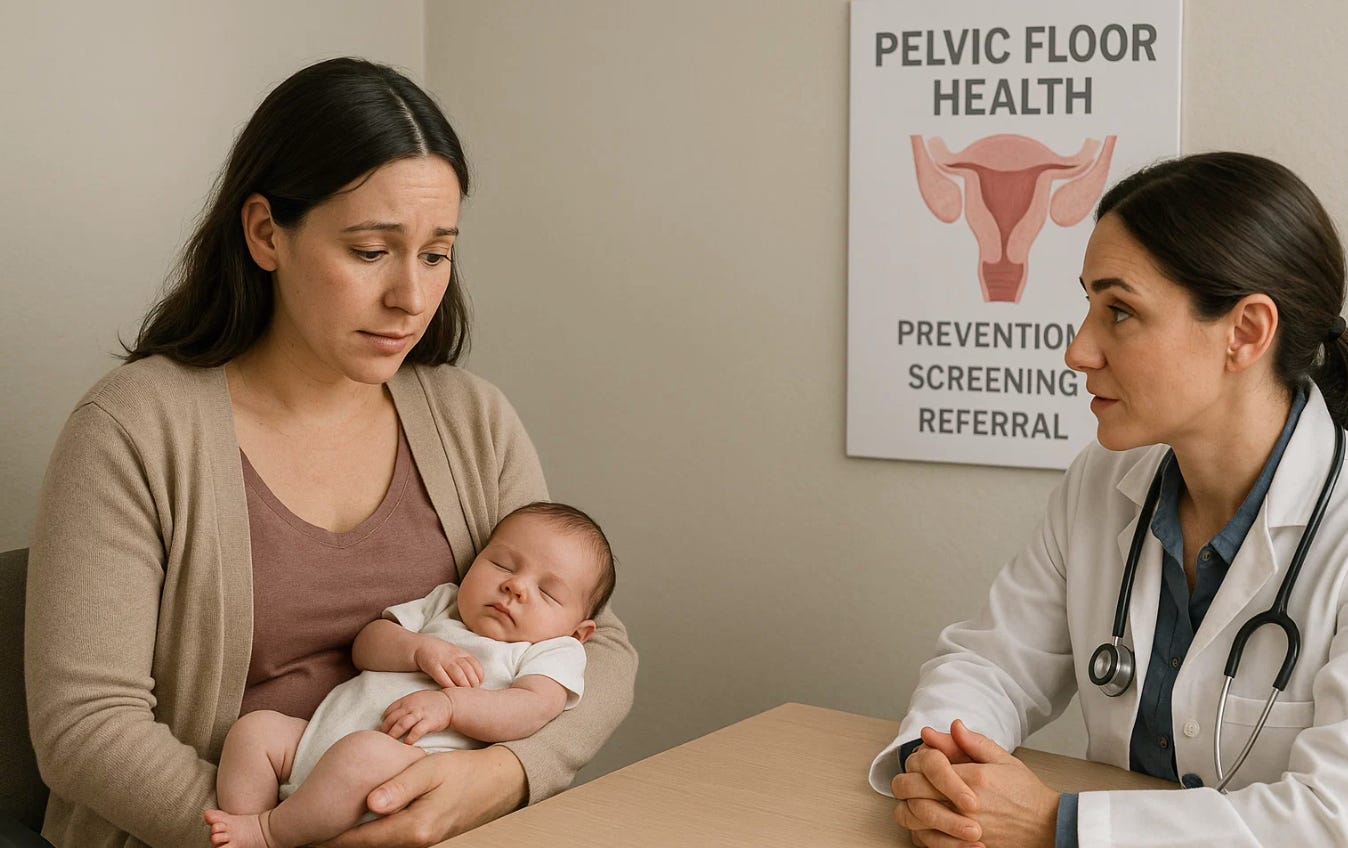
Every year, millions of women give birth. And every year, millions of those same women quietly suffer from something we hardly talk about: leaking urine after childbirth. It is common. It is preventable. And it is treatable. Yet in our postpartum visits—the one moment designed to address the changes women face—it is too often ignored.
The Unspoken Problem
Postpartum urinary incontinence is not rare. Depending on the study, as many as one in three new mothers will experience it in the months following delivery. The numbers are striking: after vaginal birth, rates of incontinence can be as high as 30–40%. After cesarean delivery, the rates are lower—often 10–15%—but not zero. The myth that cesarean birth “protects” against incontinence is only partly true. It reduces the risk, but it does not eliminate it.
That means no woman is immune. Vaginal delivery increases risk, but pregnancy itself—by stretching, compressing, and weakening the pelvic floor—already sets the stage.
And yet, most women are never told about it before delivery, never asked about it afterward, and never offered the tools to prevent or treat it. Silence is not an accident. It is the predictable outcome of a health care culture that normalizes women’s suffering and shies away from anything considered embarrassing.
Why Professionalism Demands Action
This is not just about incontinence. It is about what it means to be a professional. A professional anticipates risk. A professional informs patients about preventable complications. A professional never allows discomfort or taboo to override responsibility.
The 18th-century physician John Gregory, one of the earliest writers on medical ethics, made it clear: physicians are duty-bound not only to treat illness but to protect patients from avoidable harm. If postpartum incontinence is common, harmful, and largely preventable, then not asking about it at a postpartum visit is a professional failure.
Think about it this way: if a cardiologist failed to screen for high blood pressure—a silent, common, preventable cause of suffering—we would call it malpractice. Why is leaking urine after childbirth treated differently?
The Biology Behind the Silence
Pregnancy and birth transform the pelvic floor. Hormones loosen connective tissues. The growing uterus presses on the bladder for months. Labor stretches muscles and nerves, sometimes injuring them permanently, especially after long pushing or instrument-assisted deliveries. Even cesarean sections don’t eliminate risk, though they reduce it.
The result is a fragile system at the very moment when a woman is caring for a newborn, exhausted, and least likely to prioritize her own symptoms. Too often she assumes it is simply her new reality. And too often her clinician lets that assumption stand.
Prevention Isn’t Rocket Science
Here’s the tragedy: prevention is not complicated. Pelvic floor exercises, known as Kegels, strengthen the very muscles that control continence. Supervised training, sometimes with physical therapists and biofeedback, works best, but even consistent home practice can reduce risk.
Early education matters. Women who are taught how to perform pelvic floor exercises during pregnancy are more likely to continue them afterward, and more likely to recover quickly. The problem is not that we don’t know what works. The problem is that we don’t ask, don’t tell, and don’t normalize prevention.
Screening Better
How do we screen better? First, we need to normalize the question. Instead of waiting for a woman to volunteer, which many never will, clinicians should ask directly and without euphemism:
“Since your delivery, have you noticed any leakage of urine when you cough, sneeze, or exercise?”
This is not a long conversation—it takes seconds. Yet it signals that the issue matters, that it is common, and that there are solutions.
Screening should not stop at six weeks. Many women develop symptoms months later. A responsible system would incorporate screening into every well-woman visit during the first postpartum year.
Referral and Treatment
And when a woman answers yes? That is where referral matters. Pelvic floor physical therapy is the gold standard. These specialists use biofeedback, guided muscle training, and individualized strategies. They can transform lives.
But sometimes symptoms are persistent or more severe, and that is when referral to a urogynecologist is essential. A urogynecologist is a physician trained in both gynecology and urology. The visit may include a detailed history, a physical exam of the pelvic floor muscles, and sometimes tests such as bladder diaries, urine flow measurements, or urodynamic studies that assess how well the bladder and urethra function under stress. Some women may also undergo imaging, like ultrasound or MRI, to look for hidden injuries. The point is not to embarrass, but to precisely identify the cause of leakage so treatment can be targeted—whether that means advanced physical therapy, medications, or, in rare cases, surgery.
By naming the problem, testing it carefully, and offering individualized solutions, the urogynecologist does what every professional should: take women’s suffering seriously.
A Seatbelt for the Pelvis
The best analogy is seatbelts. Most of us will never need them, but we buckle up every time because the risk is real and the consequences are severe. Incontinence after childbirth may not be as visible as a car crash, but for the women who suffer, it shapes their physical, emotional, and social lives.
If we accept seatbelts as universal prevention, why not accept pelvic floor training as the same? The risk is high enough, the intervention simple enough, and the consequences serious enough to justify routine screening and education.
The Guideline Gap
And here is the uncomfortable truth: the American College of Obstetricians and Gynecologists (ACOG) does not currently recommend routine screening for postpartum urinary incontinence at every postpartum visit. They acknowledge it as a common complication, but they stop short of requiring systematic inquiry or universal prevention.
That is not good enough. If professionalism means anything, it means moving beyond the bare minimum. ACOG should take the lead and make urinary incontinence screening as standard as postpartum depression screening. Anything less leaves women to fend for themselves, forced to navigate one of the most common complications of childbirth in silence.
When guidelines lag behind evidence, professionalism requires clinicians to lead.
The Cost of Neglect
Failing to ask carries costs, both personal and societal. Women may withdraw from physical activity, increasing long-term risks of obesity and cardiovascular disease. They may avoid social situations, worsening postpartum depression. They may lose productivity at work or spend money on pads and treatments years later.
The silence is not just embarrassing. It is expensive, unhealthy, and unfair.
The Ethical Question
Here is the unavoidable conclusion: not asking about postpartum incontinence is not neutral. It is a choice that allows preventable suffering to persist.
Professionalism demands better. Screening should be routine. Education should be universal. Prevention should be standard. If ACOG is not ready to put this in writing, then clinicians must do it themselves. Because the only thing more uncomfortable than asking about incontinence is explaining why you never did.
Reflection
Medicine prides itself on progress. We celebrate new technologies, complex surgeries, and genetic breakthroughs. Yet here is a simple, common problem with a simple, common solution, ignored not because it is hard, but because it is awkward.
That is not progress. That is complacency. And for the millions of women living with postpartum incontinence, it is unacceptable.
If one question at a postpartum visit could change the trajectory of a woman’s health for decades, isn’t silence the real malpractice?