

The Most Human Delay: Why So Many Women Miss the Warning Signs of Preterm Labor
The Safety Ledger: Human hesitation is predictable — but in preterm labor, it’s deadly. We beat heart attacks by teaching people not to wait; now obstetrics must do the same.

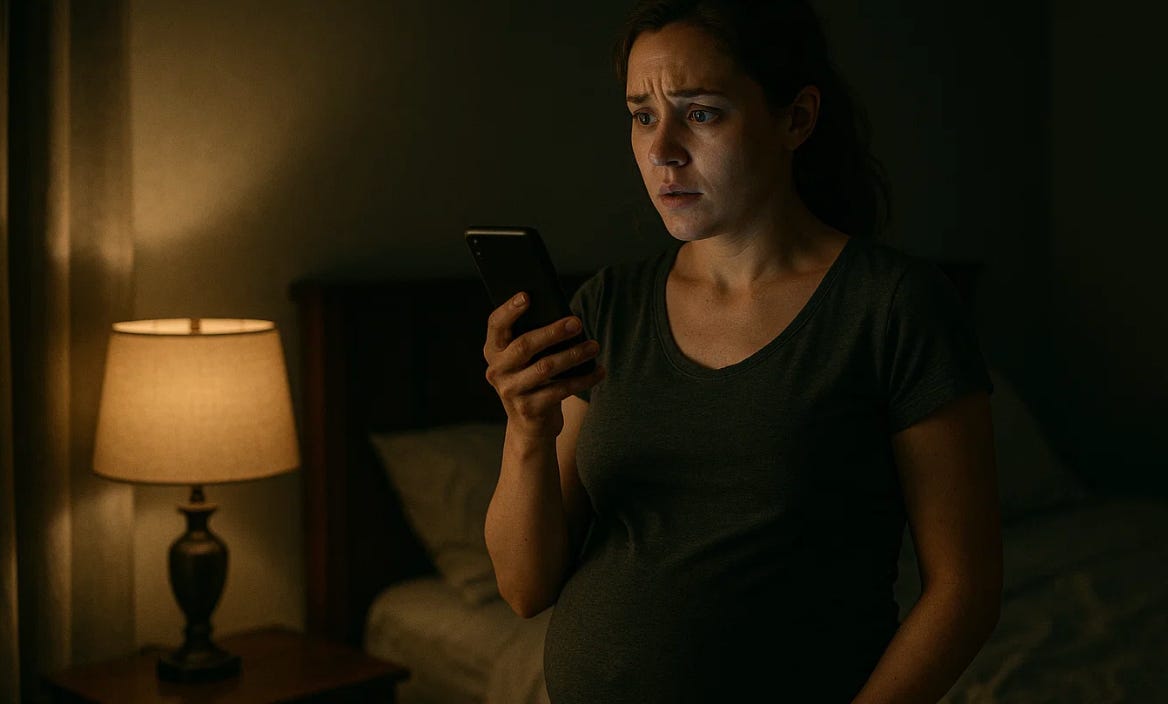
We praise instinct, but in medicine, instinct can kill.
Every obstetrician knows the story: the woman who felt a little crampy, maybe “a bit off,” decided to wait until morning — and delivered at 29 weeks.
She didn’t ignore the danger; she re-interpreted it. That’s what humans do.
The Bias That Costs Babies
If economics teaches us anything, it’s that delay has a cost.
If psychology teaches us anything, it’s that delay feels rational while we’re doing it.
Preterm birth, like a recession, rarely arrives without warning.
There are tremors — cramps, pressure, back pain, leaking fluid — that seem harmless until they accumulate into catastrophe. Every year, roughly one in ten births in the United States happens too soon. And preterm birth still accounts for most perinatal deaths and a large share of long-term disability.
Yet, despite decades of public campaigns, most women who go into spontaneous preterm labor have symptoms for hours or even days before seeking care. They “sleep on it,” precisely the way people once did with chest pain before cardiologists trained us to call 911.
This isn’t ignorance. It’s a predictable cognitive pattern — normalcy bias.
We tend to underestimate rare but catastrophic risks because our brains crave calm explanations. A backache is easier to live with than the idea of a baby arriving at 28 weeks.
Why We Wait
Economists talk about opportunity cost: we measure what we lose when we choose inaction.
Psychologists talk about loss aversion: we’d rather risk disaster quietly than appear foolish publicly. In obstetrics, both forces converge in the mind of a pregnant woman deciding whether to call her doctor at 11 p.m. for “probably nothing.”
She worries about overreacting, being scolded, paying a bill for false alarm.
She calibrates risk emotionally, not statistically.
And the system encourages it — because it often dismisses symptoms as “normal pregnancy discomfort.” When the culture rewards stoicism and punishes sensitivity, silence becomes the rational choice.
That’s why so many arrive too late.
By the time contractions are obvious, the cervix may already be dilating.
At that point, medications can’t always stop labor, and the clock starts ticking on a newborn’s survival.
The Subtle Signs We Rationalize Away
Let’s call them the “economic indicators” of preterm labor — small signals that markets and pregnancies alike tend to ignore until the crash.
Pelvic pressure or fullness: a quiet shift in equilibrium, like the first wobble before inflation spikes.
Menstrual-like cramps or back pain: dismissed as noise, though they’re often the early data points of an approaching crisis.
Change in discharge or leaking fluid: the liquidity metaphor writes itself.
Spotting or bleeding: a red flag the system downplays until it’s too late.
Sudden fatigue, nausea, or feeling “off”: the soft signals our intuition downgrades because they don’t fit the expected pattern of labor.
None of these symptoms are dramatic. That’s precisely the problem. Humans are poor at acting on ambiguous evidence. We prefer the comfort of “wait and see,” even when we know that waiting can be lethal.
The Paradox of Progress
We’ve built neonatal intensive care units that can keep a 24-week infant alive — tiny miracles wrapped in plastic domes. But our behavior hasn’t caught up with our technology. The medical system can rescue the baby; it just can’t persuade the mother to come in soon enough.
Cardiology solved this once already. Public education transformed “heartburn” into a 911 call. People learned that chest pressure, not just pain, means danger.
In obstetrics, we still rely on the false reassurance of “probably nothing.”
Every minute matters. The phrase “Time is muscle” became cardiology’s mantra. Obstetrics needs its equivalent: “Time is maturity.” Each hour of delay steals potential lung tissue, brain growth, and survival probability.
The Systemic Blind Spot
Here’s where Nobel prize winner Paul Krugman lens meets the Daniel Kahneman one: the problem is not only individual hesitation but structural design.
Our health-care system treats urgent evaluation as a luxury.
Insurance hotlines route patients through endless menus.
Labor units tell callers to “monitor and hydrate.”
Appointments are scarce; after-hours access is worse. Over 40% of patient are on Medicaid and have no specific doctor to call.
For low-income women, transportation, childcare, and fear of medical bills make delay practically rational. In other words, the system itself creates the very behavior it condemns.
From an ethical standpoint, this is not patient noncompliance — it’s a failure of design. It’s a syetm failure.
When predictable human bias meets structural friction, bad outcomes are inevitable. The solution isn’t to scold patients for waiting; it’s to make not waiting easier.
Education as Behavioral Engineering
Behavioral economists discovered that framing changes everything. When we say, “Call your doctor if contractions come every 10 minutes,” many women think they can count later. But if we say, “Every 10 minutes means right now,” the framing alters urgency.
We should teach preterm warning signs the way flight attendants teach oxygen masks — clearly, repetitively, without embarrassment.
Every prenatal visit should end with a 30-second checklist:
“If you feel pain, pressure, leaking fluid, or bleeding — call. Don’t wait.”
No permission required, no apology needed.
Think of it as the obstetric equivalent of automatic enrollment. We shouldn’t rely on willpower or perfect reasoning; we should build systems that make the safe choice the easy one.
Reframing the Narrative
There’s also an emotional politics to this. Society romanticizes endurance in pregnancy — the “strong mother” who tolerates discomfort without complaint. But in truth, strength lies in vigilance, not denial. Calling for help early isn’t weakness; it’s strategy.
When a woman senses something’s wrong, she’s usually right.
Cognitive research shows that intuitive detection — the brain’s fast, subconscious pattern recognition — often outperforms formal reasoning in detecting subtle changes. We should empower that intuition, not silence it.
The Human Factor
After a heart attack, we praise survivors for “acting fast.”
After a preterm delivery, we often ask, “Why didn’t she come in sooner?”
Same psychology, different outcome.
One has a public health campaign; the other has stigma.
Women need permission to treat their symptoms with the same seriousness society grants chest pain. Clinicians need systems that respect those instincts instead of dismissing them as anxiety.
When both happen, preterm births decline.
When they don’t, we continue to trade preventable tragedies for misplaced composure.
Reflection / Closing
Nobel prize winner Kahneman once wrote that humans are “blind to their blindness.” In obstetrics, that blindness takes the form of waiting — waiting for certainty, waiting for morning, waiting for permission.
Krugman, another Nobel prize winner would remind us that delay isn’t neutral; it compounds. The cost of inaction accrues interest in neonatal intensive care units.
So here’s the rule, economic and ethical: when in doubt, act.
If you’re pregnant and something feels wrong, call, go, be checked.
Don’t just wait on the phone. Go and get checked.
No clinician ever regrets the false alarm that saves a baby.
We learned to beat heart attacks by recognizing the early signs.
It’s time we learned to do the same for preterm labor.
After all, time may be money — but in obstetrics, time is life.