
The MedMal Room: Yes, Many Brachial Plexus Injuries ARE Our Fault-And We’re Failing to Fix It
The uncomfortable truth: Many shoulder dystocia cases with brachial plexus injury result from intrauterine and intrapartum forces beyond clinician control

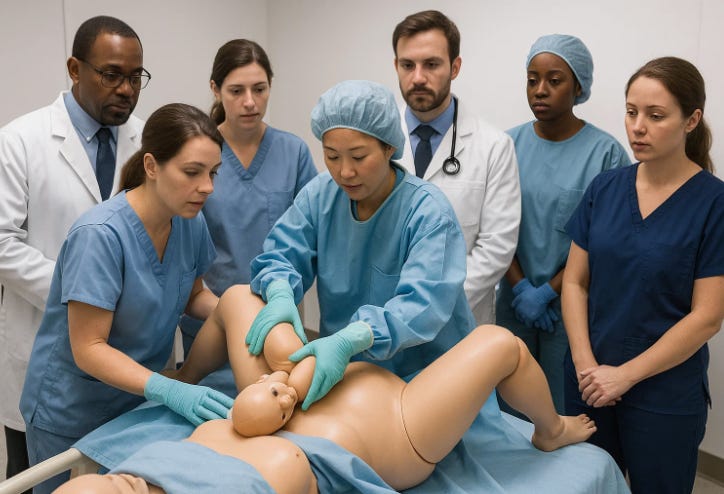
We cannot distinguish preventable from unpreventable brachial plexus injuries because we’ve systematically failed to ensure universal competency in shoulder dystocia management, real-time documentation, and simulation training.
Understanding Baby’s Brachial Plexus Injury
Brachial plexus injury represents a stretch or avulsion injury to the nerve roots arising from C5 through T1, which form the complex neural network controlling arm movement and sensation. These injuries occur when excessive lateral traction separates the fetal head from the shoulder, stretching the nerves beyond their elastic capacity.
The injury exists on a spectrum from neurapraxia with complete recovery to root avulsion with permanent paralysis, most commonly affecting the upper trunk in Erb’s palsy. What makes brachial plexus injury medicolegally contentious is that it can occur through multiple mechanisms.
Intrauterine forces can injure the plexus before labor even begins, particularly with abnormal fetal positioning, uterine anomalies, or prolonged compression against the maternal pelvis.
The injury can also occur during the second stage of labor from maternal expulsive forces alone, even in precipitous unattended deliveries without any clinician intervention.
And yes, it can occur during management of shoulder dystocia—that obstetric emergency where the anterior fetal shoulder impacts behind the maternal symphysis pubis after delivery of the head, preventing descent of the body.
Shoulder dystocia transforms every delivery into a time-critical emergency requiring immediate recognition, systematic maneuver execution, and team coordination. The head-to-body delivery interval matters enormously as the impacted fetus experiences progressive acidemia, yet the response to impaction—whether appropriate maneuvering or excessive traction—determines whether brachial plexus injury occurs. This is where clinical competence becomes the defining variable.
The Uncomfortable Truth
Brachial plexus injuries are among the main reasons doctors and hospitals are getting sued. When a baby sustains a permanent brachial plexus injury, we retreat into defensive positions. Obstetricians claim all injuries are unpredictable and unavoidable, the inevitable consequence of uncontrollable physiologic forces. Plaintiffs’ attorneys claim all injuries result from excessive traction, the predictable consequence of panicked pulling. Both are wrong (Yes, doctors can be wrong too). And our refusal to acknowledge this fundamental reality costs babies their arm function while simultaneously making it impossible to defend clinicians who actually practiced appropriately.
What We Know But Refuse to Operationalize
Excessive traction does cause avoidable injuries. Panic, inexperience, and failure to execute proper maneuvers injure babies. We know this. The obstetrician who applies fundal pressure during shoulder impaction, who pulls harder instead of performing maneuvers, who delays calling for help, who has never trained on simulation, who cannot articulate which maneuvers were performed and when—this clinician is practicing negligently. Full stop.
Yet we’ve created a system where proving appropriate management is nearly impossible. Most residency programs provide inadequate hands-on simulation training, often limiting residents to a single mannequin session or relegating shoulder dystocia education to didactic lectures. And many hospitals don’t involve attendings or staff in training. Real-time documentation during emergencies is either non-standardized or completely absent, with most delivery notes completed retrospectively when memory has already begun to fail. Many practitioners have never drilled the full HELPERR algorithm under timed conditions with the cognitive load and physical constraints of an actual emergency. We have no systematic competency verification for shoulder dystocia management beyond the vague assumption that completion of residency confers competence. Most hospitals lack mandatory annual simulation requirements, allowing skills to atrophy over years of practice.
What Research Demonstrates About Prevention
The evidence for simulation training’s effectiveness in reducing brachial plexus injuries is compelling and consistent across multiple institutions and continents. Draycott and colleagues demonstrated in their seminal 2008 study that implementation of mandatory multiprofessional shoulder dystocia training reduced brachial plexus injury rates from 9.3% to 2.3% of shoulder dystocia cases in the immediate post-training period.
The Bristol group’s twelve-year longitudinal study published in 2016 showed even more dramatic sustained improvement, with brachial plexus injury rates declining from 7.4% pre-training to 1.3% in the late training period, and remarkably, zero cases of permanent brachial plexus injury lasting over twelve months in 562 shoulder dystocia cases after a decade of sustained training.
Inglis and colleagues reported similar results from their American cohort, with overall obstetric brachial plexus palsy in vaginal deliveries decreasing from 0.40% pre-training to 0.14% post-training, and injury rates after shoulder dystocia dropping from 30% to 10.67% following implementation of their training program.
Most recently, Kaijomaa’s 2023 study from Helsinki University Hospital demonstrated significant reduction in permanent brachial plexus birth injuries following institution of regular weekly multiprofessional simulation sessions, with the most significant improvement attributed to increased successful delivery of the posterior arm.
What unites these studies is not merely that training improves outcomes, but that systematic, repeated, mandatory simulation training with objective performance assessment produces measurable, sustained reductions in permanent neurologic injury to newborns.
The Devastating Consequence
When injury occurs, we cannot differentiate between two fundamentally different clinical scenarios. We cannot distinguish the obstetrician who executed textbook McRoberts positioning, suprapubic pressure, and internal rotation in ninety seconds from the obstetrician who panicked and pulled. Both cases look identical in retrospective chart review. The documentation says “shoulder dystocia, maneuvers performed, healthy baby” until the brachial plexus injury declares itself weeks later when the infant fails to move the affected arm.
This diagnostic inability creates a perverse medicolegal environment. The competent, well-trained clinician who performed flawlessly cannot prove it. The undertrained clinician who caused injury through poor technique can hide behind vague documentation and the general acknowledgment that some injuries are unavoidable. We’ve created a system that protects incompetence while failing to protect excellence.
The Clinical Reality We Avoid Discussing
Consider what actually happens in many hospitals at three in the morning. The obstetrician manages a prolonged second stage, achieves vertex delivery, and encounters unexpected shoulder dystocia. The response depends entirely on that individual clinician’s training, recent experience, and comfort with emergency maneuvers. There is no cognitive aid posted at the bedside. There is no standardized callout system. There is no designated team member documenting each maneuver in real time. The obstetrician’s last simulation training may have been years ago, and the specifics of proper hand placement for internal rotation have faded into vague memory.
Under these circumstances, injury is not just possible but probable when things go wrong. Yet we continue to pretend that simply “knowing about” shoulder dystocia maneuvers translates into competent performance under stress. We continue to accept documentation that reads “shoulder dystocia managed with maneuvers, good outcome” without any specification of which maneuvers, in what sequence, with what duration of head-to-body delivery interval.
The Aviation Standard We Refuse to Adopt
Commercial airline pilots are required to undergo recurrent simulator training every nine to twelve months throughout their entire careers, regardless of experience level. Each recurrent training cycle typically mandates twelve to twenty hours of high-fidelity simulator time over multiple consecutive days, focusing exclusively on emergency procedures and abnormal situations.
These simulations specifically address high-stakes emergencies that pilots hope never to encounter in actual flight—engine failures, hydraulic malfunctions, severe weather encounters, emergency descents. The training is not optional, not suggested, not dependent on individual motivation or hospital resources. It is federally mandated by aviation regulatory authorities.
A pilot with thirty years of experience and ten thousand flight hours must return to the simulator with the same frequency as a newly certified first officer, completing the same hours of emergency scenario training, and passing the same proficiency evaluations.
The aviation industry determined decades ago that rare, high-consequence emergencies require maintained procedural competency that cannot be assumed based on credentials alone. Skills atrophy. Memory fades. Stress impairs performance.
The only way to ensure competent emergency response is through repeated, evaluated practice in realistic conditions. We accept this standard without question when boarding an aircraft. Yet we resist applying the same logic to obstetric emergencies that occur in every labor and delivery unit, affecting outcomes with consequences equally devastating as aviation disasters, but on an individual rather than collective scale.
What We Owe The Patient
We owe it to injured babies, and to competent clinicians, to mandate universal simulation training with objective competency assessment before independent practice. Not a single mannequin session in residency, but repeated, high-fidelity simulation with demonstrated proficiency under timed, stressful conditions. We need standardized real-time documentation protocols with closed-loop communication, timed maneuver documentation, and cognitive aids at every delivery. These aids should be as ubiquitous as crash carts in hospital wards.
And doctors who do not attend them at least once a year should not be allowed to deliver babies.
We should require annual re-certification through high-fidelity simulation, just as we require ACLS recertification despite decades of experience managing cardiac arrests. We should seriously consider video recording in delivery rooms as we do in operating rooms to enable objective review when complications occur. And we need honest peer review that identifies substandard management without blanket exculpation, review that can distinguish between the unavoidable injury despite excellent technique and the avoidable injury caused by poor management.
The Documentation Failure That Perpetuates Ignorance
We cannot distinguish preventable from unpreventable brachial plexus injuries because we’ve systematically failed to ensure universal competency in shoulder dystocia management, real-time documentation, and simulation training. Hospitals should not only train but also document the learning. Every labor and delivery unit should implement standardized, structured electronic fetal monitoring and delivery note templates that require complete contemporaneous documentation: time of recognition, sequence and timing of maneuvers, team communication, and estimated traction direction and force.
These templates should prompt entries during the event, not hours later. Equally vital is the institutional requirement for a post-event debrief—within 24 hours, attended by all involved staff, to review what happened, what was done, and what could be improved. Without such learning documentation, we lose every opportunity to transform an emergency into a source of collective learning.
A well-designed documentation system, coupled with simulation-based training, transforms shoulder dystocia from a medicolegal minefield into a teachable clinical process.
The goal is not merely to record what occurred but to create a permanent feedback loop, one that strengthens safety culture, identifies skill gaps, and generates data robust enough to separate the truly unavoidable injury from the preventable one.
Elements of an Optimal Shoulder Dystocia Documentation Standard
Real-time capture: A designated recorder documents events contemporaneously, including recognition time, sequence of maneuvers, and intervals between each.
Structured template: The delivery note should use a mandatory electronic or paper checklist, preformatted to prompt for each HELPERR step (call for Help, Evaluate for episiotomy, Legs, Pressure, Enter maneuvers, Remove posterior arm, Roll).
Timing entries: Automatic or manual time stamps for head delivery, recognition of dystocia, each maneuver, and birth of the shoulders/body.
Traction description: Direction (downward, lateral, rotational), hand placement (head vs. neck), and qualitative estimate of traction (minimal, moderate, forceful).
Communication log: Names and roles of all staff present, who called for help, and what closed-loop communication occurred.
Team performance: Identify leader, assign tasks (recorder, neonatal provider, nurse), and note if the neonatal team was called before or after resolution.
Infant outcome: Immediate neonatal condition, Apgar scores, limb movement, and whether brachial plexus examination was performed before transfer.
Debrief record: Required post-event meeting summary with learning points, timing of review, and documentation of whether findings were entered into the quality improvement system.
Video or audio option (if institutional policy allows): Optional confidential recording to allow objective review, limited to protected peer-review use.
Simulation linkage: Each documented event should trigger a follow-up simulation or case review if documentation was incomplete or if maneuvers were delayed or ineffective.
The Real Question
If we’re not willing to implement systematic approaches that distinguish competent from incompetent management, do we really believe shoulder dystocia injuries are preventable? Or are we protecting a system that allows inadequately trained clinicians to practice while simultaneously making it impossible to defend those who train rigorously and perform appropriately?
The status quo serves neither babies nor obstetricians. It only serves mediocrity. It allows us to avoid the uncomfortable work of setting real standards, enforcing real competency requirements, and acknowledging that some injuries reflect substandard care while others represent the irreducible risk of human parturition. Until we’re willing to make these distinctions operationally, every brachial plexus injury will remain litigated in an evidence vacuum where neither plaintiff nor defendant can prove what actually happened in that delivery room.
The real scandal isn’t that some babies are injured during delivery. The real scandal is that we’ve built a system incapable of learning which injuries were preventable.
Draycott TJ, Crofts JF, Ash JP, Wilson LV, Yard E, Sibanda T, Whitelaw A. Improving neonatal outcome through practical shoulder dystocia training. Obstet Gynecol. 2008;112(1):14-20.
Crofts JF, Lenguerrand E, Bentham GL, Tawfik S, Claireaux HA, Odd D, Fox R, Draycott TJ. Prevention of brachial plexus injury-12 years of shoulder dystocia training: an interrupted time-series study. BJOG. 2016;123(1):111-8.
Inglis SR, Feier N, Chetiyaar JB, Naylor MH, Sumersille M, Cervellione KL, Predanic M. Effects of shoulder dystocia training on the incidence of brachial plexus injury. Am J Obstet Gynecol. 2011;204(4):322.e1-6.
Kaijomaa M, Gissler M, Äyräs O, Sten A, Grahn P. Impact of simulation training on the management of shoulder dystocia and incidence of permanent brachial plexus birth injury: An observational study. BJOG. 2023;130(1):70-7.