
Unequal Care: The Medicaid Wall
Medicaid covers 42% of U.S. births. Yet in many communities, the coverage doesn’t open a single door.

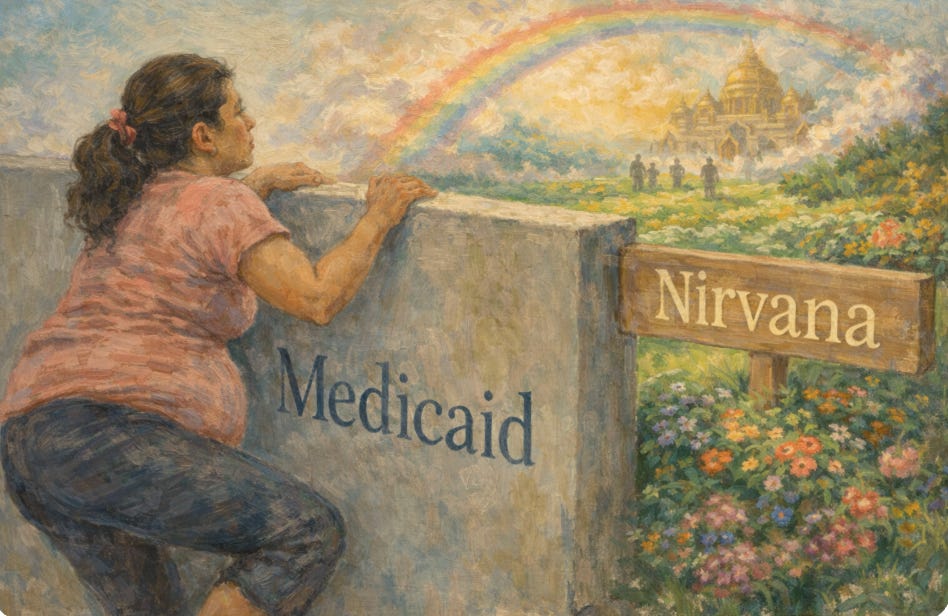
Forty-two percent. That is the share of American births covered by Medicaid. Among Black mothers, the number is 64%. Among Hispanic mothers, 58%. Medicaid is the single largest payer of maternity care in the United States.
And yet, across the country, the gap between Medicaid coverage and Medicaid access is widening.
Coverage means a card in your wallet. Access means a physician who will see you. These are not the same thing.
Who Accepts, Who Doesn’t
Nationally, about 82% of obstetrician-gynecologists accept new Medicaid patients. That sounds adequate until you look more closely. Among subspecialists, particularly maternal-fetal medicine specialists, reproductive endocrinologists, and gynecologic oncologists, the acceptance rates are lower, often much lower.
In states that expanded Medicaid under the Affordable Care Act, ObGyn acceptance actually dropped to 74%, compared to 90% in non-expansion states, likely because expansion increased demand without a proportional increase in reimbursement.
The math is straightforward. Medicaid pays roughly $6,500 for a delivery. Employer-sponsored insurance pays about $7-15,000. A practice that shifts its payer mix toward Medicaid without increasing volume faces a direct reduction in revenue per patient. Practices respond rationally. They limit Medicaid slots, restrict scheduling windows, or stop accepting new Medicaid patients altogether.
None of this requires anyone to be biased. The wall is built from reimbursement spreadsheets, not from prejudice.
The Geography of Exclusion
The Medicaid wall is not uniform. It varies by state, by specialty, and by region. In states with the lowest Medicaid-to-Medicare fee ratios, access is worst. Patients in these states face longer wait times, fewer available providers, and greater distances to reach subspecialty care.
More than a third of U.S. counties have no obstetrician and no birthing center. The March of Dimes reports that 2.2 million women of childbearing age live in maternity care deserts. These deserts overlap heavily with communities where Medicaid is the dominant insurer.
This is not a coincidence. When reimbursement is low and volume is limited, practices close or consolidate. The communities most dependent on Medicaid are the ones most likely to lose services.
What the Medicaid Wall Costs
The consequences of the Medicaid wall are measurable. Women in maternity care deserts travel an average of 2.6 times farther to reach a hospital with labor and delivery services. Longer travel times during labor are associated with higher rates of out-of-hospital births, delayed care for complications, and longer hospital stays.
Medicaid patients are less likely to receive early prenatal care, less likely to access subspecialty referrals, and less likely to have continuity of care across pregnancy and postpartum. These are not failures of patient motivation. They are failures of system architecture.
The Medicaid wall does not announce itself. There is no sign on the door that says poor women not welcome. The wall is built from policies that look neutral: network restrictions, scheduling algorithms, panel caps, credentialing delays. Each one is defensible in isolation. Together, they create a barrier that is predictable in who it excludes.
The Professional Responsibility Question
Medicine has historically understood Medicaid acceptance as a professional obligation. ACOG states that Medicaid is essential to ensuring healthy mothers and babies. The American Medical Association’s principles of medical ethics include a responsibility to support access to care for all patients.
But professional principles do not pay overhead. The tension between professional obligation and financial viability is real. The question is not whether the tension exists. It is whether we acknowledge it honestly or pretend it does not shape who gets care.
A system that covers 42% of births but cannot guarantee those births access to adequate care is not a coverage system. It is a coverage illusion.