The Impossible Conversation: How AI Can Finally Deliver What Pregnant Women Deserve Before Vaginal Birth
How a 19-item consensus list shows the gap between what women deserve and what the system actually delivers. And why "Cesarean" is missing.
A clear look at twenty essential counseling topics for birth and how AI can help us finally cover them.
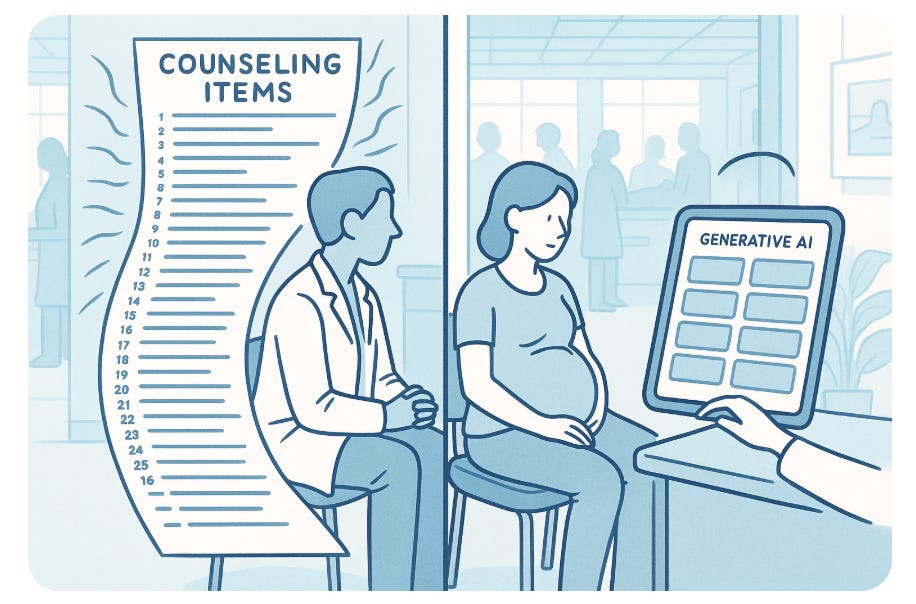
The recent Delphi consensus on what should be discussed when preparing for a vaginal birth is ambitious and honest. It lists nineteen detailed counseling domains that every pregnant woman should understand before labor. The reality is that no obstetrician or midwife practicing in a ten-minute visit system can cover all nineteen in depth. Yet women deserve exactly this level of information.
Instead of lowering expectations, we should redesign how the information is delivered. Generative AI offers a path. Not to replace counseling, but to make full informed consent finally possible.
Below are all twenty counseling domains, including the one the Delphi group left out: cesarean birth. Each item includes how AI can help and a ready-to-use prompt to generate the material.
1. The overall process of labor and birth
Pregnant women deserve a clear understanding of how labor begins, how it usually progresses, and how much variation is normal. Labor is a physiologic process with wide ranges in timing, sensation, and duration. Knowing the stages of labor helps reduce fear and gives women a sense of orientation before contractions begin. It is equally important to stress that no two labors follow the same script.
Prompt: “Create a personalized, plain-language timeline of how labor typically progresses for a [first-time or multiparous] woman at [X] weeks, including stages, duration ranges, and when to call.”
2. Maternal benefits of vaginal birth
Vaginal birth generally allows for quicker recovery, less postoperative pain, and shorter hospital stays. It carries lower risks of infection and avoids complications linked to abdominal surgery. Long-term benefits include reduced risk of placenta accreta and uterine rupture in future pregnancies. These advantages often go unrecognized unless clearly explained.
Prompt: “Make a simple comparison chart explaining maternal benefits of vaginal birth versus cesarean, including recovery, infection risk, and future pregnancy effects.”
3. Maternal risks of vaginal birth
Although vaginal birth is typically safe, it can involve tearing, hemorrhage, pelvic floor injury, or an unplanned cesarean. Individual risk varies based on anatomy, fetal size, fetal position, and labor management. Being upfront about both common and rare risks prevents surprise or feelings of failure. Realistic counseling supports informed, confident decision making.
Prompt: “List this patient’s specific maternal risks during vaginal birth in simple language and categorize them as common, less common, or rare.”
4. Short-term neonatal benefits of vaginal birth
Babies often transition more smoothly to breathing and thermoregulation after vaginal birth. They tend to feed earlier and may benefit from exposure to maternal microbiota. These physiologic benefits are meaningful but should be described without overstating guarantees. Families appreciate understanding why vaginal birth is helpful when it is safe.
Prompt: “Explain the short-term neonatal benefits of vaginal birth using a simple diagram-style description suitable for patient education.”
5. Short-term neonatal risks of vaginal birth
Some newborns experience temporary issues such as shoulder dystocia, bruising, low Apgar scores, or the need for brief resuscitation. These outcomes are uncommon and usually resolve quickly with appropriate care. Parents often feel less frightened when they know these possibilities ahead of time. Balanced counseling maintains trust while avoiding undue alarm.
Prompt: “Write a neutral, non-frightening explanation of potential neonatal risks of vaginal birth and how clinicians address them.”
6. Pain and analgesia options
Pain in labor is highly variable, and each woman’s preferences matter. Options include epidural anesthesia, IV medications, nitrous oxide, hydrotherapy, and non-pharmacologic techniques. Many women find comfort in knowing they can adjust their plan during labor. Clear counseling removes pressure to choose in advance or meet unrealistic expectations.
Prompt: “Generate a personalized labor pain-management plan for a patient who prefers low-intervention approaches but is open to an epidural if needed.”
7. Induction and augmentation
Induction can change the timing and feel of labor and may influence the likelihood of certain interventions. Methods include medication, mechanical dilation, and membrane sweeping. Women benefit from understanding why induction might be recommended and what the experience may involve. Clear expectations reduce anxiety and frustration.
Prompt: “Compare spontaneous labor versus induction at 39 weeks for a low-risk first-time mother, written in simple, patient-friendly language.”
8. Continuous fetal monitoring
Electronic fetal monitoring affects mobility and can change how clinicians interpret labor progress. Understanding baseline, variability, decelerations, and what they mean helps demystify the tracings. Parents often assume monitors guarantee safety, which is not the case. Transparent explanation helps right-size expectations.
Prompt: “Explain continuous fetal monitoring and define baseline, variability, accelerations, and decelerations at an 8th-grade reading level.”
9. Instrumental vaginal birth
Vacuum or forceps may be used when the baby needs to be delivered quickly or when pushing is no longer effective. Many parents fear these tools simply because they have never seen them. A short explanation in advance reduces panic if an assisted birth becomes necessary. Understanding typical newborn findings prevents surprise.
Prompt: “Create a short, reassuring explanation of vacuum-assisted birth, including indications and what newborn findings may look like afterward.”
10. Emergency cesarean
Even a well-planned vaginal birth can require sudden surgical delivery. Emergencies arise from fetal distress, stalled labor, or bleeding. When families know this is possible, they cope better and trust the process more fully. Explaining urgency without dramatizing it is key.
Prompt: “Write a 30-second explanation of why an emergency cesarean may become necessary, suitable for real-time communication in labor.”
11. Episiotomy
Episiotomy is no longer performed routinely and is reserved for specific clinical situations. It may prevent more severe tearing in certain circumstances but may be unnecessary in others. Women appreciate understanding why the practice has changed. Clear explanation prevents confusion if the procedure is recommended during delivery.
Prompt: “Explain when an episiotomy may be recommended and why it is not routinely used.”
12. Perineal trauma and recovery
Tears are common and typically heal well with proper care. Recovery often includes swelling, discomfort, and changes in bowel habits. Women benefit from explicit instructions on hygiene, pain control, and red-flag symptoms. Knowing what is normal helps them feel more in control postpartum.
Prompt: “Create a day-by-day perineal recovery guide for a patient after a second-degree tear.”
13. Pelvic floor effects
Temporary urinary leakage, bowel changes, and discomfort with intercourse can occur after vaginal birth. These symptoms usually improve with time and pelvic floor therapy. Providing anticipatory guidance reduces shame and normalizes recovery. Early referral when symptoms persist improves long-term outcomes.
Prompt: “Write a patient-friendly explanation of pelvic floor symptoms after birth and when to seek pelvic floor therapy.”
14. Postpartum hemorrhage
Hemorrhage is uncommon but remains one of the most significant maternal risks. Clinicians monitor closely and intervene quickly with medications and procedures. Explaining both the rarity and the preparedness of the team reduces anxiety. Women feel safer when they understand how the risk is managed.
Prompt: “Explain postpartum hemorrhage in clear language, including risk factors, prevention strategies, and standard treatments.”
15. Immediate newborn care
The first hour after birth focuses on stabilization, bonding, and early feeding. Skin-to-skin contact, vitamin K, and routine assessments are standard. Parents often feel more relaxed when they know what will occur and why. Understanding early interventions supports bonding and reduces confusion.
Prompt: “Generate a simple checklist describing what happens in the first hour after birth and the purpose of each step.”
16. Breastfeeding expectations
Breastfeeding often requires practice, patience, and support. Many women experience early challenges such as latching difficulty or nipple discomfort. Normalizing these issues empowers them to seek help without feeling they have failed. Early education improves persistence and success.
Prompt: “Write a short breastfeeding expectations guide that includes normal challenges and when to request lactation support.”
17. Birth environment and support
Knowing who will be in the room and what each person’s role is helps reduce fear of the unknown. Nurses, physicians, midwives, doulas, and pediatric teams each contribute differently. Understanding these roles improves communication and trust. It also clarifies who makes which decisions during labor.
Prompt: “Describe who participates in labor care at a typical U.S. hospital and what each person’s role is.”
18. Autonomy and shared decision making
Pregnant women should feel empowered to ask questions and expect clear explanations. Consent is not a one-time event but an ongoing conversation. When women know their choices matter, satisfaction rises even if plans change. Respectful communication strengthens the patient-clinician partnership.
Prompt: “Generate ten questions a pregnant woman can ask during labor to support shared decision making.”
19. Variability and uncertainty in childbirth
Birth is unpredictable, and flexibility is necessary. Plans may shift based on labor progress, fetal wellbeing, or maternal health. Preparing families for variability reduces disappointment when changes occur. Resilience grows when uncertainty is framed as normal rather than as failure.
Prompt: “Create three example labor scenarios showing how plans may change, written in a calm and reassuring tone.”
20. Cesarean birth: the missing domain
One in three to one in four women in the United States gives birth by cesarean, yet this topic is often under-discussed. Women need to understand indications, risks, benefits, and recovery expectations. They also deserve clarity on the difference between planned and unplanned cesarean. Leaving this out of counseling undermines informed decision making.
Prompt: “Write a balanced explanation of why cesarean occurs in one-third of U.S. births, how planned and unplanned cesareans differ in risk, and what women should know beforehand.
”
Closing Reflection
The Delphi group is right. Pregnant women should understand all of these domains. The problem is not clinicians. The problem is time.
AI gives us a way to meet the ethical standard pregnant women deserve by producing explanations, visuals, summaries, and risk discussions that no single visit can accomplish. Used carefully, reviewed by clinicians, and delivered in plain language, AI becomes a safety tool, an equity tool, and a dignity tool.
If we build systems intentionally, informed consent will no longer be an aspiration. It will finally be real.
20 PROMPTS
1. “Create a personalized, plain-language timeline of how labor typically progresses for a [first-time or multiparous] woman at [X] weeks, including stages, duration ranges, and when to call.”
2. “Make a simple comparison chart explaining maternal benefits of vaginal birth versus cesarean, including recovery, infection risk, and future pregnancy effects.”
3. “List this patient’s specific maternal risks during vaginal birth in simple language and categorize them as common, less common, or rare.”
4. “Explain the short-term neonatal benefits of vaginal birth using a simple diagram-style description suitable for patient education.”
5. “Write a neutral, non-frightening explanation of potential neonatal risks of vaginal birth and how clinicians address them.”
6. “Generate a personalized labor pain-management plan for a patient who prefers low-intervention approaches but is open to an epidural if needed.”
7. “Compare spontaneous labor versus induction at 39 weeks for a low-risk first-time mother, written in simple, patient-friendly language.”
8. “Explain continuous fetal monitoring and define baseline, variability, accelerations, and decelerations at an 8th-grade reading level.”
9. “Create a short, reassuring explanation of vacuum-assisted birth, including indications and what newborn findings may look like afterward.”
10. “Write a 30-second explanation of why an emergency cesarean may become necessary, suitable for real-time communication in labor.”
11. “Explain when an episiotomy may be recommended and why it is not routinely used.”
12. “Create a day-by-day perineal recovery guide for a patient after a second-degree tear.”
13. “Write a patient-friendly explanation of pelvic floor symptoms after birth and when to seek pelvic floor therapy.”
14. “Explain postpartum hemorrhage in clear language, including risk factors, prevention strategies, and standard treatments.”
15. “Generate a simple checklist describing what happens in the first hour after birth and the purpose of each step.”
16. “Write a short breastfeeding expectations guide that includes normal challenges and when to request lactation support.”
17. “Describe who participates in labor care at a typical U.S. hospital and what each person’s role is.”
18. “Generate ten questions a pregnant woman can ask during labor to support shared decision making.”
19. “Create three example labor scenarios showing how plans may change, written in a calm and reassuring tone.”
20. “Write a balanced explanation of why cesarean occurs in one-third of U.S. births, how planned and unplanned cesareans differ in risk, and what women should know beforehand.”
TEN ADDITIONAL PROMPTS TO MAXIMIZE COUNSELING (21–30)
21. “Summarize this patient’s individualized risk for preeclampsia, preterm birth, and postpartum hemorrhage in plain language, including what she can do to reduce risk.”
22. “Explain the signs of labor versus false labor using simple language and create a ‘when to come to the hospital’ checklist.”
23. “Write a clear explanation of fetal movement expectations in the third trimester and when decreased movement requires evaluation.”
24. “Create a simple guide comparing spontaneous labor, induction, augmentation, and cesarean, including the typical recovery time for each.”
25. “Generate a postpartum warning-sign checklist covering bleeding, infection, hypertension symptoms, mood changes, and when to call immediately.”
26. “Explain Group B Strep testing and treatment in pregnancy using plain language, including what happens if antibiotics are needed in labor.”
27. “Write a clear, patient-friendly explanation of what ‘failure to progress’ means and how it is diagnosed and managed.”
28. “Create a guide explaining newborn nursery vs rooming-in options, including feeding support, monitoring, and parental involvement.”
29. “Explain the difference between normal postpartum mood changes and postpartum depression, including when to seek help.”
30. “Generate a third-trimester birth-preparation checklist covering logistics, packing, expectations, pain options, newborn procedures, and postpartum recovery essentials.