
The Future of AI in Obstetrics: Between Wonder and Responsibility
The future has arrived. Or has it?

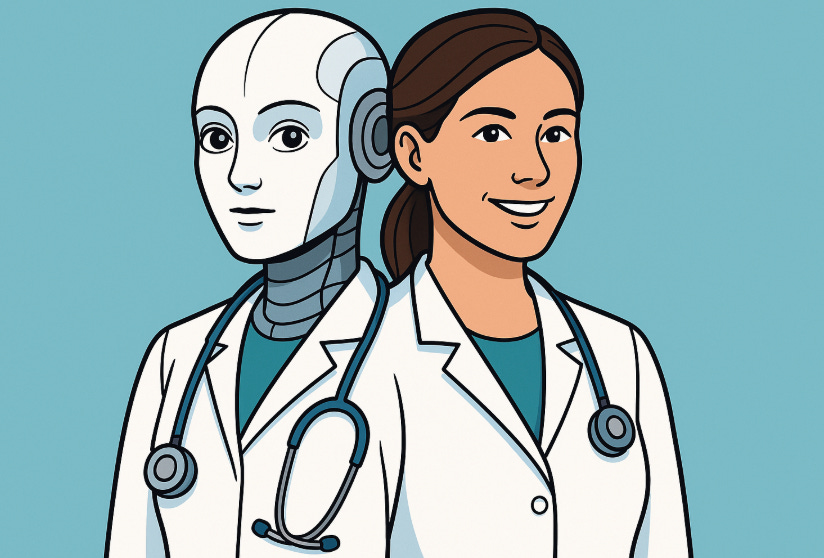
“AI will not deliver the baby soon—but an obstetrician who understands AI will deliver safer, smarter, and more efficient and compassionate care than the one who ignores it.” © Amos Grünebaum
Picture this: a pregnant woman in a rural clinic gets an ultrasound. No radiologist is available, but within seconds an AI algorithm delivers a detailed interpretation. In another room, a patient worried about a high-risk cesarean has a conversation not just with her doctor but with an AI trained on millions of similar cases. We are entering this future right now. The question is: will AI remain an assistant—or will it quietly take over parts of obstetrics we once thought only humans could do?
The Promise of AI in Obstetrics
Obstetrics has always depended on technology—from the stethoscope to electronic fetal monitoring to in-vitro fertilization to ultrasound. AI is simply the next frontier, but its reach is unprecedented.
In sonography, algorithms can not only measure fetal growth more consistently than tired human eyes, but also detect anomalies with a sensitivity that rivals experienced specialists. Subtle signs of heart malformations or skeletal dysplasia, often missed in real time, can be flagged instantly. Continuous fetal heart rate monitoring, long criticized for false positives and subjective interpretation, may be transformed by AI that learns from millions of tracings, distinguishing benign decelerations from early hypoxic patterns with remarkable accuracy.
And the reach extends beyond the delivery room. In research, AI can process birth certificate data, electronic records, and imaging archives at a speed no human team can match. What once took months of chart abstraction can now be condensed into days. The potential is staggering. But technology is never just about potential—it is also about responsibility.
Consent in the Age of Algorithms
Consent has always been more than signatures and checkboxes. It is about understanding, dialogue, and trust. Yet in modern medicine, time pressures often reduce it to a hurried conversation and a form thrust into a patient’s hands.
AI may disrupt this dynamic. Already, patient-friendly AI counselors can explain procedures in plain language, repeat information endlessly without annoyance, and adapt explanations to different literacy levels or cultural backgrounds. And unlike many of us under pressure, AI never shows frustration or impatience.
What unsettles some is that patients often report feeling more cared for by AI explanations than by their doctors. When a patient with placenta previa refuses a cesarean, a physician might explain once or twice and then grow exasperated. An AI counselor, however, will calmly reframe the risk again and again until understanding emerges. If the patient ultimately consents, was it the machine that communicated compassion more effectively? If so, perhaps we should rethink what “informed consent” really means in the AI era: not a replacement of the human physician, but a genuine partnership between human judgment and synthetic patience.
Ethics: Neutral Tool or Biased Partner?
The ethical stakes of AI are profound. On the surface, AI feels like a neutral tool: a calculator for medicine. But no algorithm is truly neutral. Training data come from our own messy, biased world. If cesarean rates are higher for minority patients due to structural racism, AI trained on those outcomes risks recommending more cesareans for those same patients. If women have been underrepresented in clinical trials, AI inherits those blind spots.
History offers a warning. Obstetrics once embraced forceps as a universal solution, only to later realize the harm of overuse. We once dismissed women’s pain as “normal” labor suffering, only to learn the consequences of untreated trauma. AI, if treated as “objective,” risks becoming the next uncritical dogma. The ethical mandate is clear: AI must be constantly tested for bias, and physicians must remain vigilant interpreters, not passive users.
Compassion—Machine or Human?
For decades, physicians reassured themselves that compassion was the last bastion of humanity in medicine. A machine could calculate, but it could never care. The reality, however, is less comforting.
In controlled studies, patients often rate AI-generated responses as more empathetic and supportive than those of physicians. Why? Because AI does not tire. It does not rush. It does not show irritation. It never interrupts. It always mirrors back empathy. A woman facing a devastating prenatal diagnosis may feel more validated by an AI’s gentle, structured reassurance than by a physician who, though deeply caring, is pressed for time and emotionally guarded.
Of course, AI does not “feel” compassion. It mimics the language of care. But for patients in distress, the effect may be indistinguishable—or even superior. This does not diminish the role of the physician. Rather, it challenges us: if patients feel more compassion from AI than from us, perhaps the problem is not the machine, but our failure to create space for genuine connection.
Research and Peer Review
Few areas are as ripe for transformation as research and peer review.
Currently, publishing a single obstetric study can take a year or more from submission to print. Manuscripts spend months in editorial limbo, waiting for reviewers—busy clinicians or scientists who volunteer their time, unpaid, often at night after hospital shifts. The process is slow, opaque, and, too often, inconsistent. Review quality varies wildly: one reviewer might offer thoughtful feedback, while another dismisses months of work in a few careless sentences. Editors struggle to find reviewers at all. Many manuscripts receive superficial or biased reviews.
The result? Enormous delays, frustrated authors, and a system sustained by free labor. And despite all this, errors slip through. Retractions are rising. Important findings languish unpublished.
Another growing problem is the rise of paper mills and fabricated submissions—fake studies churned out for profit, complete with falsified data, recycled text, and even forged reviewer recommendation letters. Detecting these fakes consumes enormous editorial time and often succeeds only after publication, further eroding trust. A striking example is a paper that claimed to analyze WeChat use over the decade 2008–2018, even though WeChat was not launched until 2011. A human peer reviewer, pressed for time, might skim the methods and results and miss this obvious impossibility. This is not laziness but the reality of cognitive overload: most reviewers focus on the statistics, tables, and study design, not on fact-checking external timelines. Worse, biases creep in—reviewers may assume the journal’s editorial team has already screened basic facts (authority bias), or that the paper’s plausibility fits their prior beliefs (confirmation bias). Thus, nonsense can slip through the net of traditional peer review.
AI, by contrast, could automatically cross-check external references, dates, and claims against real-world data. An algorithm would immediately flag that a ten-year WeChat dataset could not exist. It could also highlight recycled text indicative of paper mill products, statistical distributions too neat to be real, or reference lists padded with irrelevant or fabricated citations.
AI could change this. Already, large language models can identify statistical errors, missing references, and unclear methodology within minutes. They can summarize strengths and weaknesses with more consistency and less hostility than many human reviewers. Early trials have shown that editors sometimes rate AI-generated reviews as more constructive and kinder than those written by experts.
This does not mean replacing human reviewers entirely. Peer review is also about professional responsibility, contextual judgment, and ethical oversight. But it does mean we could offload the tedious, mechanical, and fact-checking work to AI—freeing human experts to focus on what truly matters: clinical significance, ethical soundness, and innovation. If AI can cut the months-long backlog, help defend against paper mills, and reduce the impact of reviewer bias, it might make science both faster and fairer.
A Relatable Analogy
Think of AI as a GPS. It can map the fastest route, reroute around traffic, and suggest rest stops. But it does not know your toddler is carsick, or that you prefer the scenic road to the fastest one. Medicine is the same: AI can guide, but physicians must integrate human context.
Yet unlike a GPS, AI can also comfort you when the road is blocked. It does not snap “recalculating!” in irritation. It patiently explains, again and again, every alternative. That is why patients may sometimes prefer the AI’s bedside manner to ours.
What Is Overlooked
The greatest danger may not be AI making mistakes. Doctors make mistakes too, and probably even more often than AI. It may be us abdicating responsibility. When physicians stop questioning, stop engaging, and let AI carry the moral weight, we risk becoming passive bureaucrats. Neutrality is not an option in obstetrics, where the stakes are measured in lives. The professional duty is not simply to document or to accept the machine’s output, but to advocate relentlessly for patient safety and well-being.
Practical Lessons
Patients: Do not dismiss AI as “cold technology.” It may explain things more patiently than a rushed doctor—but ask where the data come from.
Physicians: Use AI as augmentation, not replacement. If your patients feel more compassion from AI than from you, reflect on how to do better.
Researchers: Train AI on diverse, representative data. Test for bias. Do not confuse speed with fairness.
Editors and Journals: Stop relying solely on unpaid labor. Harness AI to reduce delays, improve consistency, and restore trust in peer review.
Policy-makers: Require transparency and human accountability at every stage of AI use in medicine.
Reflection / Closing
The irony is striking: AI cannot feel love or grief, yet patients often report feeling more compassion from it than from us. Peer reviewers pour months of unpaid labor into a broken system, yet AI may write more constructive feedback in seconds.
This should not make us defensive. It should make us better.
The future of obstetrics will not be man or machine. It will be man and machine—physicians providing accountability, ethical judgment, and authentic humanity, while AI contributes precision, patience, and the surprising performance of compassion.
The real question is this: when patients begin to trust AI more than us—not only for accuracy, but for empathy—will we rise to reclaim our role, or quietly surrender it?
Hashtags
#Obstetrics #MaternalHealth #AIinMedicine #MedicalEthics #Ultrasound #PeerReview #CompassionInCare