
The Four-Letter Word We Got Wrong: How “Diet” Became a Weapon Against Women
The Greek physician Hippocrates didn’t prescribe diaita as a temporary restriction—he described it as the totality of how someone lived: what they ate, yes, but also how they exercised, rested, etc.

A patient sits in my office, eight weeks pregnant, listing the foods she’s eliminating. “I’m cutting carbs,” she tells me. “And I switched to diet soda—zero calories.” She looks at me hopefully, waiting for approval.

She’s doing exactly what decades of marketing have taught her. She’s “watching her diet.” The problem is that the word she’s using doesn’t mean what she thinks it means. And that linguistic corruption has cost women their health, their peace of mind, and sometimes their pregnancies.
What “Diet” Actually Means
The word diet comes from the ancient Greek diaita (δίαιτα), meaning “way of living” or “manner of life.” The Greek physician Hippocrates didn’t prescribe diaita as a temporary restriction—he described it as the totality of how someone lived: what they ate, yes, but also how they exercised, rested, and cared for their bodies. The Latin diaeta carried this forward: a “prescribed way of life.”
For more than two thousand years, your “diet” meant simply what you eat. A panda’s diet consists mainly of bamboo. The Mediterranean diet describes how people in that region traditionally nourish themselves—olive oil, vegetables, fish, wine with meals. The DASH diet (Dietary Approaches to Stop Hypertension) is a pattern of eating designed to lower blood pressure.
In these contexts, “diet” retains its original meaning: an eating pattern. A description, not a deprivation.
Then came 1963.
The Hijacking of a Word
When Coca-Cola launched Tab in 1963, marketed to women who wanted to “keep tabs” on their weight, and when Royal Crown Cola renamed its sugarless drink “Diet Rite,” something shifted in the English language. The adjective “diet” took on a new meaning: reduced, restricted, less than.
By 1982, when Diet Coke debuted with its “Just for the taste of it!” campaign (note the defensive marketing—they knew the word had become toxic), the transformation was complete. “Diet” no longer meant how you live. It meant how you suffer.
Consider how absurd this is linguistically. A “diet soda” should mean a soda that constitutes someone’s habitual drink—the way “her diet consists of...” describes what someone eats. Instead, it means a soda with something removed. The word “diet” has become a prefix meaning absence.
The Taxonomy of Corruption
Once you see how “diet” has been weaponized, you notice it everywhere:
Diet soda. Not “sugar-free soda.” Not “artificially sweetened soda.” The marketing chose “diet” deliberately—associating the product with weight loss, restriction, and the aspirational suffering of the thin ideal.
Diet pills. Pharmaceutical interventions marketed not as medications but as shortcuts around eating. The word “diet” here implies you’re cheating on your diaita—getting the result without the living.
Diet food. Processed products engineered to be lower in calories, often by removing fat and adding sugar, or removing sugar and adding artificial sweeteners. The phrase “diet food” is an oxymoron: food is diet. What they mean is modified food, altered food, food made worse so you can eat more of it.
Diet plan. Temporary restriction protocols designed for weight loss. Not an eating pattern, but an interruption of eating. The opposite of diaita.
On a diet. The definitive corruption. “I’m on a diet” means “I am temporarily restricting food intake to achieve weight loss.” It implies a before and after, a start and stop. But you cannot be “on” a way of living. You simply live.
Why This Matters for Women’s Health
The linguistic corruption of “diet” has disproportionately targeted women. When Coca-Cola launched Diet Coke in 1982, early marketing specifically targeted female consumers; when the company later wanted to attract men, they created Coke Zero in 2005 because, as one executive noted, “diet is a four-letter word” for young men. Women were expected to embrace restriction. Men needed something rebranded.
This matters because language shapes thought. When we tell pregnant women to “watch their diet,” what do they hear? The Greek diaita, attend to your way of nourishing yourself? Or the 1963 Tab commercial, restrict, count, eliminate, suffer?
Research shows women receive contradictory messages about eating during pregnancy. “Eat for two” clashes with “don’t gain too much weight.” “Nourish your baby” clashes with “watch your diet.” The confusion isn’t accidental—it reflects two incompatible meanings of the same word operating simultaneously.
The consequences are measurable. Diet culture, the belief system that equates thinness with virtue, is linked to disordered eating, which affects far more women than men. When pregnant women bring this mindset into their care, they may restrict when they should nourish. They may count calories when they should count nutrients. They may drink “diet” soda believing it’s virtuous, not realizing that artificial sweeteners may affect gut microbiome and insulin response in ways we’re still studying.
The Marketing of Life-Stage “Diets”
Open any women’s health magazine, scroll any wellness influencer’s feed, or browse the self-help section of any bookstore, and you’ll encounter an endless proliferation of condition-specific “diets”:
The pregnancy diet. The fertility diet. The breastfeeding diet. The postpartum diet. The PCOS diet. The endometriosis diet. The menopause diet. The hormone-balancing diet. The thyroid diet. The anti-inflammatory diet. The anti-aging diet. The PMS diet. The preconception diet. The detox diet. The cleanse diet. The gut-healing diet. The adrenal fatigue diet.
Each comes with its own book, its own supplement line, its own meal plan subscription, its own influencer ecosystem. Each implies that your particular life stage or condition requires a fundamentally different way of eating. Each suggests that without this specialized knowledge, you’re doing it wrong.
Here’s what the evidence actually shows:
When researchers study dietary patterns and health outcomes, they consistently find that the same fundamental eating patterns—adequate vegetables and fruits, whole grains, lean proteins, healthy fats, limited processed foods—benefit humans across virtually all conditions and life stages. The Mediterranean dietary pattern reduces cardiovascular risk, improves fertility outcomes, supports healthy pregnancy, eases menopausal symptoms, and lowers cancer risk. Not because it’s a different diet for each condition—because it’s a healthy way of eating that supports human physiology.
The pregnancy diet is not a special diet. It’s adequate nutrition with attention to a few specific nutrients (folate, iron, choline, omega-3 fatty acids) and avoidance of a few specific risks (listeria, high mercury fish, alcohol). The foundation is the same healthy eating pattern that benefits everyone.
The fertility diet is not a special diet. When researchers at Harvard studied diet and fertility in the Nurses’ Health Study, they found that the eating patterns associated with improved ovulatory function were... the same patterns associated with cardiovascular health and longevity. More plants, less processed food, healthy fats instead of trans fats. No magic fertility foods. No special combinations.
The menopause diet is not a special diet. Yes, calcium and vitamin D matter for bone health. Yes, some women find that certain foods trigger hot flashes. But the eating pattern that supports women through menopause is the same one that supports them before and after: adequate nutrition, diverse whole foods, limited ultra-processed products.
The PCOS diet, the endometriosis diet, the thyroid diet—each has been monetized into a cottage industry of books and programs. Yet when you examine the actual evidence-based recommendations, they converge on the same principles: manage insulin response through whole foods and fiber, reduce inflammation through omega-3s and antioxidants, support hormonal health through adequate nutrition. These are not separate diets. They are the same healthy eating pattern, repackaged and resold for each condition.
Why does this matter?
Because the proliferation of life-stage “diets” creates confusion, anxiety, and opportunity for exploitation. A woman navigating perimenopause doesn’t need a “menopause diet” book—she needs to understand basic nutritional principles and perhaps pay attention to calcium and phytoestrogens. A woman trying to conceive doesn’t need a “fertility diet” program—she needs adequate folate, a healthy weight, and the same diverse whole-foods eating pattern that benefits everyone.
The marketing of specialized diets also implies that women’s bodies are uniquely complicated, requiring constant expert intervention and purchased solutions. It fragments what should be a coherent approach to nourishment into a confusing array of competing protocols. It transforms eating—a basic human activity—into a technical problem requiring specialized equipment.
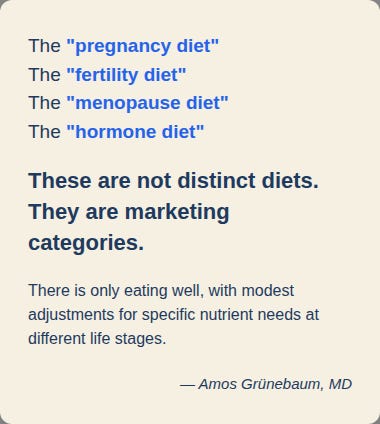
The truth is simpler and less profitable: There is no pregnancy diet, fertility diet, menopause diet, or any other condition-specific diet. There is only eating well, with modest adjustments for specific nutrient needs at different life stages.
The Mediterranean pattern. The DASH approach. Traditional foodways from cultures with good health outcomes. These are not “diets” in the corrupted modern sense. They are diaita—ways of living that nourish human bodies across the lifespan.
Everything else is marketing.
Reclaiming the Word
What would it mean to return “diet” to its original sense?
When a physician asks about your diet, they should mean: Tell me how you eat. What patterns of nourishment characterize your life? Not: Are you restricting?
When research examines “dietary patterns and pregnancy outcomes,” it should describe the Mediterranean dietary pattern, the DASH eating approach, traditional foodways of various cultures. It should describe adequacy, diversity, nourishment—not deficit.
When a pregnant woman says “I’ve been improving my diet,” it should mean she’s eating more vegetables, drinking more water, incorporating fatty fish for omega-3s. It should mean she’s moved toward diaita—a healthy way of living—not that she’s cutting, restricting, eliminating.
Practical Recommendations
For clinicians:
Stop asking if patients are “watching their diet” or “on a diet.” Ask instead: “Tell me about your eating patterns.” “What does a typical day of eating look like for you?” “Are you getting the nutrients you need?”
For patients:
When someone asks about your “diet,” clarify what they mean. If they mean eating patterns, engage fully. If they mean restriction, push back. You are not “on” anything. You are living your life.
Recognize “diet” as an adjective on products—diet soda, diet food—as a marketing term, not a health claim. A “diet” product is a modified product, often with trade-offs (artificial sweeteners for sugar, air for fat, chemistry for nourishment). It is not inherently better for you simply because it carries the label of deprivation.
The Ethical Dimension
The corruption of “diet” represents something deeper: the commodification of women’s bodies and the weaponization of language to serve commercial interests.
When a word that meant “way of living” becomes a prefix for restriction, industry has performed a kind of semantic theft. They took a neutral concept—how you eat—and loaded it with moral judgment. They transformed description into aspiration, observation into obligation.
Medicine should resist this. When we use “diet” properly—the Mediterranean diet, dietary fiber, dietary needs in pregnancy—we honor the word’s meaning. When we collude with the corruption—telling women to “diet” during pregnancy, to choose “diet” products, to restrict their “diets”—we participate in a system that has never served women well.
The Bottom Line
“Diet” is not a four-letter word. It’s a five-letter word, derived from Greek, meaning how you live and nourish yourself.
The four-letter word is the one the marketers made of it: a synonym for less, for restriction, for the temporary suffering required to achieve someone else’s aesthetic ideal.
Your diet is your diaita—your way of eating, your pattern of nourishment, the food that sustains your life. It is not a punishment. It is not a temporary departure from pleasure. It is not something you go “on” or “off.”
It is simply how you live.
And that—especially during pregnancy—is exactly what matters.