
The Evidence Room: What Your Baby Really Needs Isn’t in Drive-Thru Fast Food
From Germany to America, from Butterbrot to Big Macs: How cultural comfort foods became modern pregnancy risks—and how real protein can change the story.

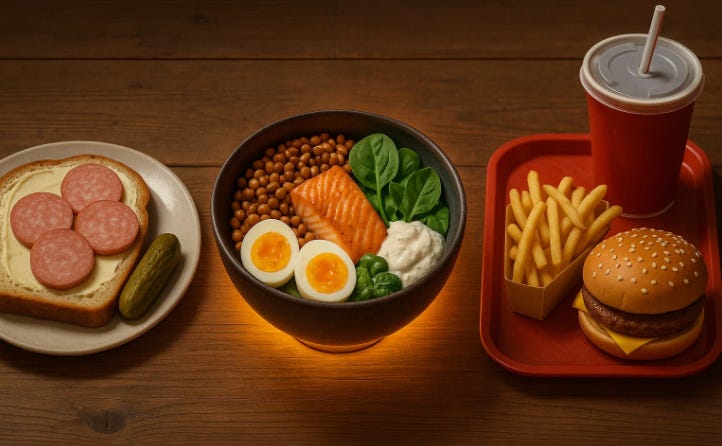
Why pregnancy is the perfect time to rethink protein, food quality, and the myth of “convenience.”
When I grew up in Germany, we didn’t eat fast food—but that didn’t mean we ate healthy.
Dinner was often Butterbrot: thick slices of white bread spread with butter so generously it glistened, topped with Wurst—salami, liverwurst, or ham. It was simple, satisfying, and unmistakably German. We believed it was wholesome because it came from home, not a restaurant. But nutritionally, it was mostly refined starch, animal fat, and salt. The Wurst was processed, the bread was white, and the butter was piled high. Looking back as a physician, I realize how cultural comfort often disguises nutritional emptiness.
Today’s fast food culture has merely industrialized that same pattern: high in fat, sodium, and additives, low in fiber, vitamins, and protective nutrients. The difference is scale—what used to be a local habit has become a global business model. And pregnancy is when those empty calories do the most lasting harm.
Let’s look at what “convenience” really delivers.
Popular Fast-Food ItemCaloriesProtein (g)Fat (g)Sodium (mg)Fiber (g)McDonald’s Big Mac59025341,0103Wendy’s Spicy Chicken Sandwich49028211,1002Taco Bell Beef Burrito Supreme46019181,2006Chick-fil-A Waffle Fries (large)5507332405Starbucks Frappuccino (grande)4006162300
That single “quick lunch” can top 2,000 calories—the daily target for an entire pregnancy diet—but with almost none of the nutrients needed for fetal growth. These meals fill the stomach, not the cells that are building a new life.
The Case Against Fast Food in Pregnancy
Fast food is engineered for shelf life, not fetal life. It’s loaded with oxidized oils, refined starches, and sodium that fuel inflammation, water retention, and insulin resistance. Regular intake increases the risk of excessive gestational weight gain, preeclampsia, and gestational diabetes.
Worse, your baby’s metabolism “learns” from your meals. Maternal diets rich in sugar and saturated fat can alter fetal gene expression in appetite and fat storage pathways—a process known as metabolic programming. What you eat becomes a biological message about the world your baby will enter.
Real Protein, Real Food
A recent New York Times article highlighted six affordable, non-meat protein sources that are ideal during pregnancy. Here’s how they support both mother and baby.
1. Legumes: Nature’s Prenatal Multivitamin
Beans, lentils, peas, and peanuts provide protein, fiber, folate, and iron—four essentials for pregnancy.
Half a cup of lentils offers 9 grams of protein and nearly 200 micrograms of folate, which helps prevent neural-tube defects and supports placental growth.
Use: microwave lentils, black beans in tacos, or chickpeas in salads.
Skip: fried or sugary bean dishes; rinse canned beans to lower sodium.
2. Eggs: Compact Brain Builders
Each egg contains 6 grams of complete protein and 150 mg of choline, vital for fetal brain and memory development. Most pregnant people consume far too little.
Forget the outdated cholesterol fears—pregnancy actually demands more cholesterol for hormone production and cell membranes.
Use: boiled eggs, omelets with vegetables, or frittatas for dinner.
Skip: greasy breakfast sandwiches from fast-food chains.
3. Fish: Protein Plus Omega-3s
Low-mercury, high-omega-3 fish such as salmon, sardines, trout, and anchovies deliver 22 grams of protein per 3.5-ounce serving plus DHA, essential for brain and eye development.
Aim for two servings a week; canned salmon or sardines are affordable and safe.
Skip: fried fish sandwiches or high-mercury species like swordfish and king mackerel.
4. Dairy: Protein and Calcium in One Spoon
Milk, yogurt, and cottage cheese offer complete proteins plus calcium, vitamin D, and iodine for bone and thyroid health. Greek yogurt delivers 18 grams of protein per cup and promotes healthy gut bacteria.
Use: yogurt with fruit and nuts, or smoothies.
Skip: sugar-laden yogurts and “milkshakes” sold as snacks.
5. Nuts and Seeds: Smart Snacking
Almonds, walnuts, chia, and pumpkin seeds add protein, magnesium, and healthy fats that stabilize blood sugar and support fetal brain development.
Use: add to oatmeal or salads, or spread nut butter on toast.
Skip: candy-coated nuts and “protein bars” high in syrup and palm oil.
6. Whole Grains: Protein in Plain Sight
Quinoa, oats, buckwheat, and brown rice supply 6–9 grams of protein per cup plus fiber, zinc, and B-vitamins. Combined with beans, they form complete proteins.
Use: batch-cook grains for easy meals.
Skip: white bread and “whole-grain” buns that are mostly refined flour.
Reflection on Processed Food and Meat
Processed meat holds a strange place in human culture—it feels traditional but is, in truth, one of the earliest forms of industrial food. Wurst, bacon, sausages, and deli meats were created to preserve animal protein before refrigeration. Today, those same foods are preserved with nitrites, salt, and chemical stabilizers that damage cells and raise the risk of cardiovascular disease and certain cancers. Plus, processed meat and cold cuts bought pre-sliced can harbor Listeria, a baby-killer.
During pregnancy, the problem deepens: processed meats are high in sodium and saturated fat but low in fiber and protective micronutrients. Frequent consumption can increase blood pressure and inflammation, both of which impair placental function. Even “lean” deli slices or turkey sausages marketed as “healthy” are often loaded with additives and lack the iron, zinc, and healthy fats that come from fresh, minimally processed proteins.
Culturally, processed meats carry nostalgia—just as my childhood Wurstbrot did—but nutritionally, they belong to the same category as fast food: convenient, tasty, and physiologically expensive. Real nourishment doesn’t need to be smoked, cured, or shrink-wrapped.
The Hidden Cost of Fast Food
That $8 combo meal might look cheap, but it’s costly to health: higher odds of gestational hypertension, cesarean birth, and postpartum weight retention. Processed meats, including Wurst, are now classified by the World Health Organization as Group 1 carcinogens for certain cancers—right beside tobacco.
By contrast, real food—beans, eggs, yogurt, grains—costs less per nutrient and delivers what supplements only imitate: balanced amino acids, minerals, and natural antioxidants.
Making It Work in Real Life
Healthy pregnancy eating is not about perfection; it’s about consistency and foresight.
Stock smart staples: beans, lentils, eggs, frozen fish, Greek yogurt.
Batch cook grains and store them in the fridge for quick meals.
Pack portable protein: boiled eggs, nuts, hummus with vegetables.
Drink water or milk, not sweetened beverages.
Trade one drive-thru meal each week for a lentil bowl, yogurt, and fruit. The change in energy and digestion will be noticeable within days.
Food as Prenatal Medicine
Pregnancy is the most creative phase of human biology. Every bite sends a biochemical signal to your baby about the kind of world they’re preparing to enter. A diet of fresh, protein-rich, minimally processed foods tells that developing brain and placenta, “This world is nourished and stable.”
Eating real food isn’t elitist—it’s preventive medicine. The best prenatal nutrition doesn’t come from a bottle but from beans, yogurt, eggs, and grains.
The Takeaway
When I think back to those childhood Butterbrote—the thick butter, the salty Wurst, the soft bread—I remember how “normal” it felt. No one questioned whether it was good for us; it was simply what everyone ate. That’s the quiet danger of culture: it normalizes the familiar, not necessarily the healthy.
Today, fast food plays the same role my childhood Wurstbrot did—only with more additives, more sugar, and more marketing muscle. But pregnancy is the moment to rewrite that story. Choose foods that build, not just fill. Replace nostalgia with nourishment.
Your baby won’t remember the taste, but their body will remember the chemistry.