
The Evidence Room: How Safe Is Birth Control?
Birth control isn’t just about avoiding pregnancy. It’s about choosing when, how, and under what circumstances to start a family—or whether to start one at all.

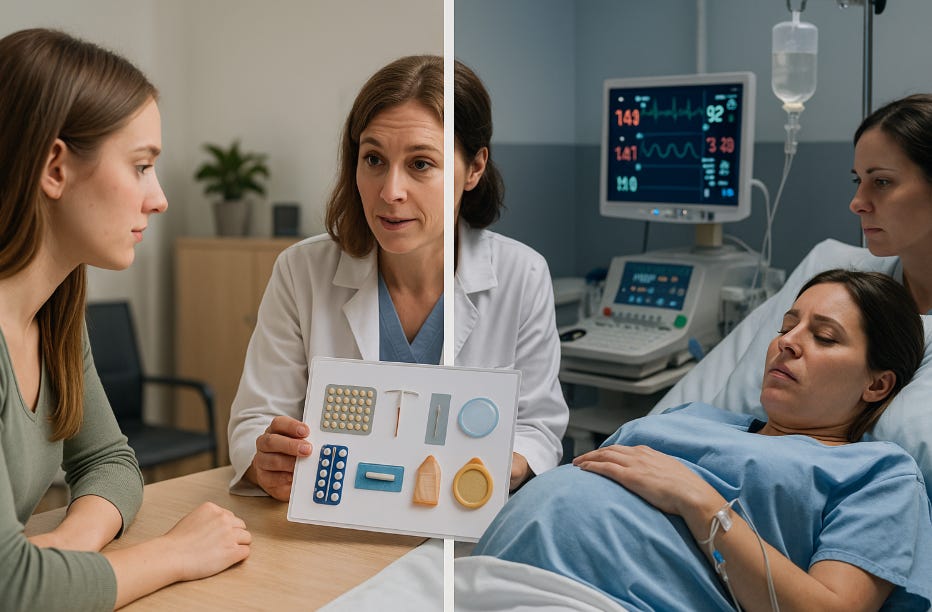
A patient once asked me, “Doctor, is birth control really safe—or am I trading one problem for another?”
That question has echoed across generations. What’s remarkable is not how dangerous contraception is, but how safe it is compared with the very thing it prevents: pregnancy. Yet the conversation about birth control often gets hijacked by fear, politics, or internet influencers. Let’s take a step back and look at the bigger picture.
More than prevention: a tool for freedom
Birth control isn’t just about avoiding pregnancy. It’s about choosing when, how, and under what circumstances to start a family—or whether to start one at all. It has given women and families the chance to finish school, build careers, manage medical conditions, and space children in ways that improve health. In many ways, contraception has done more for women’s health and equality than almost any other single medical intervention.
A short but fascinating history
The urge to control fertility is as old as humanity. Ancient Egyptians tried crocodile dung and honey pessaries. In the early 20th century, Knaus and Ogino offered the rhythm method—counting fertile days with nothing more than pencil and paper. Today, fertility apps do the same with algorithms. The 1960s pill was a revolution: suddenly a discreet pill could separate sex from pregnancy with remarkable reliability. Since then, we’ve refined methods—lower hormone doses, longer-acting devices, permanent procedures. Each generation has built a little more control, safety, and choice.
A landscape of choices
Think of contraception like a menu. Some items are permanent, some are daily specials, and some are “order only when you need it.” Here’s how it looks when you strip away the technical clutter:
Abstinence: the only method guaranteed to prevent pregnancy, but unrealistic as a lifelong plan for most.
Long-acting devices (IUDs, implants): set it and forget it, lasting years with tiny failure rates.
Pills, patches, and rings: reliable when used consistently, with side effects that are usually mild.
Injections: quarterly convenience, with a few quirks like possible weight changes.
Condoms: less effective for pregnancy prevention but the only method that truly protects against STIs.
Fertility awareness (including Knaus-Ogino rhythm): works best with discipline and regular cycles, least reliable otherwise.
Withdrawal: an old fallback, but high failure risk.
Permanent options (vasectomy, tubal ligation/salpingectomy): excellent effectiveness, but not reversible.
Emergency contraception: the “morning-after” solutions—most effective when fastest.
The forgotten comparison: pregnancy vs birth control
This is where the conversation often gets distorted. We obsess over the small, manageable risks of contraception—while ignoring the much greater risks of pregnancy itself.
Let’s look at the numbers:
Pregnancy-related death in the U.S.: about 1 in 2,500 pregnancies.
Death from the pill: fewer than 1 in 100,000 users.
Blood clot risk from pregnancy: about 5–10 times higher than from hormonal contraception.
In other words, the health risks of not using contraception—and becoming pregnant—are dramatically higher than the risks of using nearly any modern method.
But numbers don’t tell the whole story. Consider the complications that can come with pregnancy:
Hemorrhage: heavy bleeding that can require transfusion or emergency surgery.
Preeclampsia and eclampsia: high blood pressure that can damage kidneys, liver, or brain.
Gestational diabetes: a condition that can harm both mother and baby, and increase lifelong diabetes risk.
Cesarean surgery: now common, but still major surgery with infection and recovery risks.
Long-term consequences: pelvic floor damage, chronic pain, mental health effects, even higher risk of future heart disease.
Now compare this to birth control/contraception. The side effects most people worry about—spotting, mood changes, temporary weight fluctuations—are minor and reversible. Even rare complications like blood clots or infection from an IUD are far less common than the risks tied to a single pregnancy.
Think of it this way: birth control is like wearing a seatbelt. Yes, you might get a bruise from the strap in a crash. But the alternative—flying through the windshield—is far, far worse.
Why this matters
The real danger isn’t birth control—it’s the distortion of facts. When fearmongering drowns out science, people may abandon reliable contraception and face the far greater risks of unintended pregnancy. As physicians, we have an ethical duty to put numbers into perspective and stories into context.
The interesting truth is this: birth control is not just a set of pills and devices. It is one of the quiet pillars of modern public health. Safer than pregnancy, safer than many everyday medications, and transformative for generations.
Reflection
So the next time someone asks, “Is birth control safe?” maybe the better question is: Why do we keep questioning one of the safest and most empowering tools in medicine, while we accept the much higher risks of pregnancy without pause?