
Reproductive Justice Is a Beautiful Definition. It Is Not a Plan.
Rights without resources are not rights. They are intentions.

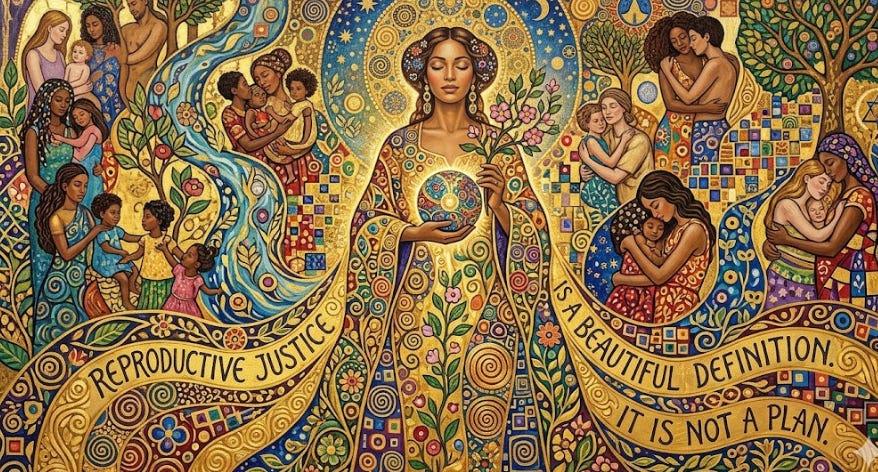
A woman I will call Maria delivered at a community hospital in the South Bronx. She had no prenatal care until 34 weeks. Not because she did not want it. Because she was on Medicaid, her local OB practice had a four-month wait for new Medicaid patients, and by the time her appointment arrived, she was already in her third trimester.
Maria’s story is not rare. It is the norm for millions of women in this country. And it is exactly what the reproductive justice movement was created to fix.
So why, 30 years after the framework was born, is Maria still waiting?
What the Framework Says
In 1994, a group of 12 Black women came together to respond to healthcare reform efforts they believed ignored the needs of Black women. Out of that meeting grew the reproductive justice framework, later adopted and expanded by SisterSong, the largest national multiethnic reproductive justice collective.
SisterSong defines reproductive justice as “the human right to maintain personal bodily autonomy, have children, not have children, and parent the children we have in safe and sustainable communities.”
That origin was legitimate. The work was important. The diagnosis was correct. Black women were being failed by the healthcare system in 1994, and they are being failed today.
My argument is not with the diagnosis. It is with the prescription — or rather, the absence of one.
What the Definition Leaves Out
Read the definition again. Bodily autonomy. The right to have children. The right to parent in safe communities. Every word is about rights.
Not one word is about payment. Not one word is about access. Not one word is about whether there is an obstetrician within 50 miles who will see you before 34 weeks, or whether that obstetrician has the resources to catch preeclampsia before it becomes a crisis, or whether the hospital where you deliver has drilled its postpartum hemorrhage protocol in the last six months.
Rights without resources are not rights. They are intentions.
The Real Engine of Reproductive Harm
The data are not hard to find. Medicaid reimburses obstetricians at roughly half the rate of private insurance. The American College of Obstetricians and Gynecologists has documented this payment gap for years. The consequence is straightforward: the best-trained physicians, the best-resourced practices, and the most capable hospitals have no financial incentive to take Medicaid patients. Many do anyway, out of mission. But many do not.
This is not primarily a racial bias story, though racial bias exists and matters. It is a payment story. Women of color are overrepresented among Medicaid enrollees in the United States — not by accident, but by history. So the payment gap falls hardest on them. The mechanism is financial. The outcome is racial. The conversation stays on race while the mechanism goes unrepaired.
The evidence from countries with universal health coverage is instructive. Racial disparities in maternal outcomes are substantially smaller in the United Kingdom, Canada, and the Scandinavian countries than in the United States. Not zero — racism exists everywhere. But smaller. Because when payment is removed as a barrier, the structural disadvantage that amplifies racial disparity is reduced.
Your ZIP Code Is More Predictive Than Your Race
Real reproductive justice is not just about rights. It is about the preconception visit that catches uncontrolled diabetes before the pregnancy begins. It is about the prenatal appointment at 10 weeks, not 34. It is about the postpartum visit at two weeks, not six — when the hemorrhage risk is still real and the mental health crisis is forming.
It is about having an obstetrician who has managed 5,000 deliveries, not 500. It is about a hospital that runs shoulder dystocia drills quarterly and postpartum hemorrhage simulations twice a year. It is about a maternal-fetal medicine specialist being a referral, not a fantasy.
None of that is in the SisterSong definition. All of it determines whether Maria lives or dies.
Thirty Years Later: What Has Changed?
The reproductive justice framework has generated scholarship, advocacy, and genuine attention to disparities in maternal care. These are not nothing.
But the U.S. maternal mortality rate has not improved. By several measures it has worsened. The Black maternal mortality rate remains two to three times the rate for white women. Obstetric deserts — counties with no obstetrician and no hospital with obstetric capability — have expanded, not contracted. Medicaid reimbursement rates have not kept pace with the cost of providing care.
A movement that correctly identified a problem 30 years ago and has not produced structural repair deserves a hard question: is the framework still helping, or has it become a substitute for the harder political work of fixing payment, access, and accountability?
What Reproductive Justice Would Actually Look Like
Every woman gets a preconception visit, regardless of her insurance or ZIP code. Chronic conditions are identified and stabilized before the pregnancy begins. High-risk pregnancies are identified early and routed to appropriate care. Postpartum follow-up starts within days of delivery, not weeks. Maternal-fetal medicine specialists are accessible to every woman who needs one, not just those with private insurance in major cities.
This requires Medicaid reimbursement parity. It requires obstetric workforce expansion in deserts. It requires hospital accountability for maternal outcome metrics. It requires political will that the framework has not yet demanded loudly enough.
None of this is in the SisterSong definition. All of it is in the data.
My Take
The reproductive justice framework earned its place in the conversation. The women who built it in 1994 were right about the problem. I do not question their moral clarity or their courage.
What I question is whether the framework, as it has evolved, is asking the right questions. “Bodily autonomy” is a right. It does not deliver a baby safely. “Safe and sustainable communities” is an aspiration. It does not staff a rural labor and delivery unit at 3 a.m.
Reproductive justice that does not demand Medicaid reimbursement parity, obstetric workforce expansion, and universal access to preconception and postpartum care is an incomplete argument. The definition is on the poster. The mechanism is in the payment schedule. Until the movement makes payment reform its loudest demand, Maria will keep waiting.
If you agree — or disagree — I want to hear it. What would it actually take to make reproductive justice real?