
Prosecuting Doctors Who Refuse Life-Saving Abortions
The Missing Obligation: Why Religious Exemptions Require Referrals

Post Summary
a user on Reddit’s r/Abortiondebate poses a direct question to pro-life users: If religion shouldn’t exempt patients from abortion restrictions, should it exempt physicians from liability when refusing life-saving abortions? The post notes that doctors aren’t exempt from negligence or malpractice in other contexts, and links to a Reuters article documenting that most states protect physicians who refuse abortions on religious grounds
Comment Summary (approximately 15 visible top-level comments, 50+ collapsed)
Responses split along predictable lines. Pro-choice commenters argued physicians who let patients die should face prosecution and license revocation. Pro-life responses ranged from “go to another doctor” (Dapper_Revolution_65) to explicit acceptance of maternal death as acceptable collateral damage (”It’s different when she’s pregnant” - RealNiceLady). One deleted pro-life commenter broke ranks, calling physicians who let both mother and fetus die rather than intervene a “POS.” A medical student (stonernunu) offered a visceral hypothetical about withholding resuscitation based on patients’ abortion views. Several commenters raised the critical issue of Catholic hospital acquisitions that occur without community notice, leaving patients unaware their local hospital operates under religious restrictions.
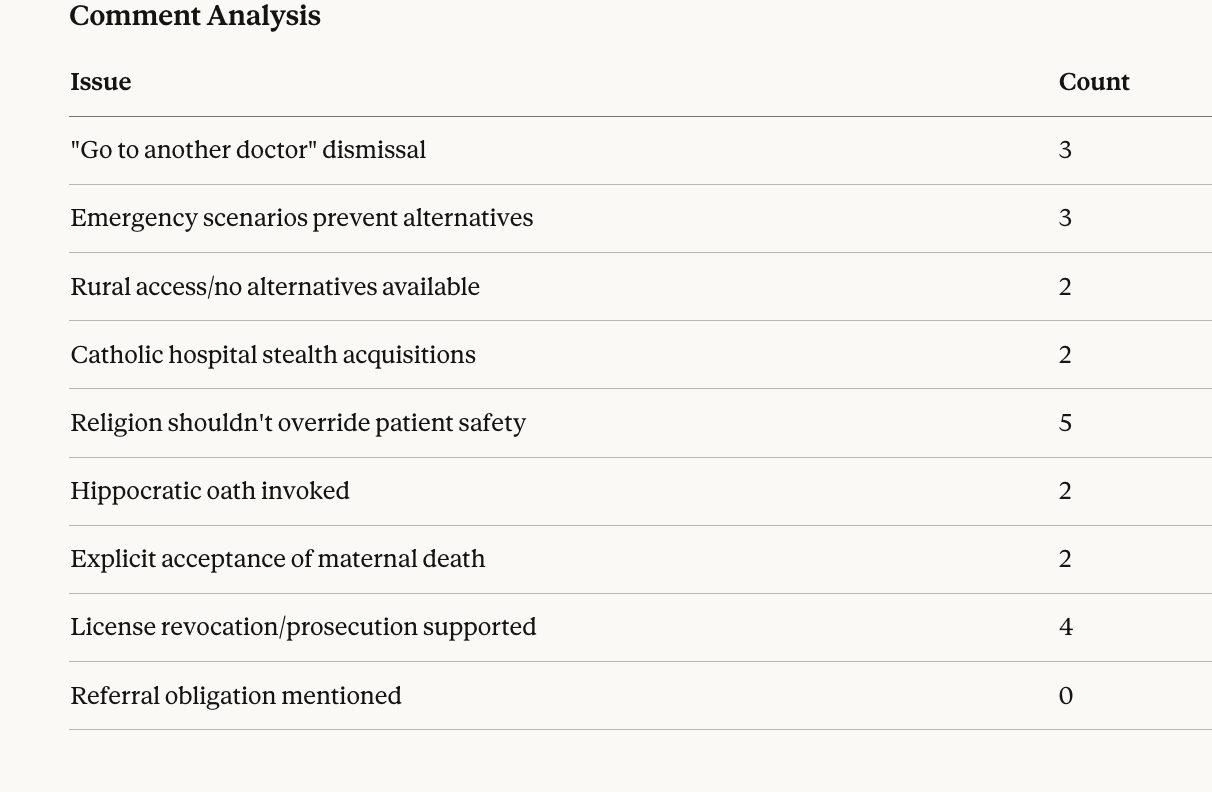
Comment Analysis
IssueCount”Go to another doctor” dismissal3Emergency scenarios prevent alternatives3Rural access/no alternatives available2Catholic hospital stealth acquisitions2Religion shouldn’t override patient safety5Hippocratic oath invoked2Explicit acceptance of maternal death2License revocation/prosecution supported4Referral obligation mentioned0
Comment
This thread exposes a critical gap in how conscience clauses function in practice versus theory. The standard justification for religious exemptions assumes a functioning referral system: the objecting physician declines but ensures the patient reaches willing care. Yet no commenter on either side mentioned this obligation.
The “go to another doctor” response reveals a fundamental misunderstanding of emergency medicine. Obstetric emergencies like placental abruption, uterine rupture, or septic abortion progress in minutes to hours. Transfer time can exceed survival time. In rural America, the nearest hospital may be the only hospital. When Catholic health systems acquire community hospitals without changing names, patients arrive expecting standard care and discover restrictions only during crisis.
The ethical framework here isn’t complex: conscientious objection in medicine has always required two conditions. First, the objection must not abandon the patient. Second, the physician must facilitate transfer to willing providers. A conscience clause that permits a physician to refuse treatment and also permits refusing referral isn’t protecting conscience. It’s permitting homicide by omission.
What’s striking is the comment accepting maternal death as categorically different “because she’s pregnant.” This reveals the unstated logic: pregnancy transforms a woman from a patient deserving standard-of-care protection into a vessel whose death is acceptable to preserve fetal life, even when both will die. That’s not a medical position. It’s a theological one masquerading as ethics.