
The Evidence Room: Food and Male Fertility: A Troubling New Link
A new study reminds us that men’s health—and particularly what men eat—may play a bigger role than we thought.

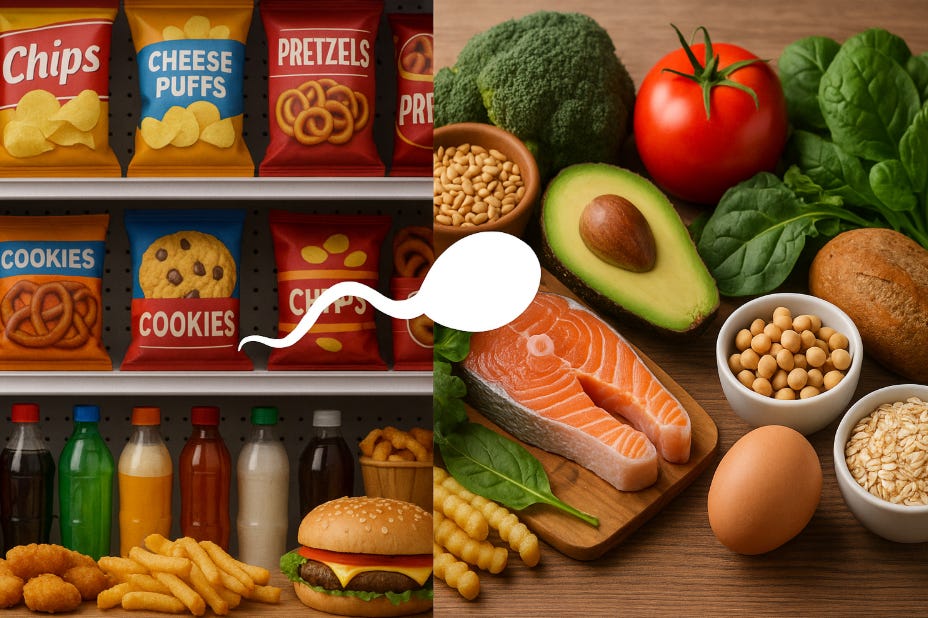
About half of all fertility problems come from the male side. Yet when couples face difficulties getting pregnant, the focus often falls more heavily on the woman. A new study reminds us that men’s health—and particularly what men eat—may play a bigger role than we thought.
The Research in Plain Language
A randomized, controlled nutrition trial titled “Effect of ultra-processed food consumption on male reproductive and metabolic health” was published in Cell Metabolism in October 2025. The study found that men who ate a diet high in ultra-processed foods (UPFs)—think packaged snacks, fast food, and sugary drinks—developed worse markers of both heart and reproductive health compared to men eating unprocessed foods.
The harm appeared even when total calories were the same. Men on processed diets gained fat, had worse cholesterol, lower levels of key reproductive hormones, and reduced sperm motility. Researchers also detected industrial chemicals such as phthalates in their blood, likely from food packaging and processing.
In short: it’s not just how much we eat, but how processed the food is.
What Counts as Processed Food?
Not all processing is bad. Washing, cooking, freezing, or fermenting foods are all forms of processing that make them safer or tastier. The problem is ultra-processed food—industrial creations made mostly from refined starches, sugars, cheap fats, artificial flavors, and preservatives. These are foods you cannot make in your kitchen because the ingredients don’t look like food at all.
Examples:
Soda, energy drinks, sweetened teas
Packaged chips, cookies, and breakfast cereals
Instant noodles and microwave meals
Fast-food burgers, chicken nuggets, and pizza
By contrast, minimally processed foods include fresh fruit and vegetables, beans, plain yogurt, nuts, fish, eggs, and whole grains. These foods require peeling, boiling, or baking—but they stay close to their natural form.
Why Do People Eat So Much of It?
Convenience, price, and marketing. Ultra-processed foods are designed to be cheap, hyper-palatable, and addictive. They are everywhere—in schools, vending machines, and supermarkets stacked at eye level. And many people grow up eating them as the default.
In countries like the U.S., U.K., and Australia, more than half of daily calories now come from ultra-processed foods. This means most people are walking around with diets built largely on ingredients our great-grandparents wouldn’t even recognize.
What’s the Problem for Fertility?
This study adds to evidence that UPFs harm male reproductive health. Sperm motility—the ability to swim effectively—is essential for conception. A decline here, combined with lower testosterone and follicle-stimulating hormone, paints a worrying picture.
Scientists also highlight that UPFs often carry endocrine-disrupting chemicals, like phthalates, from plastic packaging. These compounds can mimic hormones, disrupt sperm production, and affect metabolism.
When you add weight gain, increased fat mass, and worse cholesterol—all independent of calories—you get a double blow: poorer heart health and weaker fertility.
What Should We Eat—and Not Eat?
The advice is surprisingly simple, though not always easy to follow:
Eat more:
Fresh vegetables and fruit
Whole grains (brown rice, oats, quinoa)
Legumes (beans, lentils, chickpeas)
Lean proteins like fish, chicken, eggs
Nuts and seeds
Eat less (or avoid):
Sugary drinks, packaged snacks, and candy
Fast food burgers, nuggets, and pizza
Instant noodles and frozen ready meals
Sweetened cereals and processed deli meats
In other words, shop the perimeter of the grocery store where the fresh produce, dairy, meat, and fish are located—and spend less time in the middle aisles packed with boxes and bags.
Why This Matters
Infertility is not just a “woman’s problem.” Men’s diets matter too, and the evidence is becoming hard to ignore. If processed food harms sperm health, then cutting back may be one of the simplest, cheapest fertility interventions available.
This isn’t about perfection or guilt. It’s about awareness. Every soda swapped for water, every fast-food meal replaced with a home-cooked dish, is a small step toward better fertility, better heart health, and perhaps, a healthier next generation.
Reflection
If more than half of our calories now come from ultra-processed foods, we face an uncomfortable question: are we quietly engineering a fertility crisis with our diet? Should public health treat UPF exposure the way we treat smoking—something to be cut, not just moderated?