
Pregnancy Continuation After Severe Fetal Diagnosis in France
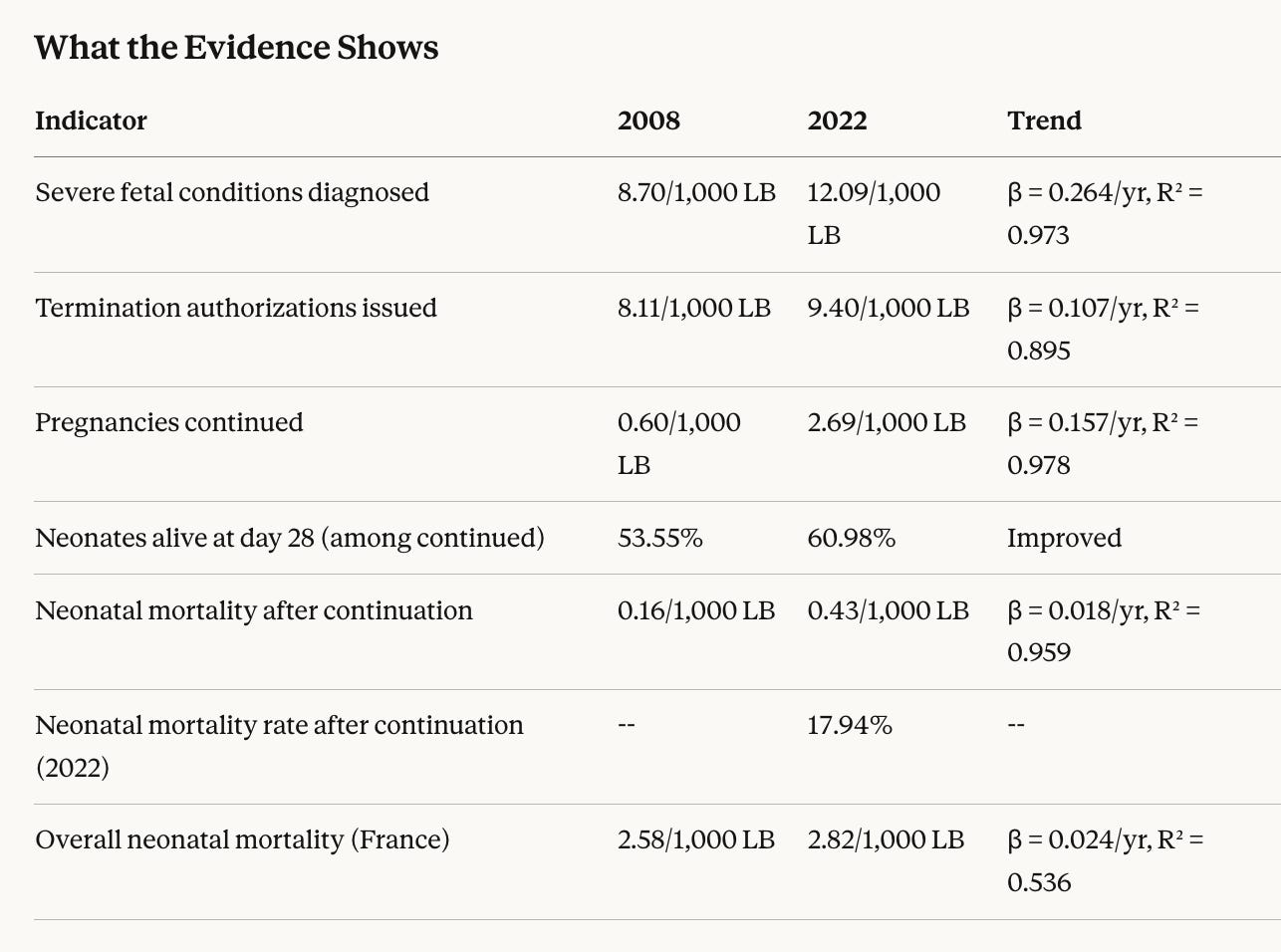
The rate of pregnancy continuation after a severe diagnosis rose from 0.60 to 2.69 per 1,000 live births. That is a 4.5-fold increase.

Source: Bourgon N, Kermorvant-Duchemin E, Lapillonne A, Ville Y. Continuation of pregnancy following prenatal diagnosis of fetal conditions: Evolution and implications. Gynecol Obstet Fertil Senol. 2026. doi:10.1016/j.gofs.2026.01.008
The Numbers You Need to Know
In France, when prenatal testing identifies a severe fetal condition, parents can choose to continue the pregnancy or request termination (no gestational age limit under French law). This time-series study used national data from 2008 to 2022 to track what parents are choosing and what happens next.
The rate of severe fetal conditions diagnosed prenatally rose from 8.70 to 12.09 per 1,000 live births over the study period. That is a 39% increase, driven largely by better screening tools, standardized ultrasound protocols, and pangenomic testing.
The rate of pregnancy continuation after a severe diagnosis rose from 0.60 to 2.69 per 1,000 live births. That is a 4.5-fold increase. In 2008, 6.85% of parents facing a severe fetal diagnosis chose to continue the pregnancy. By 2022, that number was 22.23%.
Three findings matter most.
First, the increase in continued pregnancies grew faster than the increase in diagnoses alone can explain (slope difference −0.107/1,000/yr, p < 0.001). Something beyond improved screening is driving this trend, whether medical, ethical, cultural, or personal factors. The authors note these factors remain poorly explored.
Second, when parents continue, outcomes are improving. The proportion of neonates alive at 28 days rose from about 54% to 61%. Adverse perinatal outcomes declined significantly (β = −0.004, p = 0.016). But about 14% of these conditions carry such high lethality that perinatal palliative care with treatment limitation is discussed from birth, per the Pallimage cohort data.
Third, the increase in neonatal deaths after pregnancy continuation did not specifically drive France’s rising overall neonatal mortality. The slopes were not statistically different (p = 0.089). France’s neonatal mortality problem appears rooted in prematurity outcomes, not in continued pregnancies with fetal anomalies.
The Evidence Gap
This study cannot tell us why more parents are continuing pregnancies. It uses national administrative data, so the causes of neonatal death after continuation are not documented. Long-term outcomes for the 1,050 infants alive at day 28 in 2022 are unknown. The study also cannot evaluate the economic and organizational impact of these increasingly complex neonatal stays on a system whose NICU capacity has not been updated since the late 1990s.
The declared data from France’s multidisciplinary prenatal diagnosis centers (CPDPNs) are not exhaustive, and some pregnancy outcomes were unrecorded and excluded.
Bottom Line
More parents in France are choosing to continue pregnancies after severe fetal diagnoses, and neonatal survival among those pregnancies is improving. This creates real clinical and ethical tension: more babies surviving the neonatal period with conditions that carry significant long-term morbidity, in a healthcare system that has not scaled to meet this demand.
For clinicians, the data reinforce three obligations.
First, prenatal counseling must present the actual numbers, including the roughly 18% neonatal mortality and 61% day-28 survival, not vague reassurances or catastrophic framings.
Second, the decision belongs to the parent, and that decision increasingly favors continuation.
Third, the downstream consequences for NICU capacity, palliative care infrastructure, and long-term pediatric services require planning, not just acknowledgment.
For patients: if you receive a prenatal diagnosis of a severe fetal condition, you have the right to know the actual survival and mortality figures for your baby’s specific condition. Ask for them. The aggregate numbers in this study provide a starting point, but condition-specific data should guide your decision.
Reference: Bourgon N, Kermorvant-Duchemin E, Lapillonne A, Ville Y. Poursuite de grossesse après diagnostic prénatal d’une pathologie fœtale de particulière gravité: évolution et implications. Gynecol Obstet Fertil Senol. 2026. doi:10.1016/j.gofs.2026.01.008
These are interesting statistics. I am one of those many children that parents decided to continue the pregnancy. I was diagnosed early on with fetal alcohol syndrome. My case is rather severe. But I am making the best of a bad situation. I appreciate this information. It is true that it is easier to terminate the child. But I am still grateful that I am here. Sure, I have challenges that I otherwise would not have. But I hope that even through them, I can do some good in the world for others in a similar situation. But we shall see. Thanks again for this article.