
Oliver Sacks and the Intuition of Care
How a physician and neurologist taught us to look closely, listen deeply, and treat the patient before the diagnosis.

Understanding the Issue
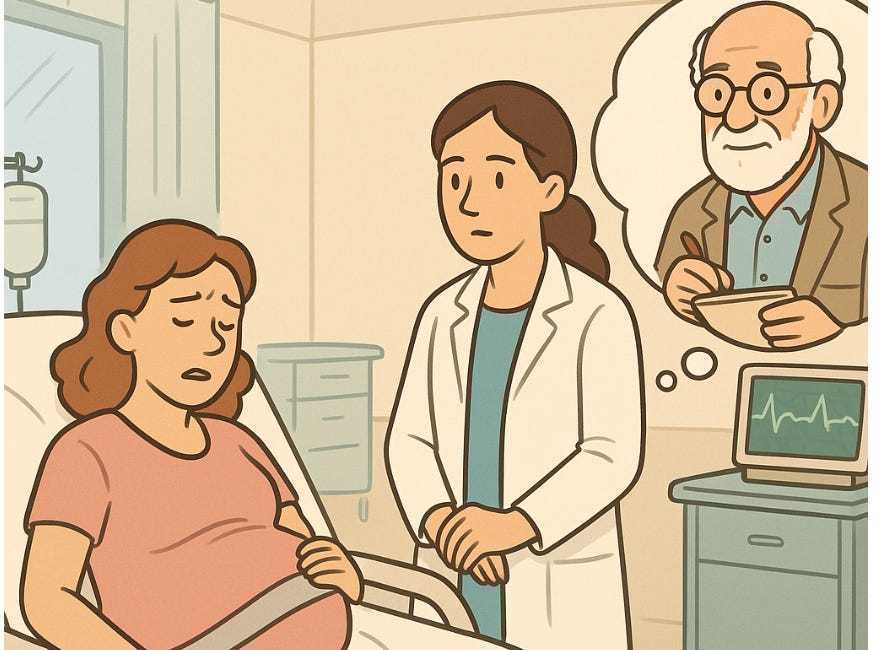
Oliver Sacks (1933–2015) was a British neurologist, writer, and clinical storyteller who spent most of his professional life in New York City at Beth Abraham Hospital and later at NYU. He is best known for describing neurological illness through the lens of human experience rather than through abstract classification. His case histories revealed how symptoms, identity, memory, fear, and adaptation blend into a single lived narrative. Obstetrics, too often dominated by metrics, guidelines, and time pressure, benefits immediately from Sacks’ method. His central message was that medicine must begin with attention to the person. In labor and delivery, where emotions run high and vulnerability is profound, this message is not optional. It is foundational.
1. The discipline of looking closely
Sacks believed that careful observation was the deepest form of clinical knowledge. He watched how patients sat, walked, held their breath, and paused before answering questions. He observed the way families hovered or withdrew. He believed that these details revealed more about the illness than many tests. In obstetrics, we sometimes narrow our attention to the EFM tracing, the centimeter updates, and the vital signs. These tools matter, but they do not tell the whole story. A woman’s facial tension, the way she grips the bed rail, the subtle shift in her breathing, or the moment she stops answering questions signal important physiologic and emotional shifts. Sacks teaches that nothing in the room is irrelevant. When clinicians widen their field of vision, they pick up instability sooner, communicate more clearly, and intervene with better timing.
2. Illness as story, not solely as biology
Sacks wrote case histories that read as narratives because he believed that disease unfolds as a lived story, not as a set of isolated findings. He captured how patients made sense of their conditions, how they coped with loss, and how they rebuilt meaning. Obstetric care is also shaped by story. A woman’s expectations, fears, cultural background, previous birth experiences, and support system all influence how she interprets the same medical information.
For example, two women with identical risks of preeclampsia may respond very differently. One may see induction as reassurance. Another may see it as a loss of control. Sacks’ approach teaches us to ask not only “What is the medical issue,” but also “What does this issue mean to her.” When we fail to ask this second question, even accurate counseling may miss its mark. The story gives the data the context it needs to be understood.
3. Human variability is not noise
Sacks devoted his life to studying conditions that challenged the idea of a single normal. He described patients with remarkable adaptations, unexpected strengths, and unusual emotional responses. He treated variability as a window into human possibility, not as a nuisance to be managed. Obstetric practice echoes this truth every day. Some women progress rapidly in labor while others plateau. Some tolerate long inductions calmly. Others reach emotional limits early. Some cope well with uncertainty. Others struggle. Modern obstetrics sometimes treats this variability as inefficiency, but Sacks would call it individuality. He would argue that clinicians should approach each woman with active curiosity, not with assumptions. Recognizing variability helps clinicians personalize care, anticipate distress earlier, and avoid rigid thinking that can lead to unnecessary interventions.
4. The moral weight of attention
For Sacks, attention was not simply a method. It was an ethical act. To pay genuine attention is to affirm the patient’s humanity. This resonates deeply in obstetrics, where women often report feeling overlooked or unheard. The structure of labor units can encourage rapid movement and quick decisions, but women remember moments of presence more than moments of speed. Sitting at the bedside, making eye contact, and asking a genuine question can change the entire emotional tone of a labor. Sacks would argue that these acts of presence shape the therapeutic relationship just as much as clinical skill. They also reduce fear, improve communication, and support safer decision-making. When a woman feels seen, she is better able to express what she needs and what is changing in her body.
5. Obstetrics as relationship, not transaction
Sacks viewed clinical care as a relationship that unfolds over time. Even brief encounters carried emotional significance.
Obstetrics compresses this relationship into hours, but the intensity magnifies the meaning. Labor requires trust, vulnerability, and rapid adaptation. The clinician becomes a guide through a physical and emotional landscape that is often unpredictable.
Sacks’ writing reminds us that the details matter. The tone used when delivering news, the care taken to explain options, the respect shown to partners and family members, and the reassurance offered at the right moment become part of the birth experience long after the baby is born. Obstetrics is richer and safer when clinicians adopt Sacks’ view that the patient is not a vessel of symptoms but a full person whose experience deserves as much attention as her physiology.
Reflection
Oliver Sacks showed that medicine becomes more accurate, more humane, and more effective when clinicians pay sustained attention to the patient’s lived world. Obstetrics, with its blend of urgency and intimacy, offers the perfect setting for his insights. When we slow down enough to observe, listen, and recognize the individuality of each woman in labor, our decisions sharpen and our relationships deepen. Sacks teaches that careful attention is not a luxury. It is a clinical and moral responsibility. The question for modern obstetrics is simple. How would our labor units change if we practiced with Sacks’ level of curiosity and presence.