
Obstetric-Related Emergency Medical Treatment and Labor Act (EMTALA) Violations and No Health Exception Bans
A study by Woskie et al, published in JAMA Health Forum shows how EMTALA laws are broken more often in states with Abortion bans.

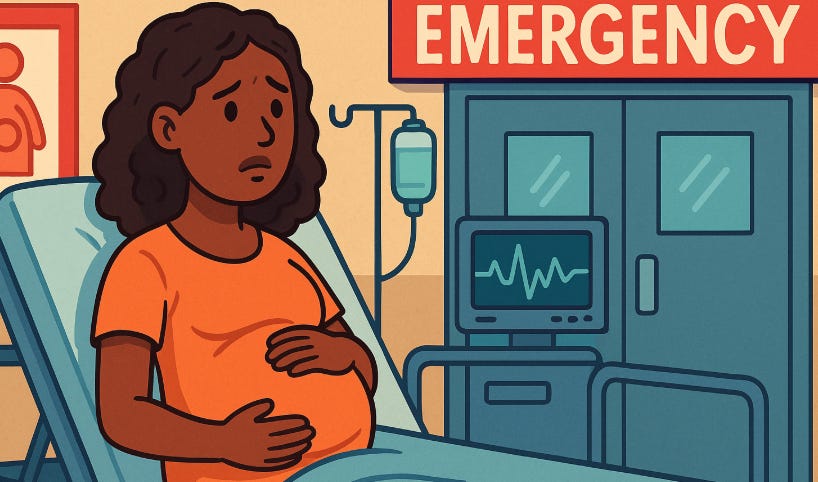
This study in JAMA evaluates whether state abortion bans that lack a meaningful health exception are associated with changes in obstetric-related violations of the Emergency Medical Treatment and Labor Act. The article is freely accessible at https://doi.org/10.1001/jamahealthforum.2025.4726. Rather than examining individual clinical outcomes, the authors focus on institutional compliance with a federal emergency care mandate and ask a narrow but consequential question. Does the legal environment created by restrictive abortion statutes coincide with measurable changes in how emergency obstetric care is delivered and regulated.
I was working in the early 1980s at a city hospital in Brooklyn. On a routine basis, we admitted pregnant women in labor and women with serious pregnancy complications to our labor and delivery unit. Many arrived late, unstable, or already in advanced labor. What was striking was that a significant number had first presented to nearby private hospitals and were sent away because they were insured by Medicaid or had no insurance at all.
Some of these women clearly should have been admitted emergently at the private hospital where they first sought care about a mile away. Instead, they were sent by car or transferred out, often without adequate evaluation or stabilization. By the time they reached us, their conditions had worsened. We saw preventable complications that were the direct result of delay, not disease severity. At the time, we struggled to understand how hospitals could justify this behavior. Ethically and medically, it felt indefensible. Yet it was common. The private hospitals simply did not want to care for uninsured patients, and there was little to stop them.
That practice, known at the time as “patient dumping,” was one of the primary reasons Congress enacted the Emergency Medical Treatment and Labor Act in 1986. EMTALA was designed to make illegal what had become routine behavior in American hospitals. The reality of that era was described bluntly in The House of God, Samuel Shem’s 1978 novel based on his medical training, which captured practices that many physicians recognized immediately. It was published the year I started my ObGyn training.
Hospitals would sometimes pay for a taxi ride or bus fare to send an unwanted patient elsewhere, a practice framed as efficiency rather than abandonment. The derisive term “GOMER,” short for “Get Out of My Emergency Room,” reflected an institutional culture in which patients without insurance, power, or social capital were viewed as burdens to be displaced rather than people to be treated. EMTALA established a federal obligation requiring hospitals with emergency departments to provide an appropriate medical screening examination and stabilizing care to any patient who presents with an emergency medical condition, including women in labor, regardless of insurance status or ability to pay. What we witnessed in Brooklyn in the early 1980s was not an aberration. It was the norm. EMTALA exists because that norm had to be stopped.
What is EMTALA
EMTALA, the Emergency Medical Treatment and Labor Act, was enacted by the U.S. Congress in 1986 as part of the Consolidated Omnibus Budget Reconciliation Act in response to widespread reports of patient dumping, the refusal or transfer of uninsured or underinsured patients from emergency departments without evaluation or stabilization. EMTALA applies to all hospitals that participate in Medicare and operate an emergency department, which effectively includes nearly all U.S. hospitals. The law imposes three core obligations.
First, hospitals must provide an appropriate medical screening examination to any individual who presents to the emergency department and requests evaluation, regardless of insurance status or ability to pay, to determine whether an emergency medical condition exists.
Second, if an emergency medical condition is identified, including active labor or other pregnancy-related emergencies, the hospital must provide stabilizing treatment within its capabilities.
Third, if the hospital cannot stabilize the patient, it may transfer the patient only after stabilization to the extent possible and only under strict conditions. Importantly, EMTALA is a process statute, not a treatment mandate.
It does not require a specific intervention. It requires evaluation, stabilization, and lawful transfer. Violations are enforced through investigations, civil monetary penalties, and potential termination of Medicare participation, making EMTALA a foundational legal framework governing emergency obstetric care in the United States.
The study is an original investigation using a staggered difference-in-differences design applied to a complete national dataset of EMTALA investigations from 2018 through the first quarter of 2023.
These data were obtained from the Centers for Medicare and Medicaid Services through a Freedom of Information Act request. States were classified as exposed only if they enacted total or near-total abortion bans applying across gestation, lacked a clinically meaningful health exception beyond imminent threat to life, and generated a documented conflict with EMTALA enforcement. Six states met these criteria, with Texas entering earliest through Senate Bill 8. The primary outcome was the quarterly count of obstetric-related EMTALA violations at the state level. Secondary analyses examined emergency department utilization and specific categories of violations. After adjustment for state and calendar-quarter fixed effects and emergency department visit volume, treated states experienced an increase of 1.18 obstetric EMTALA violations per state-quarter compared with controls, with a 95 percent confidence interval of 0.49 to 1.86 and a P value of .001. The association was largely driven by Texas, which showed an average treatment effect of 0.69 additional violations per quarter. The increase was concentrated in failures to provide a medical screening examination rather than failures of stabilization or transfer.
What this evidence represents requires careful interpretation. An EMTALA violation is not a measure of maternal morbidity or mortality, nor is it a proxy for poor clinical care in every instance. It is, however, a signal that a hospital failed to meet a legally defined minimum obligation to evaluate or stabilize a patient presenting with an emergency medical condition. Screening failures occur at the earliest point of contact. They reflect hesitation or refusal to even determine whether an emergency exists. In obstetrics, that moment matters because delay in evaluation can precede every downstream failure.
The specificity of the findings strengthens their credibility. The authors did not observe parallel increases in medical, surgical, or psychiatric EMTALA violations during the same period. This argues against a generalized increase in enforcement activity or reporting and suggests a disruption that is specific to obstetric emergencies. Subtype analysis reinforces this interpretation. The rise in violations was driven by failures to provide a medical screening examination, not by failures in stabilization or transfer. In other words, the breakdown appears to occur before treatment decisions are made.
Texas warrants particular attention. It accounted for most of the excess violations and had the longest exposure period. Texas is also a non–Medicaid expansion state, and the authors report concurrent increases in emergency department utilization among uninsured and self-pay patients. While the study cannot determine causal pathways, it is plausible that reduced access to outpatient reproductive care shifts more pregnant women into emergency departments, increasing both clinical and administrative strain. Importantly, adjusting for emergency department volume did not eliminate the observed association between abortion bans and obstetric EMTALA violations.
The authors appropriately emphasize the limits of their analysis. EMTALA violations are rare events and complaint-driven, making estimates sensitive to small absolute changes and to reporting behavior. The postpolicy observation window is short. The data cannot distinguish abortion-related encounters from other pregnancy-related emergencies, nor can they link violations to individual patient outcomes. These constraints matter, and the study does not claim more than its data allow.
From a professional standpoint, the findings raise uncomfortable but necessary questions. EMTALA was designed as a backstop, a guarantee that emergency evaluation would not be withheld because of diagnosis, payment status, or institutional preference. When violations increase at the level of screening, that guarantee is weakened in practice.
For clinicians, this creates risk. EMTALA obligations attach to hospitals, but they are executed by physicians and nurses working under institutional policies shaped by state law. Legal ambiguity can translate into clinical hesitation, even when federal law clearly requires evaluation.
This study does not argue that abortion bans inevitably lead to EMTALA violations, nor does it demonstrate downstream harm. What it demonstrates is more modest and more concrete. In states that enacted abortion bans without meaningful health exceptions, there was a measurable increase in obstetric EMTALA violations, particularly failures to screen pregnant women presenting with emergencies. That signal, limited but specific, suggests that legal and regulatory environments can influence the most basic functions of emergency obstetric care. For a statute intended to ensure that no emergency goes unassessed, that finding deserves serious attention.