

Every Monday. Starting now.
I have been an obstetrician for fifty years. I have delivered more than ten thousand babies. I have sat across from thousands of patients, answered thousands of questions, and tried, in each encounter, to give the most honest and evidence-based answer I could.
I retired from clinical practice. I thought I was done sitting in waiting rooms.
Then I found Reddit.
Reddit is not a medical resource. Nobody would call it that. It has no peer review, no editorial board, no conflict-of-interest disclosures. What it has is something rarer: the unfiltered, unmedicated, unedited voice of patients at two in the morning, when the fear is loudest and the office is closed.
I started reading r/BabyBumps, r/TryingForABaby, r/Miscarriage, r/Menopause, and dozens of others. I was not looking for anything in particular. What I found stopped me.
Patients are making major reproductive decisions based on what strangers told them online. They are refusing medications their doctors recommended because someone on Reddit had a bad experience. They are pursuing treatments their doctors never mentioned because someone on Reddit swore by them. They are terrified of conditions that are largely benign, and oddly calm about conditions that are not. The gap between what the evidence says and what the community believes is, in many cases, enormous.
That gap is a clinical problem. It is also an opportunity.
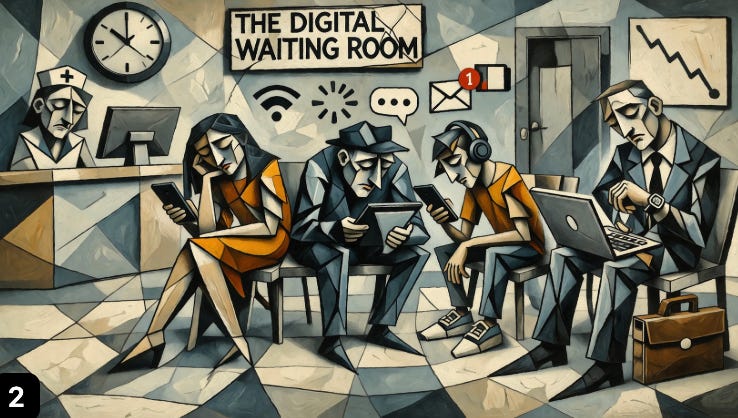
This is why I am launching ObGyn Intelligence on Social Media: The Digital Waiting Room.
Every Monday morning, I will choose one post from a women’s health Reddit community that I believe contains a clinically meaningful story. Not the most dramatic post. Not the most viral. The most instructive -- the one that reveals something important about what patients actually think, fear, believe, and do between appointments.
I will analyze it the way I would analyze a case presentation. I will identify where the community got it right, where it got it wrong, and where the evidence has something to say that neither the patient nor the commenters knew to ask. I will use the post as a door into the clinical and scientific literature -- explaining the condition, the data, the guidelines, and, when warranted, my disagreement with the guidelines.
Each piece will be written for two audiences at once. Patients should be able to read it and understand exactly what is happening in their bodies and what the evidence says about their options. Clinicians should be able to read it and learn something they may not have encountered in residency, or may have forgotten in the decades since.
Writing for both audiences simultaneously is harder than writing for either one alone. I have been doing it for most of my career. I find it more honest.
Why Reddit and not the clinical literature?
The clinical literature tells us what we know.
Reddit tells us what patients believe.
These two things are not the same, and the distance between them is where most of medicine’s communication failures live.
A patient who leaves her appointment with a correct diagnosis and an incorrect mental model of what that diagnosis means will make decisions based on the mental model, not the diagnosis. She will find others online who share her mental model and call it community. She will be reassured by people who cannot reassure her and alarmed by people whose experience does not apply to her case.
I have watched this happen for fifty years. The internet did not create the problem -- the exam room did, every time a clinician gave a correct answer to a question the patient was too frightened to ask.
Reddit is where patients go because the exam room left space.
What this series is not.
It is not a diagnosis. Nothing I write here should be used to make a medical decision without a physician. I will say this every week, and I will mean it every week.
It is not a replacement for care. It is an argument for better care -- better communication, better counseling, better preparation for the conversations that patients are already having, just not with their doctors.
It is not balanced for balance’s sake. If the evidence clearly favors one course of action, I will say so. If a widely held community belief is wrong, I will say so. I have never found false equivalence to be a service to patients, and I am not going to start now.
One more thing.
The subjects in this series -- pregnancy loss, uterine anomalies, genetic risk, reproductive failure, the fear that arrives before the first ultrasound -- are not light subjects.
I will not pretend they are.
But I will try, every Monday, to bring the same combination of honesty and warmth that I brought to fifty years of examining rooms. The fear does not go away when it is named. But it becomes, I have found, a little more bearable.
I hope you will join me.
The Digital Waiting Room publishes every Monday morning.
It is available to paid subscribers.