
Mary Shelley and the Ethics of Creating Life
How the author of Frankenstein helps us confront responsibility, vulnerability, and the moral weight of bringing new life into the world.

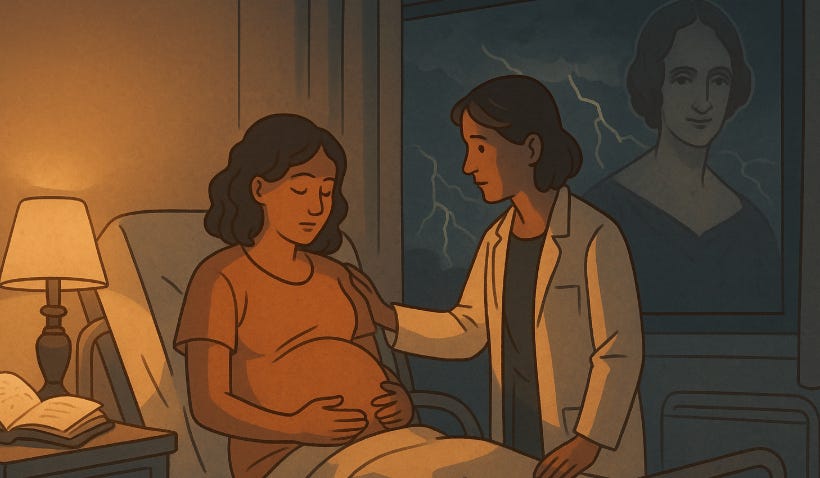
Understanding the Issue
Mary Shelley (1797–1851), the English novelist best known for Frankenstein, grew up surrounded by political philosophers, early feminists, and scientists pushing the boundaries of what could be known about life. She wrote her most famous work at age nineteen, imagining a world where scientific ambition collided with ethical failure. Shelley did not write clinical treatises, yet her insights into creation, responsibility, and abandonment give obstetrics a powerful lens for thinking about pregnancy and childbirth. Her story is also shaped by her own obstetric experiences. She became pregnant multiple times, survived miscarriages, buried children, and lived through a period when maternal mortality was common. Shelley understood the fragility of life not in theory but in her body. Her writing helps us think more clearly about what it means to care for women who stand at the threshold between fear and hope.
1. Creation carries responsibility that cannot be delegated
In Frankenstein, the catastrophe begins when Victor creates life but refuses to care for what he has made. Shelley’s warning is clear. Creation without responsibility becomes harm. In obstetrics, pregnancy is its own kind of creation, but the responsibility is shared. Women carry the physical burden, and clinicians carry the obligation to guide them. When health systems become rushed, fragmented, or impersonal, women may feel abandoned at the very moment they need structure and reassurance. Shelley prompts us to see obstetrics not as a series of tasks but as a moral commitment. Every induction plan, every fetal monitoring decision, every emergency intervention expresses a form of care that must not be withdrawn when circumstances become complicated.
2. Fear thrives when explanations are absent
Shelley understood fear as the natural outcome of unanswered questions. Her creature becomes terrifying to those who never ask how he came to be. Pregnant women often confront their own unanswered questions. What does this tracing mean. Why is labor slowing. What does the word “risk” actually imply. When clinicians rely on jargon or silence, fear multiplies. Shelley teaches that lack of explanation invites misunderstanding, and misunderstanding invites fear. Obstetric care becomes safer when clinicians give clear, honest explanations, even when outcomes are uncertain. Women are capable of navigating risk, but they cannot navigate silence.
3. Bodies in transition need protection, not judgment
Shelley’s writing is filled with characters whose bodies undergo change that others do not understand. Transformation becomes a source of vulnerability. Pregnancy is also a profound transformation. The physical changes are visible, but the emotional and psychological transitions are often hidden. Women in labor may feel powerful and frightened at the same time. They may feel judged for their pain tolerance, their birth preferences, or their requests for intervention. Shelley would remind clinicians that transformation demands compassion. A laboring woman does not need commentary about her choices. She needs support that recognizes her changing body as part of a human story rather than as a clinical puzzle.
4. Systems can create distance where closeness is required
One of Shelley’s central themes is estrangement, especially when institutions prioritize order over empathy. Modern obstetrics can unintentionally recreate that distance. Triage units may feel like bureaucratic checkpoints. Labor rooms can fill with rotating staff. The woman may recount the same history to multiple clinicians, losing the sense that anyone truly sees her. Shelley’s work asks a simple question. What happens when a system forgets the person at its center. Obstetric care becomes more humane when teams close these gaps through continuity, attentive listening, and consistent communication. These acts counter the structural distance that hospitals often impose.
5. Birth stories can haunt or heal
Shelley understood the power of narrative. Her characters are shaped by the stories they inherit and the ones they create. Birth, too, becomes a narrative that women carry for decades. A compassionate clinician can transform a frightening moment into a memory of strength. A dismissive comment can turn an ordinary challenge into a lasting wound. Many women recall their birth experience more vividly than the medical details. Shelley encourages us to see birth not only as a physiological event but as a story in formation. The question for clinicians is whether they are helping the woman build a story she can live with, one where she is respected, informed, and supported.
6. Autonomy must be honored even when the path is not straightforward
Shelley resisted simplistic portrayals of agency. Her characters make choices shaped by fear, fatigue, and limited options. Pregnant women do the same. They weigh information, personal history, cultural norms, and emotional readiness. When they request or decline interventions, they are not making abstract ethical statements. They are navigating uncertainty with the tools they have. Shelley’s perspective reinforces that autonomy requires support, not pressure. Clinicians should offer balanced information, acknowledge the woman’s reasoning, and recognize that good decisions sometimes emerge slowly. Respecting autonomy in labor means respecting the person’s process, not just her final choice.
7. The moral work of obstetrics is to stay present
Shelley’s greatest caution is against abandonment. Every tragedy in Frankenstein grows from the moment Victor walks away. In obstetrics, abandonment rarely happens physically. It happens emotionally, when clinicians rush through explanations, overlook distress, or fail to acknowledge fear. Staying present is not simply being in the room. It is demonstrating commitment through clarity, kindness, and responsibility. Obstetric care becomes ethically grounded when clinicians refuse to disappear in moments of uncertainty. Shelley’s enduring lesson is that creation demands presence. For obstetrics, this means that supporting a woman through pregnancy and childbirth is not only a clinical role. It is a moral one.
Reflection
Mary Shelley helps us understand that childbirth is not merely the arrival of a baby. It is an encounter with uncertainty, identity, vulnerability, and meaning. Her work challenges clinicians to act with responsibility, to honor the woman’s story, and to reject the distance that institutions sometimes create. The question her writing leaves us is simple. When a woman gives birth in our care, do we stand with her or do we step away. The answer defines not only her experience but the ethical character of our profession.