
Labor Pain Relief Is Not a Binary Choice
What AJOG’s Expert Review by Bateman and Carvalho actually says about epidurals, alternatives, and honesty

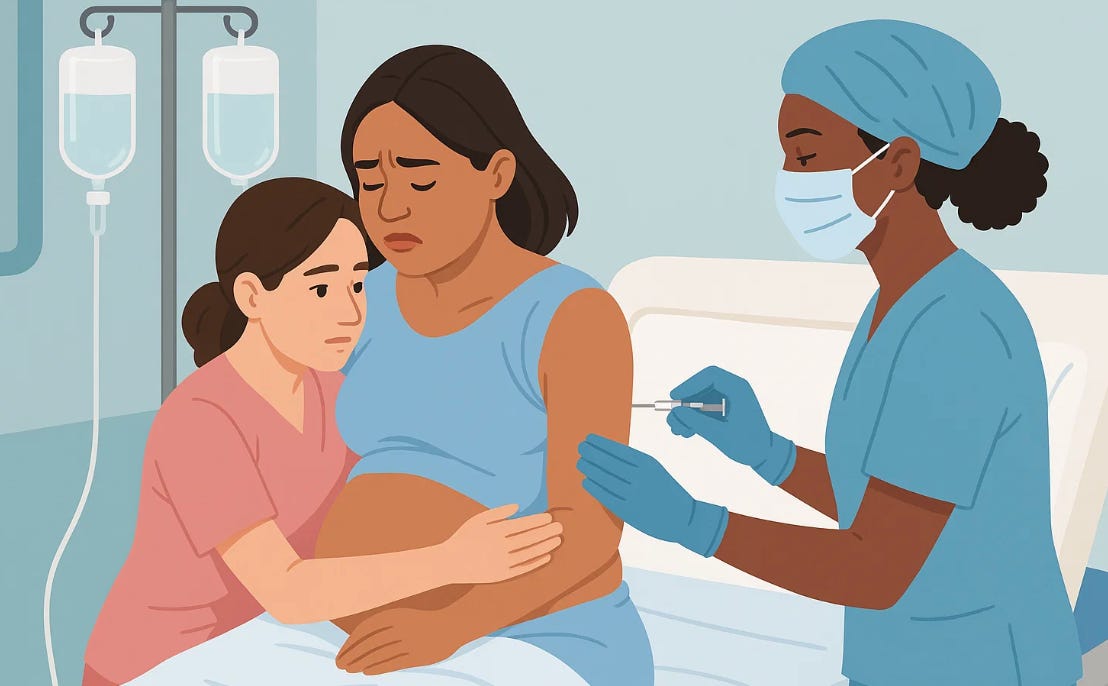
Pain during labor is real, variable, and ethically relevant.
Yet modern obstetrics often presents pain management as a polarized choice. Either epidural anesthesia or “natural” birth.
In 2023, the American Journal of Obstetrics and Gynecology published an Expert Review titled “Pharmacologic and Nonpharmacologic Options for Pain Relief During Labor” by Brian T. Bateman, MD, MSc, and Breno C. Carvalho, MD. The review provides a comprehensive, evidence-based framework that dismantles simplistic narratives and exposes how counseling around labor pain has drifted away from scientific honesty.
When AJOG publishes an Expert Review on labor analgesia, it is not a lifestyle article. Bateman and Carvalho do not argue for or against epidurals. They do something more important. They clarify what each option does, what it does not do, and where the evidence has been oversold or misunderstood.
What the authors examined
The review systematically evaluates pharmacologic options including neuraxial analgesia, systemic opioids, nitrous oxide, and local anesthetic techniques, alongside nonpharmacologic approaches such as continuous labor support, water immersion, movement, positioning, breathing techniques, and complementary methods.
Bateman and Carvalho are explicit about scope. Pain relief is the primary outcome. Secondary outcomes include labor duration, operative delivery, maternal satisfaction, and neonatal effects. The review emphasizes that no single modality optimizes all outcomes simultaneously.
Epidural analgesia. Effective, not neutral
The authors reaffirm what decades of data show. Neuraxial analgesia is the most effective method for pain relief in labor. Full stop. No nonpharmacologic approach comes close in magnitude or reliability.
At the same time, the review does not sanitize tradeoffs. Epidurals are associated with longer second-stage labor, increased need for oxytocin augmentation, and higher rates of operative vaginal delivery. Importantly, modern low-dose techniques mitigate but do not eliminate these effects.
The review also clarifies what epidurals do not do. Contemporary evidence does not support a causal increase in cesarean delivery when epidurals are placed early. That myth persists more by repetition than by data.
Systemic opioids and nitrous oxide. Modest benefit, real limits
Bateman and Carvalho are notably frank about systemic opioids. These agents provide modest analgesia at best and are frequently accompanied by maternal sedation, nausea, and neonatal respiratory depression. Satisfaction is variable, and pain relief is often incomplete.
Nitrous oxide occupies a unique space. The review characterizes it as anxiolytic rather than analgesic. Many women report feeling more in control, even when pain intensity remains high. This distinction matters. Nitrous oxide may improve coping without meaningfully reducing pain scores.
The authors caution against marketing nitrous oxide as an epidural alternative. The evidence does not support that equivalence.
Nonpharmacologic methods. Helpful, but not analgesics
The review carefully evaluates nonpharmacologic interventions, including doula support, water immersion, movement, massage, acupuncture, and breathing techniques. These approaches can improve maternal satisfaction and sense of agency. Some may modestly reduce reported pain. None provide reliable analgesia comparable to pharmacologic methods.
Bateman and Carvalho emphasize a critical ethical point. Nonpharmacologic methods should be offered as supportive tools, not as substitutes framed through ideology or moral pressure. Overstating their analgesic efficacy misleads patients.
Where counseling goes wrong
The review implicitly critiques how labor pain options are often presented. Epidurals are sometimes framed as a failure of coping. Nonpharmacologic approaches are sometimes framed as safer or more “natural,” despite limited analgesic effect.
This framing is not evidence-based. It reflects cultural narratives rather than data. Bateman and Carvalho’s synthesis shows that honest counseling requires acknowledging both effectiveness and tradeoffs, without valorizing or stigmatizing any choice.
The ethical dimension
Pain relief is not a luxury. It is a legitimate clinical outcome. Minimizing pain without regard to patient values is paternalistic. Minimizing risks without regard to pain is equally problematic.
Ethically sound counseling requires presenting analgesic options accurately, including their limitations. Patients cannot exercise autonomy when efficacy is exaggerated or downsides are concealed.
Practical lessons from the AJOG review
First, epidural analgesia remains the gold standard for pain relief and should be described as such. Second, alternatives should be framed honestly, supportive but limited. Third, language matters. Avoid false binaries between “medical” and “natural.” Fourth, respect that some patients prioritize pain relief, while others prioritize mobility or a particular birth experience.
Reflection
Bateman and Carvalho’s AJOG Expert Review does not tell clinicians what patients should choose. It tells clinicians what they must stop doing. Stop romanticizing pain. Stop underselling epidurals. Stop overselling alternatives. Evidence-based obstetrics is not about steering patients toward a preferred narrative. It is about telling the truth clearly and letting informed values guide the decision.