
IVF Without Safety: The Ethical Catastrophe of Political Pronatalism
Promoting IVF while maternal mortality rises is not pro-family—it’s policy malpractice. Family building begins with keeping mothers alive.

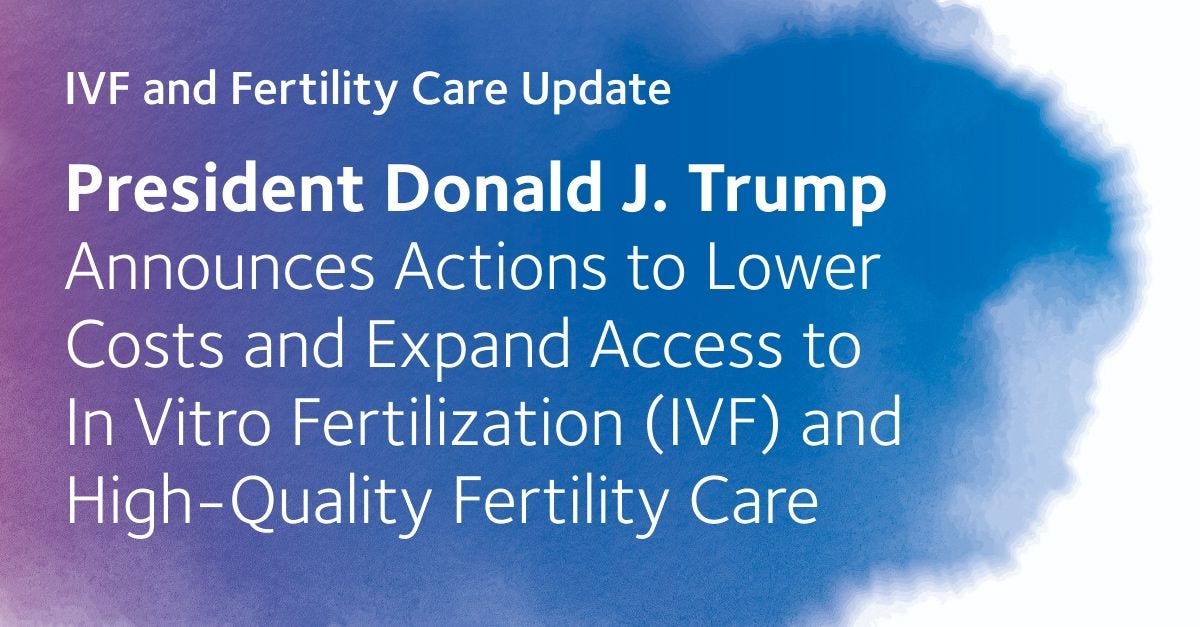
As an obstetrician and MFM specialist, I must categorically reject the idea that expanding in vitro fertilization (IVF) access, without fixing our broken maternal care system, represents progress.
The United States has the highest maternal mortality rate among developed nations—and it is still rising. Promoting more pregnancies without first securing safe systems for childbirth is not compassion. It is negligence at scale.
Every year, hundreds of women in the United States die from pregnancy-related causes that should never occur in a wealthy nation. Hemorrhage, preeclampsia, infection, and cardiovascular complications remain leading culprits, but behind these medical terms lies a deeper failure: a disintegrating safety infrastructure. Labor units are closing across rural America. Postpartum care remains an afterthought. Racial disparities are widening. Yet the latest political headlines celebrate efforts to “expand access to IVF” as if that alone constitutes progress in women’s health.
IVF is an extraordinary scientific achievement. It has helped millions of families conceive. But it is also a medical intervention that carries higher risks than spontaneous conception.
Women who conceive through IVF are significantly more likely to develop preeclampsia, placenta previa, postpartum hemorrhage, and to deliver preterm or by cesarean section. These risks increase further with advanced maternal age and multiple gestations—both more common in IVF patients. To expand IVF access without simultaneously strengthening obstetric safety systems is to invite predictable tragedy.
In ethics, context is everything. When a system is already failing to protect mothers, encouraging more high-risk pregnancies becomes morally indefensible. The policy calculus here is not neutral: it shifts risk downward onto women while shifting political credit upward to those who claim to be “pro-family.” This is not family building. It is political theater staged on the bodies of pregnant women.
The contradiction deepens when viewed against the backdrop of the Dobbs decision and its aftermath.
The same political movement now claiming to “support IVF and fertility care” has spent the past two years dismantling reproductive rights. State abortion bans have criminalized physicians, delayed lifesaving care, and endangered women with ectopic pregnancies, sepsis, and miscarriages. The Alabama Supreme Court’s 2024 ruling—declaring frozen embryos to be legally equivalent to children—shows how this ideology collapses under its own weight. IVF inherently involves the creation, freezing, and often the discarding of embryos. Declaring embryos “persons” makes IVF legally precarious, if not impossible.
This is not an abstract ethical puzzle. It is a direct consequence of selective moral reasoning. A government cannot credibly promote IVF while simultaneously endorsing embryo personhood laws that criminalize the very process. The ethical contradiction is staggering.
The rhetoric of “lowering costs” adds insult to injury. Without insurance mandates, federal subsidies, or Medicaid coverage, IVF remains financially out of reach for most families. One cycle averages over $15,000 and may need to be repeated several times. Claiming affordability while refusing to fund it is like promising universal education while shuttering public schools. It sounds compassionate but functions as exclusion. Fertility care remains the privilege of the insured and affluent, while millions of women lack access to even basic prenatal care.
If policymakers truly cared about family building, they would start where families actually struggle: with maternal safety, economic stability, and postpartum support. They would ensure every hospital that delivers babies has 24/7 obstetric coverage, blood banking, and rapid response teams. They would fund community-based doulas and midwives, especially in underserved areas. They would guarantee paid parental leave, mental health services, and access to contraception and abortion. Those are the foundations of reproductive freedom and family health.
Instead, we are witnessing the rise of selective pronatalism—a moralized push for more births, detached from any commitment to maternal survival or autonomy. It is the same logic that drives abortion bans and opposes contraception access: an obsession with pregnancy as a moral outcome rather than a medical event. But ethics demands coherence. You cannot claim to value life while ignoring the lives of the women who create it.
In medicine, “first, do no harm” applies not only to individuals but to systems. Expanding high-risk pregnancies without expanding safety is harm. Encouraging IVF in states where pregnant women cannot obtain emergency abortions is harm. Using women’s fertility as a political prop while refusing to invest in maternal health is harm.
The ethical obligation of physicians is to resist policies that endanger patients, even when cloaked in the language of “family values.” Our duty is to truth, safety, and compassion—not to ideology.
Reflection / Closing:
Ethics without empathy is manipulation. Policy without safety is malpractice. If America truly wishes to support families, it must first protect mothers. More pregnancies without more safety means more deaths, not more life. Until maternal survival is treated as a non-negotiable national priority, every political celebration of “fertility expansion” remains an empty gesture—dangerous, dishonest, and profoundly unethical.