
It’s Not AI. It’s the Prompt. How Women (and everyone else) Can Use AI to Read Food Safely.
How asking the right questions with AI cuts through food marketing and wellness myths

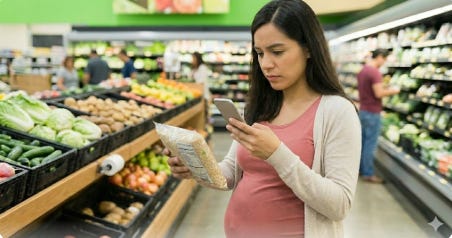
Food labels are not written for average people. They are written for regulators, lawyers, and marketing teams. That gap matters, because women’s health and especially pregnancy are periods when vague advice like “eat clean,” “avoid processed foods,” or “choose organic” can create false confidence or unnecessary fear.
An organic label does not tell you whether a food is ultra-processed, raises blood sugar, or carries infection risk. Yet many women are expected to make daily decisions based on exactly that misunderstanding.
What women actually need is interpretation, not slogans.
Food safety in pregnancy, for example, is not about perfection or purity. It is about prioritizing real risks. Organic raw produce can carry higher Listeria risk than conventional cooked food. Unpasteurized organic milk is still unpasteurized. Some additives that look alarming on a label are clinically irrelevant, while other risks are missed entirely because they do not fit a wellness narrative. Without a framework, the loudest voices win, not the best evidence.
This is where prompts matter.
A prompt is a complete instruction to tell an LLM like ChatGPT or Claude or Gemini what it should do. In very specific ways.
A well-designed prompt does not replace medical judgment. It forces clarity. It turns a dense ingredient list into a pregnancy-specific analysis that separates chemical exposure from microbial risk, ultra-processing from farming method, and evidence from assumption. This is how physicians already think: not “good or bad,” but compared to what, for whom, at what dose, and under what conditions. Prompts allow patients to borrow that reasoning safely and transparently.
This post is about tools, not trends. If you want evidence-based clarity instead of wellness noise, subscribe. Paid subscribers get access to physician-designed prompts you can actually use, starting with food labels, where misunderstanding is common and the stakes in pregnancy are real.
Below the pay line
What follows is a pregnancy-specific food label prompt (other coming soon), designed to translate ingredients into clinically meaningful information. You can copy it, paste it, and use it on any product by uploading a photo of the label. The power is not in the AI. It is in the question it is forced to answer.
