
Investigate Before We Indict -PART 2: From Plane Crashes to Delivery Rooms
What obstetrics forgot about investigation, blame, and safety

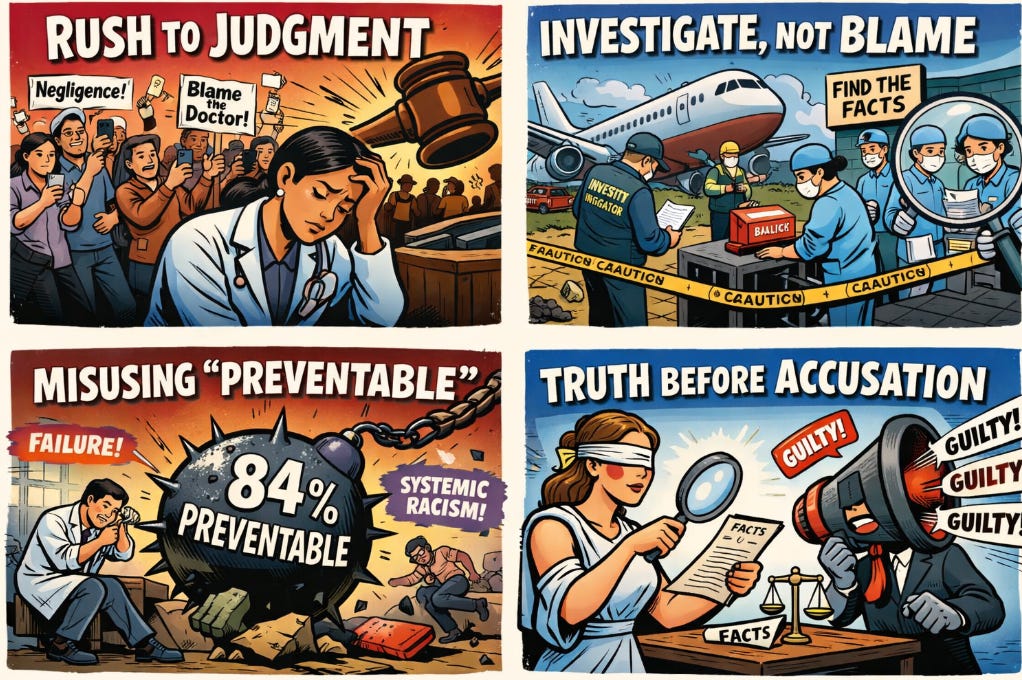
Series introduction
This essay is Part 2 of a four-part Obstetric Intelligence series titled Investigate Before We Indict. Part 1 examined how maternal deaths are increasingly judged before they are investigated. Part 2 focuses on process, comparing obstetrics with aviation safety investigations to show why separating investigation from blame is essential for patient safety and professional integrity. Part 3 will examine how maternal mortality statistics, particularly the term “preventable,” are commonly misunderstood. Part 4 will conclude with what clinicians, organizations, and advocates owe the truth when tragedy becomes public.
1. How High-Risk Industries Protect Truth
When an airplane crashes in the United States, the response is immediate but disciplined. The National Transportation Safety Board deploys a specialized “Go Team” within hours. Flight recorders are secured. Wreckage is cataloged. Maintenance logs are reviewed. Air traffic control communications are reconstructed. Witnesses are interviewed. Data collection begins immediately, but conclusions do not.
The investigation typically takes many months and often more than a year. During that time, no one is permitted to declare pilot error, mechanical failure, or system breakdown as fact. The NTSB explicitly does not investigate for the purpose of assigning legal blame. Its sole mandate is to determine probable cause so that future crashes can be prevented.
This separation of investigation from adjudication is not an accident. It reflects a deep understanding of how safety actually improves. Premature attribution biases investigators, distorts causal analysis, and locks in explanations before evidence is fully understood. In aviation, such shortcuts are recognized as dangerous.
We accept this discipline without protest because the logic is obvious. Assigning blame before understanding cause does not honor victims. It increases the likelihood of repetition. Safety depends on patience, restraint, and rigorous process.
2. Medicine’s Abandonment of Process
When a mother dies in childbirth, we do the opposite.
Within hours, sometimes minutes, public verdicts appear. Social media identifies failure. Advocacy groups assign causation. Professional organizations issue statements attributing the death to system breakdown, racism, or negligence before anyone outside the institution has reviewed a single medical record.
The same society that insists on disciplined investigation for aviation accepts speculation as explanation in medicine.
The internet accelerates this collapse of process. Initial reports, often incomplete or inaccurate, spread rapidly. Confident assertions are shared widely. Corrections, when they come, travel far less. Psychologists describe this as the illusory truth effect. Repetition increases belief regardless of accuracy.
By the time a formal maternal mortality review is completed, the public narrative has often hardened beyond correction. The conclusion, whatever it is, must compete with months of entrenched assumptions and moral certainty.
The harm is concrete. Clinicians implicated in public narratives cannot respond. Patient confidentiality, professional ethics, and pending litigation impose silence. Even when reviews later find no deviation from standard of care, reputational damage persists. Careers are altered. Moral injury follows.
This is not accountability. It is exposure without evidence.
3. Why Process Is an Ethical Obligation
Process is often dismissed as bureaucratic delay. In reality, it is an ethical safeguard.
Disciplined investigation protects families from false explanations offered in the heat of grief. It protects clinicians from unjust accusation when outcomes were unpreventable despite appropriate care. Most importantly, it protects future patients by ensuring that the correct lessons are learned.
Without process, accountability becomes performative. Statements are issued to signal alignment rather than understanding. Safety becomes rhetorical rather than operational. Truth becomes optional.
Obstetrics prides itself on being a safety-critical profession. Yet safety-critical industries do not tolerate instant verdicts. They understand that truth emerges slowly, through structured analysis, not through narrative momentum.
If obstetrics wishes to reduce maternal mortality meaningfully, it must reclaim its commitment to investigative discipline. That means resisting the demand for immediate explanation. It means allowing uncertainty to exist until evidence resolves it. It means acknowledging grief without assigning causation prematurely.
Investigation before indictment is not moral evasion. It is moral responsibility.
The aviation comparison is incredibly powerful. The observation about how instant verdicts collapse investigative discipline is spot-on. I've noticed this pattern across healthcare more broadly, where the pressure to "do something" imediately often prevents the systematic work needed to actually understand what happened. The point about illusory truth effect is critical too, once a narrative hardens publicly, even formal reviews struggle to dislodge it.